
As pickleball continues its rapid ascent as a premier recreational activity, its integration into residential environments has faced a significant engineering hurdle: acoustics. Unlike the low-frequency "thud" associated with tennis, pickleball produces a sharp, percussive "pop" that can reach decibel levels disruptive to high-density residential living. For architects, developers, and homeowners, understanding the technical nuances of noise mitigation is essential for creating a sustainable play environment that respects the acoustic comfort of the surrounding community.
To solve the noise problem, one must first understand the physics of the sound itself. The primary acoustic challenge of pickleball lies in its impulse noise profile. When a polymer paddle strikes a perforated plastic ball, it generates a sound characterized by a high-pressure peak and a very short duration.
Technical studies have identified that the "pop" of a pickleball impact typically centers around the 1250 Hz frequency range. This is a critical detail because the human ear is highly sensitive to frequencies between 1,000 Hz and 4,000 Hz: the range where human speech resides. Because the sound is repetitive and occurs in a frequency band we are biologically tuned to notice, it is perceived as more intrusive than ambient traffic or the lower-frequency sounds of other sports.
In a residential setting, a single court can produce sound levels between 68 and 73 dBA at a distance of 50 feet. Without mitigation, these levels often exceed local noise ordinances, which frequently cap residential noise at 55–60 dBA during daylight hours.
The most cost-effective noise mitigation strategy is proper site planning. Engineering a court layout involves more than just fitting the dimensions; it requires an analysis of sound directivity.
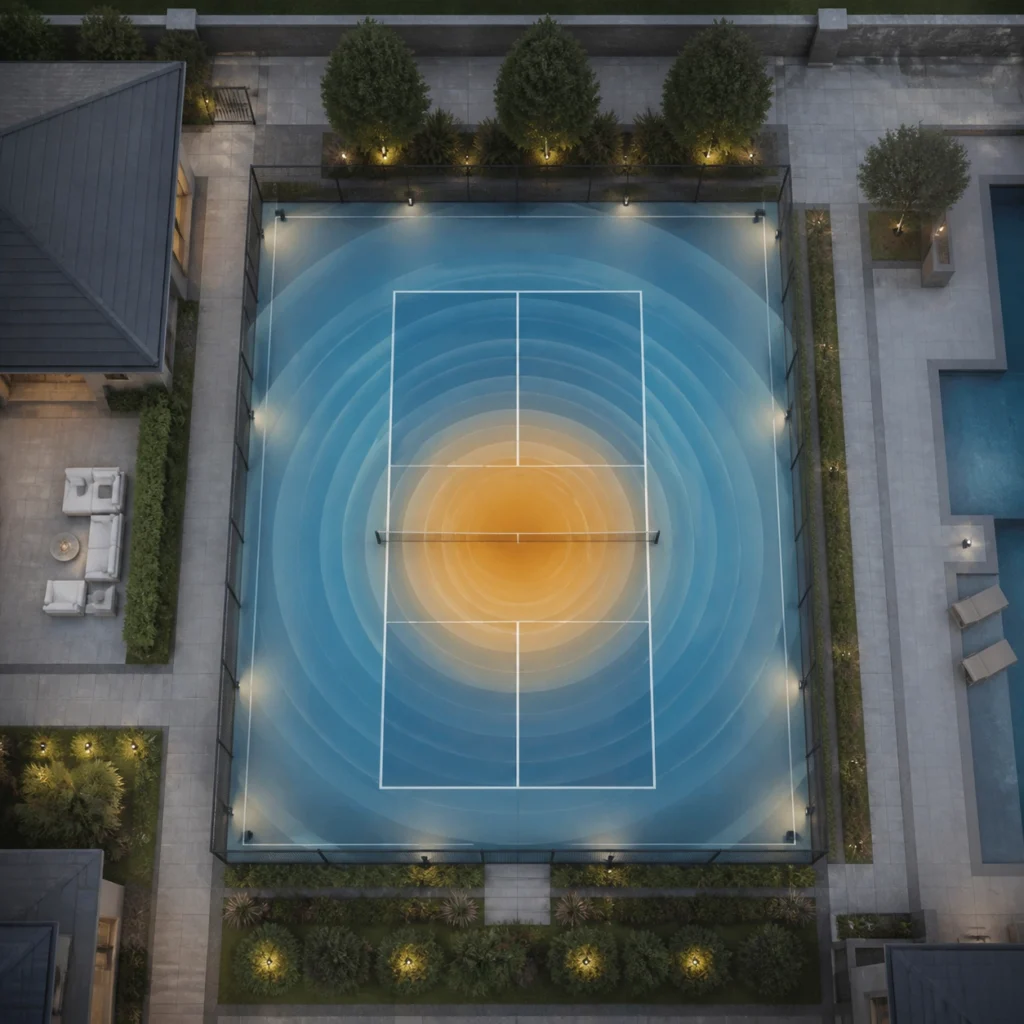
Sound intensity follows the inverse square law, meaning the sound pressure level decreases by approximately 6 decibels for every doubling of distance from the source. While a distance of 500 feet is often cited as the "ideal" buffer for unmitigated courts, residential lots rarely allow for such luxury. In these cases, the orientation of the court becomes a vital tool.
Sound does not radiate equally in all directions from a pickleball paddle. The highest sound pressure levels are typically directed toward the sidelines rather than the baselines, due to the mechanics of the stroke and the paddle's surface area. By orienting the court so that the sidelines face the least sensitive areas (such as a park or a busy road) and the baselines face the nearest residences, the "perceived" noise impact can be reduced even before physical barriers are installed.

Technical diagram illustrating the sound radiation patterns and decibel drop-off across a standard 20'x44' pickleball court.
Mitigation at the source is the first line of defense. Engineering advancements in equipment have led to the development of "Quiet Category" gear, designed specifically to dampen the 1250 Hz peak.
When distance and equipment are insufficient, engineering a physical "path mitigation" solution is required. This involves placing an acoustic obstacle between the source (the court) and the receiver (the neighbor).
Standard chain-link fencing offers zero acoustic protection. To turn a fence into a sound barrier, it must be outfitted with materials that possess high Sound Transmission Class (STC) ratings.
Mass Loaded Vinyl (MLV) is a common technical choice. It is a high-density, flexible material infused with metal particles to increase its mass without increasing its thickness. When applied to court fencing, it works by:
For a barrier to be effective, it must break the "line of sight" between the paddle impact and the neighbor's ear. This typically requires fencing heights of at least 10 to 12 feet.
In professional or high-use residential installations, specialized acoustic blankets are used. These consist of a reinforced outer shell with an inner core of sound-absorptive mineral wool or fiberglass. Unlike MLV, which primarily blocks sound, these blankets also reduce reverberation within the court area, preventing the sound from "bouncing" and amplifying.

Architectural rendering of a residential court utilizing a 12-foot acoustic barrier system with integrated mass-loaded vinyl panels.
The court surface itself plays a secondary but important role in noise mitigation. The choice of material affects how much sound is reflected and how much impact noise is generated when the ball hits the ground.
Standard hard-court acrylic is applied directly over a concrete or asphalt base. This creates a highly reflective acoustic environment. While excellent for play consistency, it does nothing to dampen the sound of the ball impact. For those utilizing a concrete base, proper preparation is vital to ensure any subsequent overlays or tiles perform as intended. The key requirement is a level, moisture-sealed surface that allows overlays or tiles to perform as intended over time.
Modern modular sports tiles offer a technical advantage in noise reduction. These tiles are often designed with a "honeycomb" or "ribbed" underside that creates a small air gap between the tile and the concrete.

In premium residential projects, noise mitigation is often integrated into the broader site and building design. This includes the use of privacy walls, boundary treatments, and landscaping to create a multi-layered acoustic buffer.
Softscaping and Natural Barriers
While a row of hedges is often thought to be a good sound barrier, the technical reality is that vegetation is poor at blocking sound unless it is exceptionally dense and several meters thick. However, landscaping can be used in conjunction with solid barriers. For example, a solid masonry wall or an acoustic fence can be "camouflaged" with greenery. The greenery helps to scatter high-frequency sounds, while the solid mass of the wall does the heavy lifting of blocking the transmission.
Overhead and Vertical Acoustic Elements
Additional architectural surfaces near the court can help manage sound by providing more opportunities for acoustic treatment. When these elements are lined with sound-absorptive materials, they can help intercept upward-radiating sound before it disperses into the surrounding area.

To achieve a residential pickleball installation that meets professional acoustic standards, follow this technical hierarchy:
Engineering a pickleball court for a residential area is a balancing act between playability and acoustic responsibility. By focusing on the 1250 Hz frequency, utilizing mass-heavy barriers, and optimizing site geometry, it is possible to enjoy the game without compromising the peace of the neighborhood. The priority should remain on materials and design strategies that deliver both durability and functional acoustic performance.


