
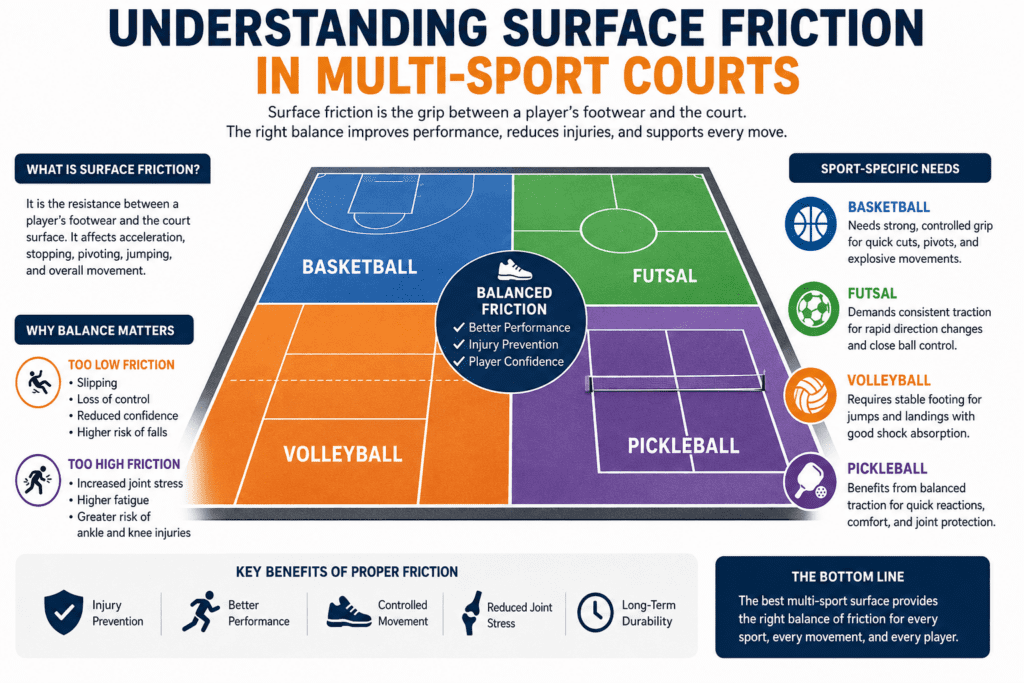
Surface friction is one of the most important factors in sports flooring. It affects how players move, stop, turn, jump, land, and recover during play.
For multi-sport courts, friction needs to sit in the right range. A surface that is too slippery increases the risk of falls. A surface that has too much grip can place extra stress on ankles, knees, hips, and lower backs.
The goal is not simply to create the grippiest surface possible. The goal is to create a surface that provides controlled traction, safe movement, and consistent performance across different sports.
Surface friction is the resistance created between a player’s footwear and the court surface.
It influences:
In sport, friction must be predictable. Players need to trust that the court will respond the same way across the full playing area.
Multi-sport courts are used for different activities, each with its own movement patterns.
Basketball requires sprinting, pivoting, jumping, and sudden stops.
Futsal requires rapid direction changes, close ball control, and constant footwork.
Volleyball requires jumping, landing, shuffling, and diving.
Pickleball requires short reaction movements, lateral steps, and controlled stopping.
Because these movements are different, the surface must provide a balanced level of grip. It needs to support fast movement without locking the foot too aggressively into the floor.
Basketball places high demand on court friction because players are constantly changing direction.
Common movements include:
If the surface has too little friction, players may slip when defending, cutting, or landing.
If the surface has too much friction, the foot can grip too strongly during pivots, increasing stress on ankles and knees.
A basketball surface should provide strong but controlled traction, allowing players to move confidently while still being able to rotate and adjust their foot position safely.
Futsal is especially demanding because the game is fast and played in a smaller space than outdoor football.
Players rely on:
A slippery surface can reduce control and make fast changes of direction unsafe.
However, excessive grip can also be a problem. Futsal players frequently twist, turn, and plant their feet. If the surface grips too aggressively, it can increase loading through the knees and lower limbs.
The best futsal surfaces provide consistent traction across the court, helping players move quickly while maintaining control.
Volleyball has different friction needs compared with basketball and futsal.
Players need secure footing for:
Shock absorption is especially important because volleyball involves repeated jumping and landing.
The surface should provide enough grip for stable take-off, but it should not be so aggressive that it restricts natural movement. Players also need a surface that allows controlled recovery during dives and low defensive movements.
A good volleyball court surface balances grip, cushioning, and stability.
Pickleball is played with short, quick movements rather than long sprints.
Players often perform:
Because pickleball is popular with a wide range of ages, comfort and joint protection are important.
Too little friction can cause slipping, especially during side-to-side movement.
Too much friction can increase stress on knees, hips, and ankles, particularly for older players or frequent recreational users.
A suitable pickleball surface should provide controlled traction without feeling overly harsh underfoot.
It is easy to assume that a grippier court is always safer, but this is not always true.
Excessive friction can cause the foot to stop suddenly while the body continues moving. This can increase twisting forces through the ankle, knee, and hip.
This is why high-quality sports flooring is designed to balance:
The best surface is not the one with the most grip. It is the one with the most appropriate grip for the sport being played.
A multi-sport court should feel the same from one side to the other.
Inconsistent friction can occur because of:
When friction varies across the court, players cannot predict how the surface will respond. This increases the risk of slipping, over-gripping, or missteps.
Regular cleaning and correct maintenance are important for keeping friction performance consistent over time.
When selecting a surface for basketball, futsal, volleyball, and pickleball, the key is balance.
A good multi-sport surface should offer:
No single sport should dominate the surface design unless the court is primarily built for that sport.
For true multi-sport use, the surface should support a wide range of movement styles safely and consistently.


