
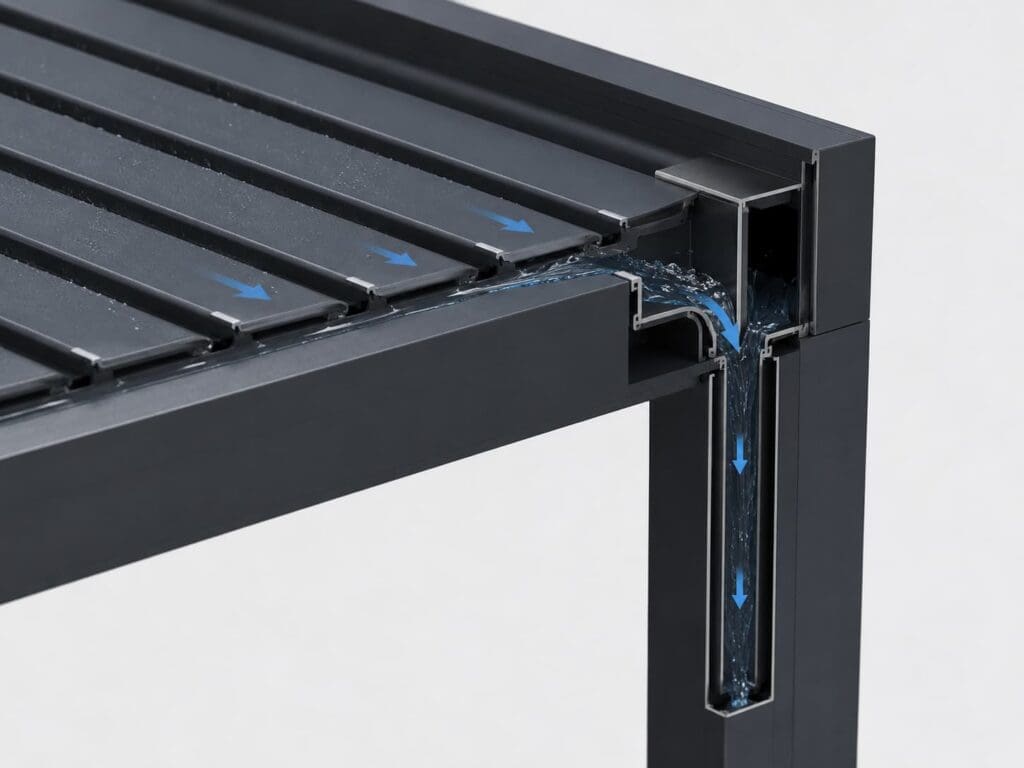
A motorised louvre roof may appear almost flat when the blades are closed, but underneath the clean exterior is a carefully planned rainwater-management system.
Rather than allowing water to spill randomly from the edges, a properly designed louvre roof collects rainwater from the blades, directs it into integrated perimeter gutters and then carries it through concealed channels inside the supporting posts.
Understanding this drainage process is important when choosing a louvre pergola, planning its foundations or deciding where the discharged water should go.
When rain begins, the aluminium louvres rotate into their closed position. The blades overlap or interlock to form a weather-resistant roof surface.
Rainwater landing on the roof then follows a controlled path:
Although the roof looks simple from the outside, the drainage system operates much like the gutters and downpipes on a house.
The main beams of a louvre pergola often serve two purposes. They provide structural support for the roof while also containing the perimeter gutter system.
These gutters are built into the frame rather than attached to the outside.
This concealed design helps maintain the clean architectural appearance of the pergola. There are no conventional external spouting systems hanging from the sides of the structure.
The gutters collect water arriving from the louvre blades and direct it around the roof perimeter towards the drainage points.
Depending on the pergola design, water may be directed to:
The number of drainage posts required depends on the roof size, gutter design, local rainfall intensity and the way the structure has been installed.
Closed louvres are not simply flat pieces of aluminium. Their shape is designed to control water movement.
Many systems use overlapping blades with raised edges, internal channels or interlocking profiles. These features help prevent rainwater from falling directly between the blades under normal conditions.
The roof may also be installed with a subtle engineered fall that encourages water to travel towards the gutters. This fall may be difficult to see from ground level but is important for reliable drainage.
Once the water reaches the edge of the blades, it drops or flows into the concealed gutter system inside the beams.
After entering the gutters, the water must be carried towards the drainage posts.
Internal channels within the roof frame guide the water to the selected corners. These channels are hidden inside the aluminium structure and form part of the pergola’s overall drainage design.
The system helps reduce:
The channels must remain clear for the system to work correctly. Leaves, seeds, dirt and insects can sometimes enter the gutters, particularly when a pergola is located near trees.
Periodic cleaning is therefore recommended.
Once the water reaches a drainage corner, it enters a concealed cavity or downpipe inside the pergola post.
The water then travels straight down through the post.
This is known as integrated post drainage.
From the outside, the post still looks like a standard structural column. The downpipe is hidden inside it, maintaining the clean appearance of the pergola.
At the bottom of the post, the water usually exits through one of several arrangements.
A drainage opening near the bottom of the post releases water onto a suitable surface.
This option may be appropriate where the water can safely discharge onto concrete, paving, gravel or a landscaped drainage area.
Water travels through the bottom of the post and into a drainage connection installed beneath the structure.
This creates a highly concealed finish but must be planned before the pergola footings, deck or concrete slab are completed.
The post drainage outlet may connect directly to an approved stormwater system.
This can be especially useful for larger roofs or areas with heavy rainfall. Stormwater connections should be planned in accordance with the site conditions and local requirements.
A common mistake is to choose the pergola position without considering where the rainwater will eventually discharge.
The drainage outlet should not release water where it could cause problems around:
Where the pergola is being installed over a deck, the drainage post may need to align with a gap, a planned downpipe route or a suitable collection point below the deck.
For installations on concrete, drainage outlets may need to be positioned before the slab is poured.
Planning the water path early produces a cleaner installation and reduces the need for visible pipework later.
An integrated louvre roof drainage system is designed to control normal rainfall, but every gutter has a maximum capacity.
During exceptionally intense rain, water may accumulate faster than the gutters and post channels can discharge it. Wind-driven rain can also behave differently from rain falling vertically.
Performance can be affected by:
A pergola should therefore be selected and configured for the expected site conditions rather than relying only on its appearance.
A closed louvre roof is intended to provide strong protection from rain, but it should not always be treated as a completely sealed internal building roof.
Small amounts of water may enter during severe wind-driven rain, particularly where strong wind pushes water against the blade joints.
Water may also drip temporarily when the louvres are opened shortly after rainfall. Water remaining on the blades can be released as the blades rotate.
Allowing the roof to drain before opening it can help reduce this effect.
Integrated gutters require less visual attention than external spouting, but they should not be forgotten.
Basic maintenance should include:
Pergolas located beneath trees may require more frequent cleaning than structures in open areas.
A gentle hose test can help confirm that water is flowing into the gutters, towards the posts and out through the drainage outlets.
Possible signs that the drainage system needs inspection include:
These issues do not always indicate a fault with the roof. In many cases, the cause is a blocked outlet, trapped debris or an unsuitable discharge point.
Even a well-designed gutter system depends on correct installation.
The structure must be level where required, while still maintaining any specified drainage fall. Posts must be positioned correctly, gutter joints must be sealed and drainage channels must align with the intended outlets.
The installer should also confirm that:
Drainage should be tested before the installation is considered complete.
One of the advantages of a modern aluminium louvre roof is that its rainwater system is largely hidden from view.
The blades collect and direct the rain. Integrated gutters carry the water around the roof frame. Concealed channels take it to the designated corners. The water then travels straight down through the posts before being released or connected to stormwater.
The result is a clean-looking outdoor roof without conventional external gutters and downpipes.
However, the drainage route should always be considered during the design stage. Correct post placement, suitable outlet locations and regular gutter maintenance all help ensure that the system continues to perform effectively through changing weather conditions.
Not necessarily. Some systems use one or two selected drainage posts, while others may use all four corners. The final configuration depends on the pergola design, roof size and site requirements.
It can, but the discharge location should be carefully considered. Concentrated water may cause staining, splashing or moisture problems beneath the deck. A planned drainage connection is often preferable.
The gutters are generally incorporated into the perimeter beams, making them far less visible than conventional house spouting.
Yes. This needs to be planned before installation so that the post outlet and underground drainage connection align correctly.
Water remaining on the blades may drip as the blades rotate. Allowing time for the roof to drain before opening can reduce this.
This depends on the surrounding environment. A pergola beneath trees will usually require more frequent cleaning than one installed in an open area. Gutters should also be inspected whenever drainage appears slower than normal.


