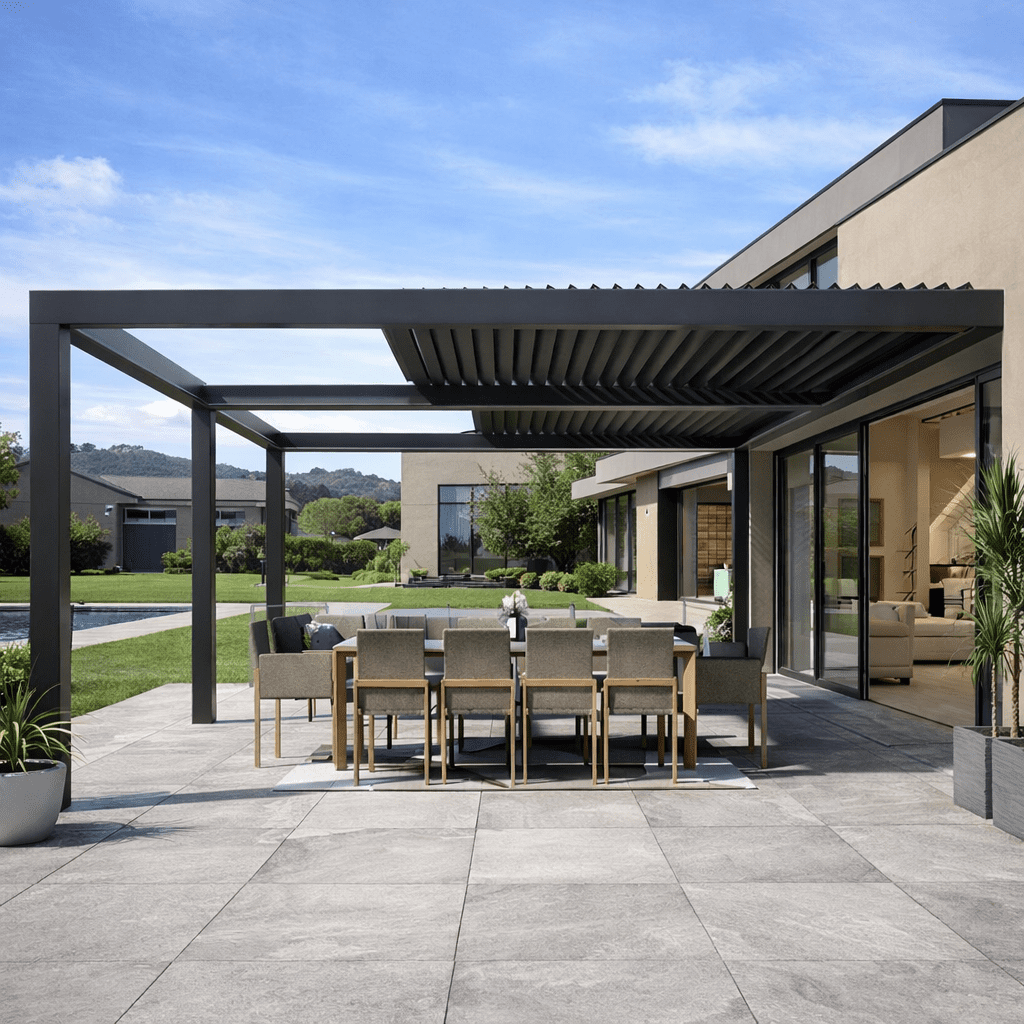
Outdoor living has moved well beyond basic patios and fixed covers. Today, spaces are expected to adapt—morning sun, midday heat, afternoon wind, and evening rain all within the same day.
That’s where retractable louvre systems come in.
They’re not just a variation of a pergola. They represent a shift toward dynamic outdoor structures—systems that change with conditions instead of forcing you to adapt to them.
A retractable louvre system is an outdoor roof structure made up of horizontal slats (louvres) that can both rotate and retract.
This gives you two levels of control:
• Rotation – adjust the angle of the louvres to control sunlight, airflow, and shade
• Retraction – slide the louvres fully open to expose the sky
Unlike fixed roofs or standard louvre systems, retractable designs allow the roof to completely clear, transforming a covered space into an open-air environment within seconds.
At a structural level, retractable louvre systems combine:
• Aluminium framing (typically 6063-T6 or T5 depending on system)
• Motorised tracking systems
• Interlocking louvre blades
• Integrated drainage channels
When activated:
• The louvres rotate open
• Then slide back along tracks
• Stacking neatly at one end of the structure
Most modern systems are fully motorised, controlled via:
• Remote control
• Wall switch
• Smart app (Tuya or similar ecosystems)
Optional upgrades often include:
• Rain sensors (auto-close during rain)
• Wind sensors
• Integrated LED lighting
• Track Blinds and glass enclosures
Understanding where retractable systems sit in the market is key.
• Permanent cover
• No moving parts
• Maximum weather protection
• Limited flexibility
• Rotate only
• Good balance of control
• Cannot fully open
• Rotate + fully retract
• Maximum flexibility
• Highest level of control
This makes retractable systems the most adaptable option—but also typically more engineered than basic alternatives.
There’s a clear shift happening in outdoor design—especially in New Zealand and coastal markets.
Outdoor areas are no longer occasional-use zones.
They’re being used for:
• Daily dining
• Work-from-home setups
• Year-round entertaining
• Hospitality environments
A fixed solution can’t always handle that level of use.
New Zealand conditions can change quickly:
• Strong sun → sudden rain
• Wind shifts throughout the day
• Seasonal changes in sun angles
Retractable systems allow you to respond instantly instead of compromising.
Design trends are moving toward open, minimal structures.
Retractable systems support this by allowing:
• Full sky exposure when needed
• Clean, modern profiles
• Seamless indoor-outdoor transitions
You decide how much sun, shade, or airflow you want—at any time.
Unlike standard louvres, you can fully open the roof and bring the sky back into the space.
Close the system during rain while maintaining drainage through integrated gutters.
High-end outdoor systems are increasingly seen as permanent lifestyle upgrades, not accessories.
With systems like Tuya:
• Automate opening/closing
• Integrate with weather sensors
• Control remotely
These systems are highly versatile.
• Decks and patios
• Poolside areas
• Outdoor kitchens
• Garden lounges
• Restaurants and cafés
• Hotel courtyards
• Rooftop bars
• Resort outdoor areas
In hospitality settings, they directly impact:
• Customer comfort
• Usable floor space
• Revenue potential
Not all retractable systems are built the same.
Key things to look for:
• 6063-T6 (higher strength, architectural grade)
• 6063-T5 (common in many systems)
• 304 stainless steel (standard for durability)
• 316 stainless steel (preferred in coastal areas)
• Internal gutter systems
• Hidden downpipes within posts
• Weather-rated motors
• Reliable track systems for smooth operation
This is where cheaper systems often fail—particularly in coastal or high-wind environments.
It depends on how you use your space.
They make the most sense when:
• You want both open and covered functionality
• The space is used frequently (not just occasionally)
• You value flexibility over simplicity
• You’re designing a long-term outdoor solution
For some projects, a fixed or standard louvre system may still be the better option.
But if adaptability is the priority, retractable systems sit at the top of the category.
Retractable louvre systems represent a broader shift in outdoor living.
We’re moving away from static structures—and toward spaces that respond to how we actually live.
Instead of asking:
“What structure should I build?”
The better question is:
“What do I need this space to do—throughout the day, and throughout the year?”
If the answer involves flexibility, control, and year-round usability, a retractable louvre system is one of the most complete solutions available today.