
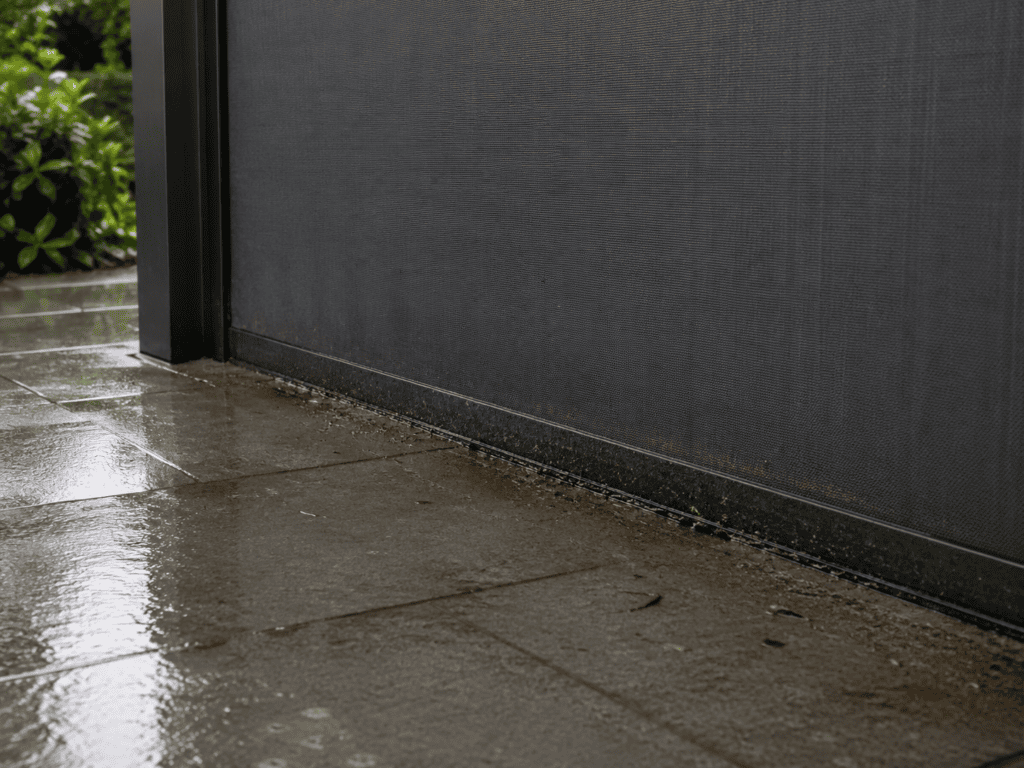
Outdoor blinds are designed to provide protection from wind, rain, glare and low-angle sunlight. However, their performance depends heavily on accurate measuring and installation—particularly the clearance between the bottom of the blind and the surface below it.
An outdoor blind should close neatly against its intended stopping point, but the fabric and bottom rail should not scrape, drag or bunch across decking, concrete or paving. Even minor contact can eventually cause fabric damage, alignment problems and unreliable operation.
Some outdoor blind systems use a bottom seal, brush strip or flexible rubber edge that sits close to the ground. This can help reduce draughts and limit water or debris entering beneath the blind.
That is different from allowing the blind fabric or aluminium bottom rail to drag across the surface.
A properly installed blind should:
The correct clearance will depend on the blind system, the floor surface and the installation conditions. Manufacturer requirements should always be followed, particularly with motorised and zip-track outdoor blinds.
Outdoor blind fabrics are manufactured to handle exposure to sun, wind and changing weather. They are not intended to be repeatedly rubbed against abrasive surfaces.
Concrete, textured paving and composite decking can act like sandpaper. Each time the blind opens or closes, contact with the surface may slowly wear away the bottom edge of the fabric.
This can lead to:
Once the bottom edge becomes damaged, the blind may no longer roll evenly onto its tube. A minor installation issue can therefore develop into a much larger operational problem.
Outdoor surfaces frequently remain wet after rain, washing or overnight condensation. Decking may also retain moisture between boards, while shaded paving can remain damp for long periods.
When blind fabric rests directly against a wet surface, moisture can be absorbed or held against the material. This is particularly problematic if the blind is then retracted while still damp.
Rolling wet and dirty fabric into the headbox may contribute to:
Outdoor blinds should ideally be allowed to dry before being retracted. Maintaining suitable clearance makes this much easier and prevents the lower section from continually sitting in surface water.
Decks and paved areas naturally collect dust, leaves, pollen, sand and other debris. Coastal properties may also experience wind-blown salt and fine grit.
If the blind drags along the ground, these contaminants can attach to the bottom rail or fabric. They may then be pulled into the side tracks and cassette when the blind is opened.
Fine grit inside the tracks can increase friction and interfere with the smooth movement of the blind. Over time, this may affect the zip edges, guide channels and motor operation.
Keeping the blind clear of the ground reduces the amount of debris entering the system and makes routine cleaning easier.
Outdoor surfaces are rarely perfectly level.
Timber decking may have slight variations between boards. Pavers can settle or move over time, and concrete is often installed with a deliberate fall to help move water away from the building.
If a blind is measured from only one point, the bottom rail may touch the surface at one end while remaining clear at the other. This uneven contact can force the bottom rail out of level.
Possible consequences include:
Measurements should therefore be taken at several points across the blind opening. The lowest available clearance often determines the final position of the bottom rail.
Zip-track outdoor blinds rely on the fabric edges travelling smoothly inside vertical guide tracks. These tracks help maintain tension and reduce fabric movement in normal wind conditions.
When the bottom rail hits the ground before the blind has reached its programmed stopping position, the motor may continue applying downward force. That pressure can transfer into the fabric and side tracks.
This may cause the fabric to bunch, the bottom rail to tilt or the zip edge to bind inside a guide.
Motor limits should be set so that the blind stops cleanly without forcing the bottom rail into the deck or paving. Manual blinds should also close without requiring excessive pressure at the end of their travel.
Timber is a natural material that expands and contracts as moisture and temperature levels change. A deck that provides adequate clearance during a dry summer may sit slightly differently during a wet winter.
Individual boards may also cup, warp or lift.
Allowing a small amount of practical clearance helps accommodate normal seasonal movement. Installing a bottom rail tightly against a timber deck leaves little tolerance for future changes.
The clearance should still be small enough to provide effective weather protection, but sufficient to prevent the rail from scraping when the deck moves.
Paving and concrete are normally constructed with a slight slope so rainwater can drain away. This means the distance between the blind headbox and the ground may vary from one side of the opening to the other.
Water should also be able to move beneath and away from the blind.
If the bottom rail sits directly on the paving, it may obstruct drainage or trap leaves and debris. Water can then pool against the blind, the tracks or the surrounding structure.
Correct clearance supports both blind operation and surface drainage.
The bottom rail provides weight, tension and stability to the blind. It should remain level throughout its movement and when the blind is fully closed.
A level bottom rail helps distribute tension evenly across the fabric and keeps both sides moving at the same rate.
If one end continually contacts the floor first, the blind may begin to operate unevenly. This can place additional strain on the motor, track inserts and fabric edges.
Installers should check the bottom rail across the entire width—not just at the motor side or one convenient measuring point.
There is no single clearance that applies to every outdoor blind.
The appropriate gap depends on:
For many installations, only a small visible clearance is needed. However, the bottom rail and blind fabric should not be forced to scrape along the surface.
Where there is a major slope across an opening, the solution may involve adjusting the blind position, adding a suitable threshold or improving the surface beneath the blind. A severely uneven floor should not be compensated for by allowing one end of the blind to drag.
Before setting the final motor limits or completing installation, the blind should be operated several times.
The installer should confirm that:
The blind should also be tested in different positions rather than only fully open and fully closed.
Correct clearance is a small installation detail that can have a major effect on the lifespan and reliability of an outdoor blind.
Preventing the fabric and bottom rail from dragging helps reduce moisture contamination, dirt buildup, abrasion and track misalignment. It also allows the blind to open and close smoothly without unnecessary strain on its motor or operating system.
Careful measuring, accurate track installation and correctly programmed limits will produce a cleaner finish and help the blind perform as intended for years to come.
For the best result, outdoor blinds should be measured and installed according to the specific system requirements, with the condition, level and drainage of the deck or paved surface taken into account.


