
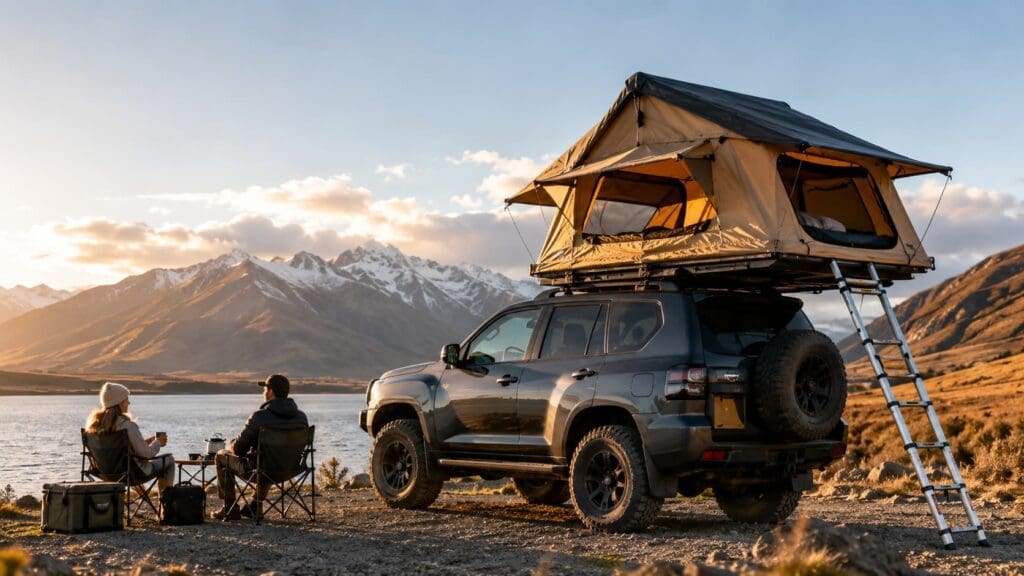
Camping is changing. More travellers are looking for ways to explore without towing a caravan, relying on crowded holiday accommodation or spending time setting up a traditional ground tent at every stop.
For many weekend campers, road-trip travellers and outdoor enthusiasts, a rooftop tent offers a practical middle ground. It provides a dedicated sleeping space on top of the vehicle while allowing the vehicle itself to remain available for storage, cooking equipment and other adventure gear.
The ADA Overland catalogue demonstrates how the category has expanded beyond a single tent style. Current options include soft-shell, hard-shell, aluminium-shell, ABS-shell, side-opening and compact triangle-style rooftop tents for different vehicles and types of travel.
One of the biggest reasons people consider a rooftop tent is the convenience of arriving at a campsite and preparing a sleeping area relatively quickly.
Traditional camping may involve unloading a tent, clearing the ground, assembling poles, positioning a groundsheet and arranging the sleeping equipment. A rooftop tent keeps much of the sleeping setup together on the vehicle.
Setup time varies between models, but hard-shell and wedge-style tents are generally chosen by travellers who want a straightforward opening process. Some models lift vertically, while others open into a triangle or wedge shape.
This can be especially useful on road trips where the traveller may be staying in a different location each night.
A rooftop tent creates a raised sleeping platform rather than placing the camper directly on the ground.
This can help avoid some of the common frustrations associated with ground camping, including:
The vehicle still needs to be parked on stable and reasonably level ground, but the sleeping platform itself is supported by the tent base and roof-rack system.
For travellers visiting remote campsites, beaches, farms or basic campgrounds, this raised setup can provide a more organised sleeping environment.
Rooftop tents work particularly well for people whose camping trips revolve around driving.
Instead of transporting a separate trailer or large caravan, the accommodation travels on the vehicle roof. This makes rooftop tents appealing for touring routes, weekend escapes and multi-stop journeys.
They may be suitable for:
The vehicle becomes the central part of the camping system, with the rooftop tent providing the sleeping area and side awnings or annex rooms creating space at ground level.
Earlier rooftop tents were often associated with large four-wheel-drive vehicles and specialist expedition equipment. The wider variety of modern formats means buyers can now compare models based on the vehicle, available roof space and intended use.
Soft-shell tents generally unfold to create a larger sleeping platform. They can provide generous internal space and may suit couples or families who prioritise room over the fastest possible setup.
Because part of the tent opens beyond the vehicle roof, a soft-shell model can offer more sleeping space than its packed footprint might suggest.
Hard-shell models close into a rigid roof-mounted case. When opened, the shell becomes part of the tent structure.
These models are popular with frequent travellers because the opening process is often simple and the packed profile is usually tidy. They are commonly used by campers who regularly move between destinations.
An aluminium-shell rooftop tent can provide a rigid external structure suited to touring and repeated use. Aluminium models are often selected for their robust appearance, streamlined form and compatibility with overland vehicle setups.
The ADA Overland range includes several aluminium hard-shell and triangle-style configurations.
ABS-shell tents use a moulded outer case to protect the folded tent. These models can provide a smooth external profile and may suit buyers seeking a practical combination of protection, appearance and setup convenience.
Triangle tents open at one end to create a wedge-shaped sleeping space. Their simple form makes them particularly attractive to solo travellers and couples who value quick overnight stops.
The range of configurations shown throughout the catalogue reflects how rooftop tents can now be chosen around a particular travel style rather than treated as a single universal product.
Many rooftop tents include an integrated sleeping base, reducing the amount of bedding equipment that needs to be assembled each night.
Depending on the model, the tent may also include:
The raised position can also provide better views and airflow than a small ground tent, particularly when camping near lakes, beaches, mountains or open countryside.
However, buyers should still compare mattress thickness, internal dimensions, ventilation and weather protection carefully. A larger exterior does not always mean substantially more usable sleeping space.
Another reason for their popularity is the ability to combine a rooftop tent with related products.
A vehicle setup might include:
The rooftop tent provides the bedroom, while the surrounding products create areas for cooking, changing, relaxing and storing equipment.
The catalogue includes rooftop tents alongside side awnings, awning rooms, shower tents, portable lights, water tanks and roof-rack equipment, demonstrating how the products can work together as a broader touring setup.
Caravans and camper trailers can provide substantial comfort, but they also require storage space, towing capacity and additional consideration when parking or travelling on narrow roads.
A rooftop tent avoids the need to tow separate accommodation. This can make it easier to use the vehicle for shorter trips or reach destinations where manoeuvring a trailer would be inconvenient.
A rooftop tent is not a replacement for every campervan or caravan. Internal living space is limited, access is by ladder and the tent must usually be packed away before driving. However, for travellers who spend most of their day outdoors, these compromises may be acceptable.
Rooftop tents are visually distinctive. Images of vehicles parked beside beaches, forests and mountain routes have helped introduce more people to this style of camping.
The appeal is not only about appearance. These images demonstrate a simple idea: the same vehicle used for everyday transport can become the base for a weekend camping setup.
That visibility has encouraged more travellers to investigate rooftop tents, even if they do not consider themselves traditional four-wheel-drive or overland enthusiasts.
A rooftop tent must be selected for the vehicle and roof system rather than appearance alone.
Before purchasing, buyers should check:
Vehicles have both dynamic and static roof-load considerations. The dynamic limit applies while the vehicle is moving, while the static load relates to the vehicle when parked.
The rooftop tent, mounting hardware, roof racks and any additional roof-mounted accessories contribute to the total load.
Not every factory roof rail or crossbar is suitable for a rooftop tent. The rack system must be compatible with the vehicle and capable of supporting the tent according to the rack and vehicle manufacturers’ requirements.
A larger rooftop tent may provide more sleeping room, but it will also add weight and occupy more roof space.
Buyers should consider the overall vehicle height, garage clearance, wind resistance and whether other equipment needs to be carried on the roof.
The listed capacity should be compared with the actual internal dimensions. Two adults may require a different sleeping width from one adult and a child.
A family camping at one location for several days may prioritise internal room and annex options. A solo traveller moving every day may prefer a compact hard-shell or wedge-style model.
A rooftop tent may be a good option when:
A ground tent may still be more suitable when roof capacity is limited, the vehicle needs to be driven after camp is established or the camping party requires several separate sleeping areas.
The growth of rooftop camping is being driven by flexibility. Travellers can choose from compact overnight tents, larger fold-out models, rigid hard-shell tents and complete vehicle-camping systems with awnings and annex rooms.


