
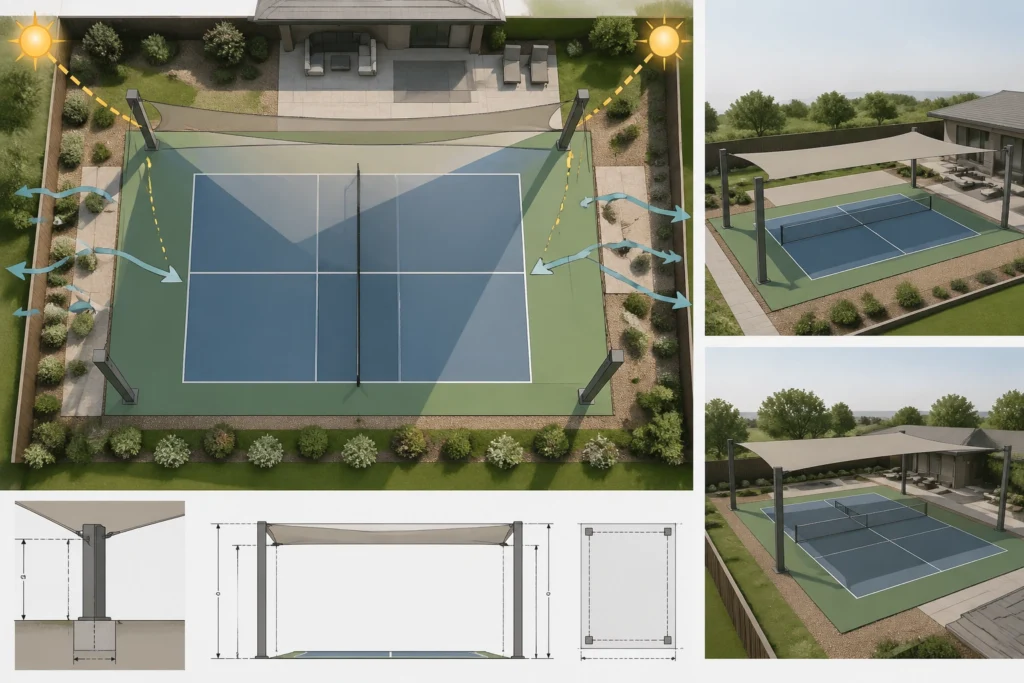
Pickleball has transitioned from a niche recreation to a dominant force in residential landscape design. As more property owners convert underutilized lawn space into professional-grade courts, the challenge of environmental control becomes paramount. A backyard pickleball court is a significant investment, but its utility is often dictated by the movement of the sun and local weather patterns.
Integrating modern shading solutions is no longer an afterthought; it is a technical requirement for ensuring player safety, optimal visibility, and year-round usability. This guide explores the technical integration of architectural shading systems with backyard sports infrastructure, focusing on structural requirements, thermal comfort, and strategic orientation.
Before a single post is set in concrete, the integration of shade must begin with Sun Mapping. In the Southern Hemisphere, particularly across New Zealand latitudes, the sun’s arc changes significantly between the summer and winter solstices.
The industry standard for outdoor court construction is a North-South orientation. This placement ensures that during the peak playing hours of the morning and late afternoon, the sun remains to the side of the players rather than directly in their line of sight. However, even with perfect orientation, glare remains a primary cause of unforced errors and eye strain.
Shading solutions should be prioritized over the "Kitchen" (the non-volley zone) and the baseline areas. These are the zones where players spend the most time and where focus is most critical. By utilizing 3D sun-path modeling, designers can determine exactly where shadows will fall at 10:00 AM and 4:00 PM, allowing for the strategic placement of overhead shade structures or fixed canopies.
Integrating shade into a sports environment requires a balance between permanent protection and atmospheric flexibility. There are three primary architectural systems used in modern court integration.
Adjustable overhead blades or slatted roof elements provide a high-control approach to court-side shading. The primary advantage of this type of system is the ability to manage light ingress and ventilation simultaneously.
For larger coverage areas where a mechanical roof may not be feasible, high-tension fabric sails or "Hip End" structures are utilized.
Retractable solutions offer the most flexibility for multi-use spaces. If the court doubles as an event space or a general-purpose play area, retractable awnings allow for a completely open sky when the weather is mild and full shade when the index is high.

Integrating a structure over or adjacent to a pickleball court involves strict adherence to Overhead Clearance standards. A standard pickleball lob can reach heights of 15 to 20 feet. If a shading structure is too low, it fundamentally alters the game.
The vibration and impact of a pickleball game: combined with the wind loads of a large shading structure: require precise engineering.
A dark-colored court surface can absorb a tremendous amount of solar energy, reaching temperatures far exceeding the ambient air. Shading systems integrated with Thermal Management features can reduce the effective surface temperature by up to 15°C.
When designing a shaded zone adjacent to a court, it is essential to maintain airflow. A structure with three closed sides will trap hot air, leading to player fatigue. Modern designs utilize open-sided adjustable shade structures or cantilevered umbrellas that promote cross-ventilation. This creates a "cool pocket" of air that is naturally drawn across the court by the movement of the players.

Pickleball is known for the distinct "pop" of the paddle hitting the ball. In residential areas, this can lead to noise complaints. Shading structures can be integrated with acoustic baffling or positioned to act as sound deflectors. High-tension fabric structures are particularly effective at absorbing mid-frequency sound waves, preventing the noise from echoing off nearby hard surfaces like glass pool fences or house walls.
Because pickleball courts are often subjected to high-pressure cleaning and potential impact from stray balls, the materials used in the shading system must be exceptionally durable.
The most successful backyard court designs treat the shading solution as the hub of a "Player Lounge." This area acts as the transition zone between the high-intensity play on the court and the relaxation of the home.
Key features to integrate within the shaded zone include:
Integrating shade into a pickleball environment is a precise exercise in architectural planning and sports science. To achieve a professional result, keep these requirements at the forefront of your project:
By treating the shading system as a functional extension of the court itself, you can transform a simple backyard facility into a world-class sporting retreat that is usable, comfortable, and safe regardless of the season.


