
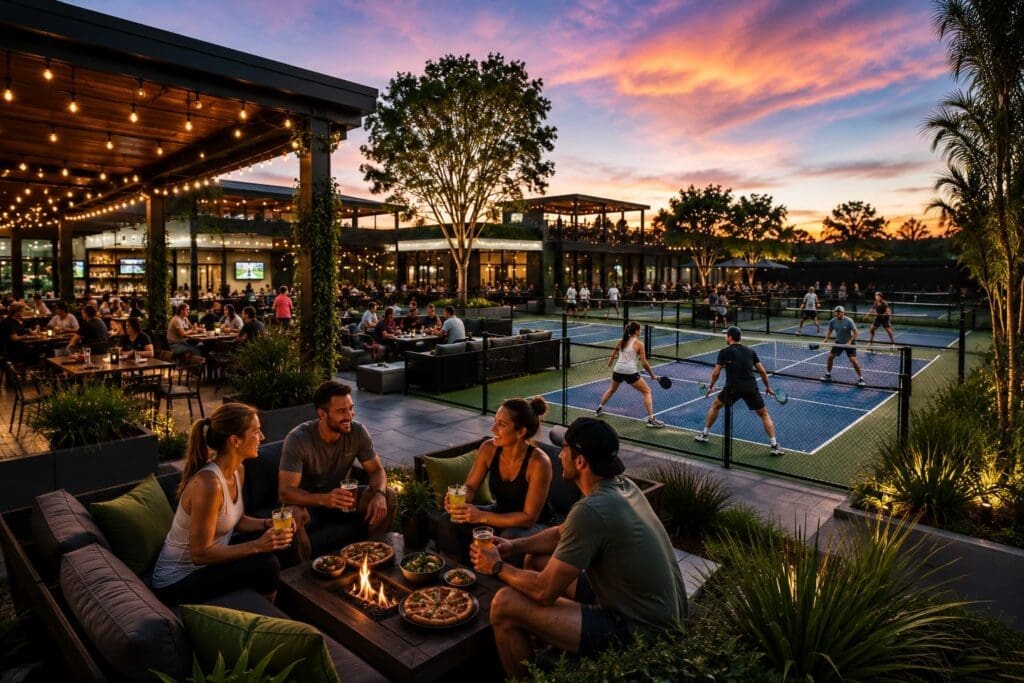
For decades, sports facilities and restaurants largely operated as separate businesses. Today, that model is rapidly changing as a new generation of entertainment venues combines food, drinks, social spaces, and pickleball courts into one destination.
Across North America, Australia, and increasingly New Zealand, operators are discovering that people are not simply looking for a place to play sport. They want a complete experience where they can exercise, socialise, eat, drink, and spend time with friends and family in a single location.
The result is the emergence of the modern "Eat, Drink & Play" venue, with pickleball sitting at the centre of the trend.
Pickleball has become one of the fastest-growing sports in the world, attracting players of all ages and skill levels. Unlike many traditional sports, it is easy to learn, highly social, and requires less physical strain than tennis or squash.
The sport's accessibility means venues are not limited to serious athletes. Instead, they attract:
This broad appeal creates a customer base that naturally supports hospitality and entertainment offerings alongside the courts.
Modern pickleball facilities are increasingly being designed more like hospitality precincts than traditional sports clubs.
Many new developments now include:
Instead of customers arriving for a one-hour game and leaving, these venues encourage visitors to stay for several hours, significantly increasing revenue opportunities.
One of the biggest reasons these venues are succeeding is that pickleball acts as a social catalyst.
Groups can play a few games before enjoying lunch, drinks, or dinner. Corporate teams can combine meetings with team-building activities. Families can enjoy a meal while children remain active on the courts.
This creates a much broader entertainment offering than a traditional restaurant or sports facility alone.
For many operators, pickleball is becoming the modern equivalent of bowling centres, golf entertainment venues, and mini-golf complexes—but with a healthier and more active focus.
Around the world, a growing number of operators are building entire entertainment destinations around pickleball, combining courts with restaurants, bars, live events, and social experiences.
Often regarded as one of the pioneers of the concept, Chicken N Pickle combines indoor and outdoor pickleball courts with chef-driven restaurants, sports bars, rooftop entertainment areas, live music spaces, corporate event facilities, and family-friendly games.
Since launching in 2016, the company has expanded across multiple locations throughout the United States. Their success has demonstrated that pickleball can become the centrepiece of a profitable hospitality and entertainment business rather than simply a sports facility.
Electric Pickle takes the concept even further by blending pickleball with large-scale entertainment. Venues feature multiple courts, restaurants, bars, live DJs, music events, golf simulators, lawn games, and social gathering spaces.
The experience is designed to feel more like a modern entertainment destination than a traditional sports club, appealing to both players and non-players alike.
Pickle and Social focuses on creating all-day social destinations that combine pickleball, food, drinks, events, and community engagement. The model demonstrates how pickleball can successfully anchor a hospitality-focused venue that attracts guests throughout the day and evening.
Rally has developed a premium social club atmosphere where quality food and beverage offerings sit alongside well-designed courts, spectator areas, lounges, and event spaces. The venue experience focuses on bringing people together regardless of their playing ability.
Located in Miami, Sip & Pickle showcases how pickleball can be integrated into urban entertainment precincts. Open-air courts, food, drinks, music, and social events combine to create an energetic destination that attracts visitors well beyond the sport itself.
Venue owners are increasingly recognising that food and beverage sales often generate higher profit margins than court bookings alone.
By integrating hospitality with recreation, businesses can:
The combination of sport and hospitality helps create a destination rather than simply a facility.
New Zealand is perfectly positioned for this trend.
Kiwis already embrace outdoor dining, community sport, and social recreation. As pickleball participation continues to grow locally, there is a significant opportunity for:
Many existing hospitality venues have underutilised outdoor space that could be transformed into revenue-generating pickleball courts.
Successful venues typically focus on creating an experience rather than simply installing courts.
Key design considerations include:
The goal is to create a venue where visitors come to spend an afternoon or evening—not just an hour.
The future of pickleball is not just about sport. It is about community, entertainment, and creating places where people genuinely want to spend time.
The success of overseas concepts such as Chicken N Pickle, Electric Pickle, Rally, Pickle and Social, and Sip & Pickle demonstrates that the combination of food, drinks, entertainment, and pickleball is more than a passing trend—it is a rapidly growing sector of the hospitality industry.
As pickleball participation continues to rise, expect to see more restaurants, bars, entertainment venues, resorts, and lifestyle developments incorporating courts into their offerings.
For hospitality operators, developers, investors, and community organisations, the opportunity is clear: create destinations where people can play, eat, drink, connect, and stay longer.
The future is no longer just eat or play. It is eat, drink, play, and stay.


