
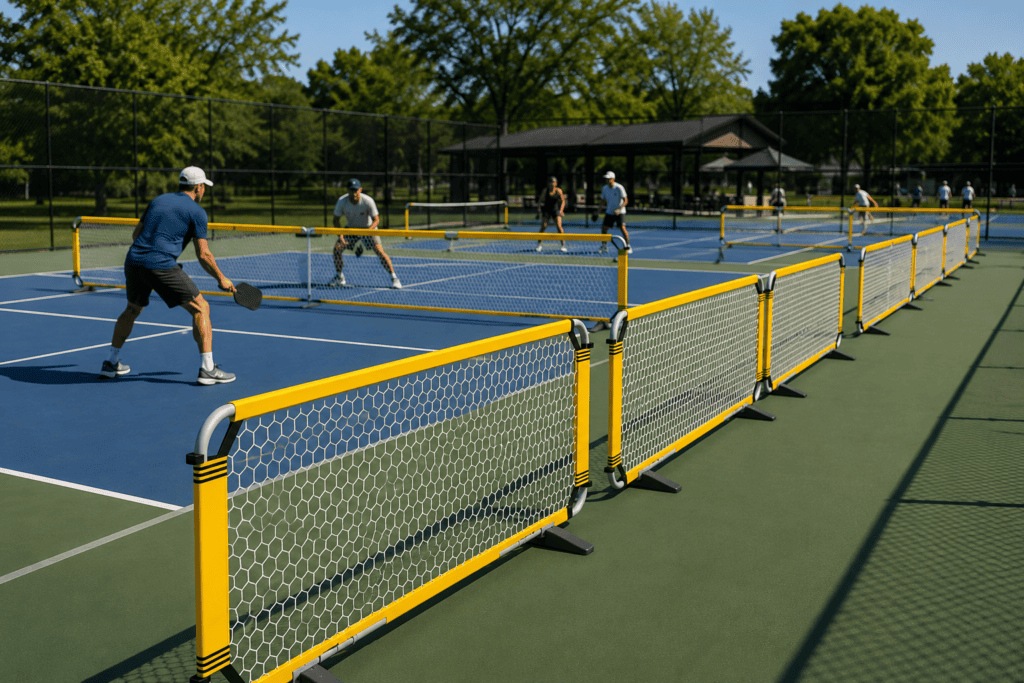
Pickleball participation continues to grow across New Zealand, Australia, and around the world. As more clubs, schools, community centres, and private facilities add courts, one simple accessory is becoming increasingly important: portable court barriers.
Designed to separate courts, control stray balls, and improve player safety, court barriers have quickly become a standard feature at many modern pickleball venues.
One of the most common challenges at busy pickleball facilities is balls rolling onto neighbouring courts.
Not only can this interrupt play, but it can also create safety concerns for players focused on a rally. Portable court barriers help contain balls within the playing area, reducing stoppages and allowing games to continue with fewer interruptions.
For facilities operating multiple courts side-by-side, this can significantly improve the overall playing experience.
Portable barriers help define individual playing spaces and create a cleaner, more organised appearance.
Whether used for:
Barriers provide a professional finish that players immediately notice.
Facilities looking to attract new members or host competitions often use court barriers as part of their overall court presentation strategy.
Unlike permanent fencing, portable court barriers can be moved and reconfigured as needed.
This flexibility makes them ideal for:
Multiple barriers can be connected together to create longer court divisions or spectator separation zones.
Safety is one of the biggest benefits of court barriers.
By reducing the number of loose balls moving between courts, facilities can lower the risk of trips, falls, and accidental collisions.
This is particularly important for:
A safer playing environment creates a better experience for everyone on court.
Modern court barriers are designed to be lightweight, durable, and easy to handle.
Most systems feature:
This allows clubs and facility operators to deploy barriers quickly when needed and store them efficiently after use.
Portable pickleball barriers are increasingly being used by:
Creating clear court separation and improving member experience.
Managing multiple activities within shared sports spaces.
Providing flexible court layouts for changing programmes.
Delivering professional event presentation and improved court management.
Maximising the usability of indoor and outdoor courts.
As pickleball continues to expand, facility operators are looking beyond simply installing courts. The focus is now on creating safer, more organised, and more enjoyable playing environments.
Portable court barriers are a simple investment that delivers immediate benefits through:
For clubs, schools, and community facilities looking to improve the player experience, court barriers are quickly becoming an essential part of modern pickleball court design.


