
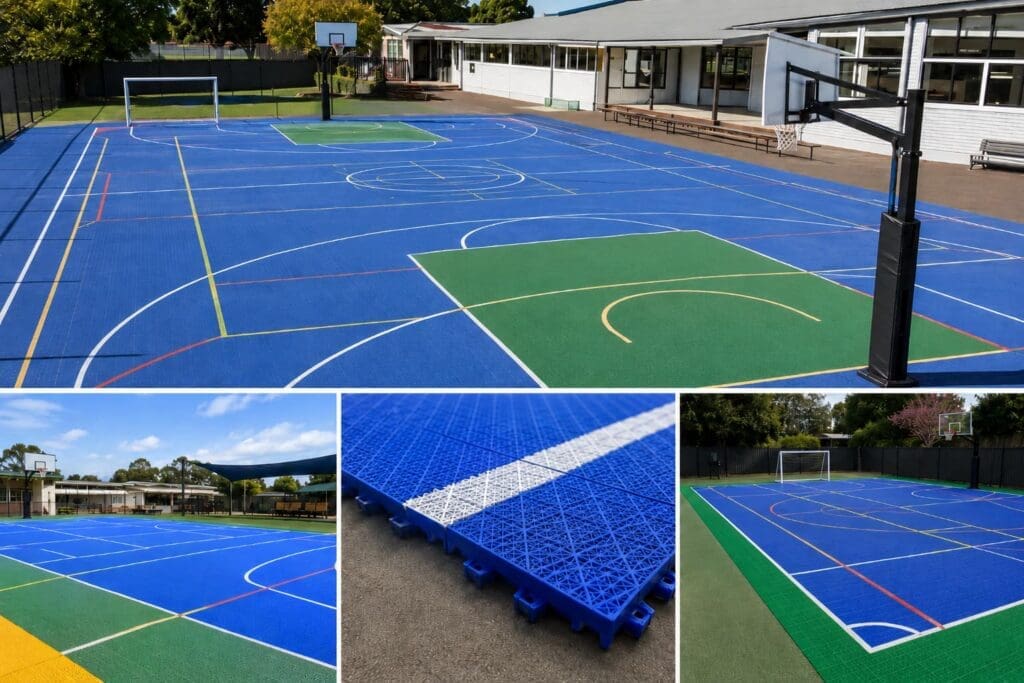
Schools are under increasing pressure to provide better sport and PE spaces, but many do not have the budget, land, or time for large construction projects. New concrete slabs, full court builds, drainage works, fencing, lighting, and civil preparation can quickly become expensive and disruptive.
This is where modular sports flooring is changing the way schools think about outdoor and indoor sport areas. Instead of building a completely new facility, schools can often upgrade existing hardstand areas, old asphalt spaces, unused courts, covered areas, halls, or outdoor play zones into practical multi-sport courts.
A well-planned modular court can support pickleball, futsal, basketball, netball, general PE activities, fitness drills, and lunchtime play — all from one flexible surface.
Not every school has the space for separate basketball, netball, futsal, pickleball, and PE areas. A multi-sport court gives schools more value from the same footprint.
One court can be used for:
Pickleball
Futsal
Basketball
Netball
Volleyball
Badminton-style activities
PE games
Fitness circuits
After-school sport
Community hire
This makes the space useful throughout the school day, not just for one sport or one age group.
For primary schools, the focus may be general movement, PE games, and modified sport. For intermediate and secondary schools, the same court can support more structured training, competition, and lunchtime use.
Traditional court construction can involve earthworks, concrete pouring, asphalt preparation, curing time, surfacing, line marking, drainage, and fencing. That can mean weeks of disruption.
Modular sports flooring is different. In many cases, it can be installed over an existing suitable base, such as concrete or asphalt. This reduces the amount of heavy construction required and can make the project faster and more manageable for schools.
The key advantage is that schools can often turn an underused space into a sports court without starting from scratch.
Suitable areas may include:
Old tennis courts
Unused asphalt areas
Covered outdoor learning areas
Existing basketball courts
Concrete play areas
Indoor halls
Outdoor hardstand zones
The base still matters. A stable, level surface is important for performance, safety, and long-term use. But compared with a full new build, modular flooring can make the upgrade process much simpler.
Pickleball is one of the easiest sports to add to a school court because it uses a smaller playing area than tennis and is accessible for a wide range of ages and abilities.
For schools, pickleball works well because it is:
Easy to learn
Lower impact than many court sports
Suitable for mixed ability groups
Good for PE lessons
Fun for lunchtime activity
Space-efficient
A single larger court space can often be marked for multiple pickleball courts, allowing more students to play at once. This is especially useful for schools that want high participation without needing a large footprint.
Pickleball also works well alongside basketball, futsal, and netball line marking, as long as the layout is planned properly from the start.
Futsal is another strong option for schools because it suits smaller spaces and encourages fast movement, ball control, teamwork, and decision-making.
A modular court surface can provide a consistent playing area for futsal during PE classes, lunchtime games, and after-school training. It can also be used as a shared court with basketball and netball markings.
For schools with limited field space, futsal gives students a football-style option even when grass fields are wet, closed, or unavailable.
Basketball and netball are already core sports in many New Zealand schools. A multi-sport modular court can be marked to support both, helping schools get better use from one area.
Instead of having a court that only supports one game, schools can design the layout to include:
Basketball key and three-point lines
Netball thirds and shooting circles
Shared centre lines
Modified junior court markings
Training zones
This flexibility is especially useful for schools where different year groups need different court sizes.
A multi-sport court is not just for organised sport. It can also become a daily PE and movement space.
Teachers can use the area for:
Warm-ups
Agility drills
Relay activities
Small-sided games
Balance and coordination work
Fitness circuits
Skill stations
House competitions
Lunchtime sport
Because the surface is consistent and clearly marked, teachers can run activities with less setup time. Students can move between sports and drills more easily, and the space becomes more useful across the whole school.
Many schools already have older courts that are cracked, faded, slippery, or no longer attractive for students to use. In some cases, the base may still be suitable, but the top surface needs improvement.
Modular sports tiles can help refresh the look and function of these areas. They can create a cleaner, brighter, more modern court surface while allowing schools to add updated line markings and multi-sport layouts.
Colour can also be used to make the court easier to understand. For example, different zones can help separate playing areas, safety run-offs, and sport-specific sections.
The most important part of a school multi-sport court is planning the layout properly before installation.
Schools should consider:
Which sports will be used most often
Which age groups will use the court
Whether the court is for PE, competition, or general play
How many students need to use the space at once
Whether the area needs fencing
Whether hoops, goals, or net systems are required
How line markings will overlap
Whether the court will be used after hours
A good layout should avoid making the court too confusing. Too many lines can make the surface hard to use, so the most important sports should be prioritised.
For many schools, a practical mix may include basketball, netball, futsal, and pickleball, with simple supporting lines for PE activities.
Modular flooring can be used in different school settings depending on the product type and base surface.
Outdoor modular tiles are commonly used for courts, playground sport areas, and covered outdoor spaces. They are designed to allow drainage and provide a durable sports surface.
Indoor sports flooring may be better suited for halls, gym spaces, fitness zones, and covered training areas where weather is not an issue.
For schools, the best option depends on the location, expected use, budget, and existing base.
One of the biggest advantages of a multi-sport court is participation. A single-purpose court may only suit one group of students. A multi-sport court can serve many groups across the week.
This means better value for the school and more opportunities for students to be active.
A modular multi-sport court can support:
PE classes during the day
Lunchtime games
School teams
After-school programmes
Holiday programmes
Community use
Club training
Fundraising or hire opportunities
For schools looking to improve facilities without taking on a major building project, this is a practical way to get more use from existing space.
Schools do not always need major construction to improve their sport and PE facilities. With the right planning, existing concrete, asphalt, indoor, or covered areas can often be upgraded into flexible multi-sport courts.
Modular sports flooring gives schools a practical way to support pickleball, futsal, basketball, netball, and everyday PE use from one shared space.
For schools wanting more activity, better participation, and stronger use of existing areas, a modular multi-sport court can be one of the most effective upgrades available.


