
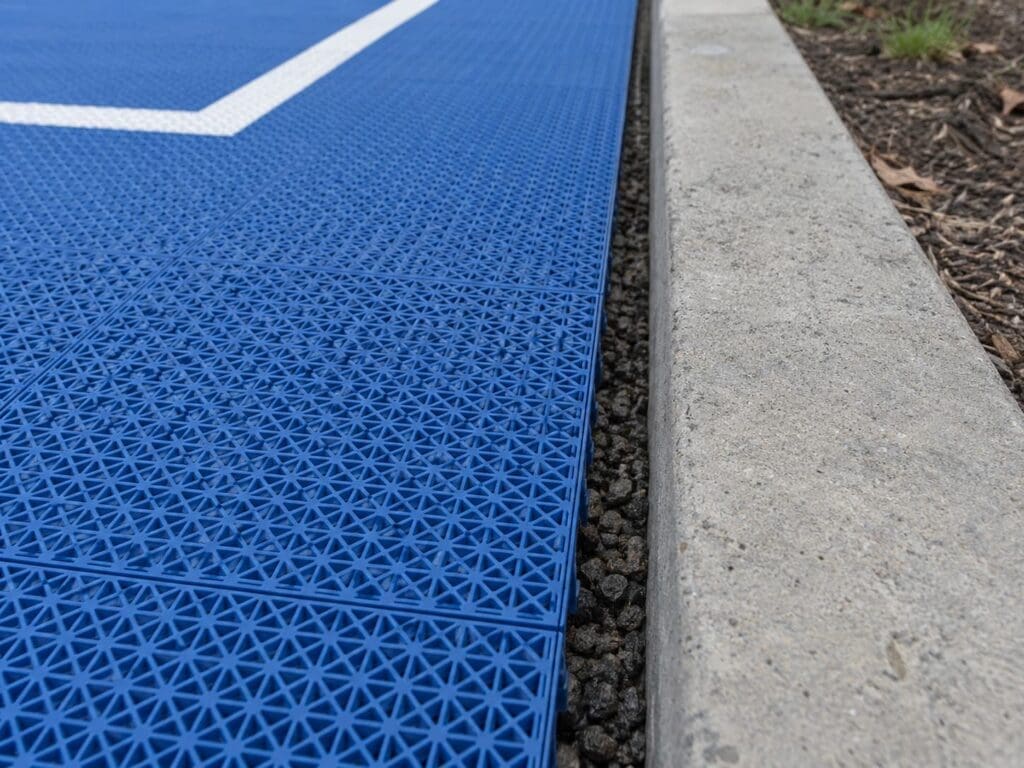
Modular outdoor sports court tiles are designed to create a durable, free-draining and comfortable playing surface over a suitable hard base. However, one of the most important installation details is often overlooked: the expansion gap around the perimeter.
Outdoor tiles expand and contract as temperatures change. Without enough clearance around walls, kerbs, fence posts and other fixed objects, the surface can become restricted. This may cause tiles to lift, buckle, separate or place unnecessary pressure on the interlocking joints.
Most modular sports tiles are manufactured from polypropylene or a similar flexible plastic material. These materials naturally move when exposed to changes in temperature.
A court surface installed on a hot summer day may be larger than the same surface during cooler weather. Direct sunlight can also heat the tiles well above the surrounding air temperature.
Because the tiles are normally installed as a floating system, they need room to move independently from the concrete or asphalt base underneath.
The tiles should not be tightly fitted between fixed boundaries.
As a general guide, allow a minimum expansion gap of approximately:
The correct gap can vary depending on:
Dark-coloured tiles may absorb more heat than lighter colours, which can increase thermal movement.
The supplier’s installation instructions should always take priority where a product-specific expansion allowance is provided.
Expansion clearance should be maintained around all fixed objects, including:
Tiles should be carefully cut around these objects while still maintaining sufficient movement clearance.
Where the tiles finish at an open edge, matching ramped edge tiles can normally be installed.
These edge pieces:
Ramped edging should not restrict the ability of the main court surface to expand.
Where the court finishes against a concrete kerb or perimeter upstand, the tiles should not be installed tightly against the concrete.
A suitable detail normally includes:
Any trim used over the gap should allow the tiles to slide underneath it. It must not clamp the tiles firmly to the base.
When tiles finish against a building wall, leave the required clearance between the final tile row and the wall.
The gap can sometimes be concealed using a removable flashing or trim. However, the trim should be fixed to the wall or surrounding structure rather than through the floating tile surface.
Avoid filling the gap with:
These materials may prevent the court surface from moving correctly.
Fence posts, basketball systems and other equipment can create local pressure points if the tiles are cut too tightly.
Each opening should be cut slightly larger than the fixed object so the tiles can expand without binding.
The tile surface should not be used to support or stabilise permanent sports equipment. Equipment should be independently fixed into the structural base below.
In most installations, modular court tiles are installed as a floating interlocking system.
This means they sit over the prepared concrete or asphalt base without being glued across the entire surface.
The tiles should generally not be:
Some court layouts may include manufacturer-approved anchor points, transition strips or central fixing details. These should only be used where specifically recommended for the chosen tile system.
Outdoor modular tiles are designed to allow water to pass through the surface and drain across the base below.
The perimeter detail should not block this drainage path.
The base should have:
A blocked perimeter can cause water, dirt and organic material to collect under the court.
Insufficient clearance can lead to:
These problems may not appear immediately. The court may look correct after installation but begin moving once temperatures rise.
Yes. The expansion gap can often be concealed without restricting the tiles.
Possible options include:
The key requirement is that the court surface must still be free to move underneath or beside the trim.
An expansion gap will not correct problems caused by a poor base.
Before installing modular court tiles, check that the substrate is:
Concrete is generally the preferred substrate. Suitable asphalt may also be acceptable, depending on the system.
Compacted gravel, loose aggregate or unstable paving is normally unsuitable because movement underneath the tiles can affect ball bounce and joint alignment.
Common mistakes include:
These issues can usually be avoided by planning the perimeter details before the tiles arrive.
A standard perimeter arrangement will generally include:
The expansion gap is a small detail that has a major effect on the long-term performance of a modular sports court.
As a general rule, allow at least 25 mm around the perimeter and consider increasing this to 30–40 mm for larger courts or areas exposed to strong sunlight and temperature changes.
Always confirm the final requirement against the selected tile supplier’s installation instructions, particularly for full-size tennis courts, basketball courts, pickleball courts and multi-sport facilities.
A properly planned perimeter allows the tiles to move, drain and perform as intended while reducing the risk of lifting, buckling and damaged connections.


