
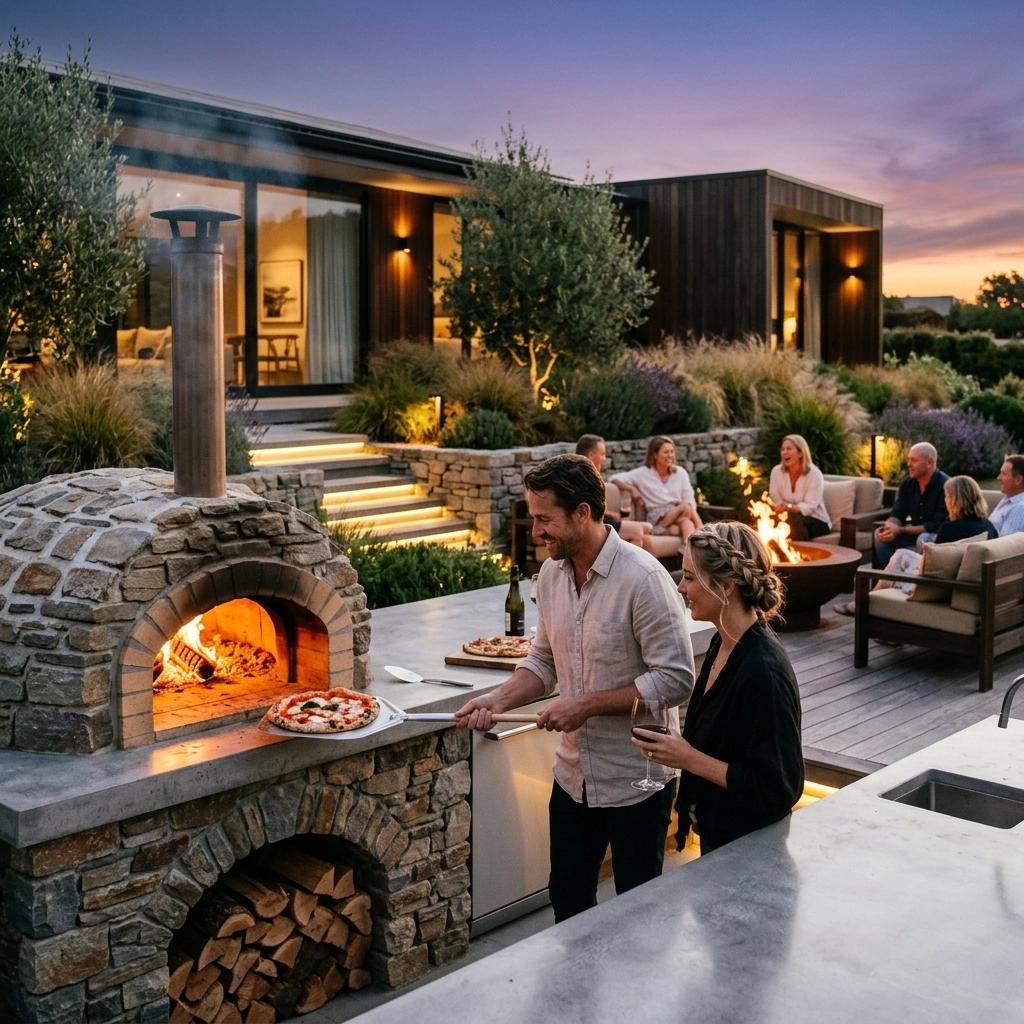
For decades, the gold standard of premium landscape design was the "postcard garden." It was a space designed primarily for the eyes: perfectly manicured lawns, static water features, and ornamental plantings that were meant to be admired from behind a glass sliding door. The outdoor space was a vista, a silent backdrop to the life happening inside the home.
Today, that paradigm has shifted. We are witnessing a move away from passive observation toward active participation. The modern homeowner no longer wants a garden they can just look at; they want a landscape they can experience. At the heart of this evolution are two ancient elements reinvented for the contemporary era: wood fired pizza ovens and outdoor fires.
This transition from "viewing" to "doing" is more than a design trend; it is a fundamental change in how we perceive the boundaries of our homes and how we foster human connection.
The shift toward experiential design is driven by a desire for sensory engagement. While a beautiful view is visually stimulating, an active outdoor zone engages the sense of smell, touch, and taste.
When you incorporate wood fired pizza ovens into a terrace or patio, you aren't just adding an appliance; you are adding a ritual. The process of curing the wood, managing the flame, and watching dough rise in seconds under intense heat is a performance. It transforms the host from a service provider into a curator of an experience.
Similarly, outdoor fires have evolved from decorative gas strips into rugged, architectural statements that invite people to gather, stoke the embers, and linger long after the sun has set. These elements create a "gravitational pull" that draws people out of the climate-controlled indoors and into the fresh air.

In the past, outdoor kitchens or fire pits were often treated as afterthoughts: bolted onto the edge of a deck or placed in a far corner of the yard. In the modern "doing" landscape, these features are the primary anchors of the architectural plan.
Modern designers are now applying indoor kitchen logic to the outdoors. The placement of a pizza oven dictates the flow of the entire space. You need:
By designing with these functional requirements in mind, the landscape becomes a high-performance machine for entertaining. The layout and flow of these spaces are now just as critical as the choice of plants.
If the pizza oven is the heart of the "doing" kitchen, the outdoor fire is the heart of the "doing" lounge. The shift here is away from the "look-but-don't-touch" fireplace and toward open, interactive fire zones.

Outdoor fires act as a natural social catalyst. There is a primal comfort in gathering around a real flame that a television or a formal dining room cannot replicate. Design is responding to this by creating "sunken" fire pits or tiered seating areas that prioritize the fire as the central point of interaction.
The focus is on:

For a landscape to truly succeed as a "doing" space, the transitions between different activities must be seamless. This is where the marriage of structure and function becomes vital.
While the oven and the fire provide the "why" for being outside, the surrounding environment provides the "how." Designers are increasingly using architectural elements to define these zones without closing them off.
For instance, a retractable roof system might cover the cooking area to ensure the pizza party happens regardless of a light drizzle, while the fire zone remains open to the stars. This zoning ensures that the "doing" isn't limited by the weather or the time of day.

The appeal of a "doing" landscape is not about output. It is about atmosphere, rhythm, and the way certain spaces invite people to settle in and stay longer.
A wood-fired pizza oven changes the pace of an evening. People gather earlier. Conversations start around the prep bench. Someone tends the fire, someone shapes dough, someone watches the first blistered crust come out of the oven. The space becomes active in a relaxed, natural way.
An outdoor fire does something similar once the cooking slows down. It gives the night a second act. Chairs turn toward the flame. The mood softens. The experience becomes less about hosting and more about sharing time outdoors without needing an agenda.
When planning a space centered around "doing," the choice of materials becomes paramount. These areas are subjected to high heat, frequent use, and the elements.
✔ Heat-Resistant Surfaces: Natural stones like granite or high-grade concrete that can handle the thermal shock of a nearby oven.
✔ Robust Hardware: Stainless steel and powder-coated aluminums that resist corrosion, especially in coastal environments.
✔ Functional Lighting: Task lighting over the pizza prep area and ambient, low-level lighting around the fire pit to ensure safety without killing the mood.
The goal is to create a space that feels like it belongs in the landscape, not like a kitchen that was accidentally left outside. This requires a balance of raw, organic materials and clean, architectural lines.

As we look toward the future of residential design, the trend is clear: the garden is no longer a museum. It is a workshop, a kitchen, a lounge, and a sanctuary. By shifting the focus from viewing to doing, we are reclaiming our outdoor spaces and making them a central part of our daily lives.
Whether it’s the smell of a sourdough crust crisping at 400 degrees or the quiet crackle of a log turning to ash in a fire pit, these experiences are what turn a house into a home. They invite us to slow down, participate, and enjoy the environment we have worked so hard to create.


