
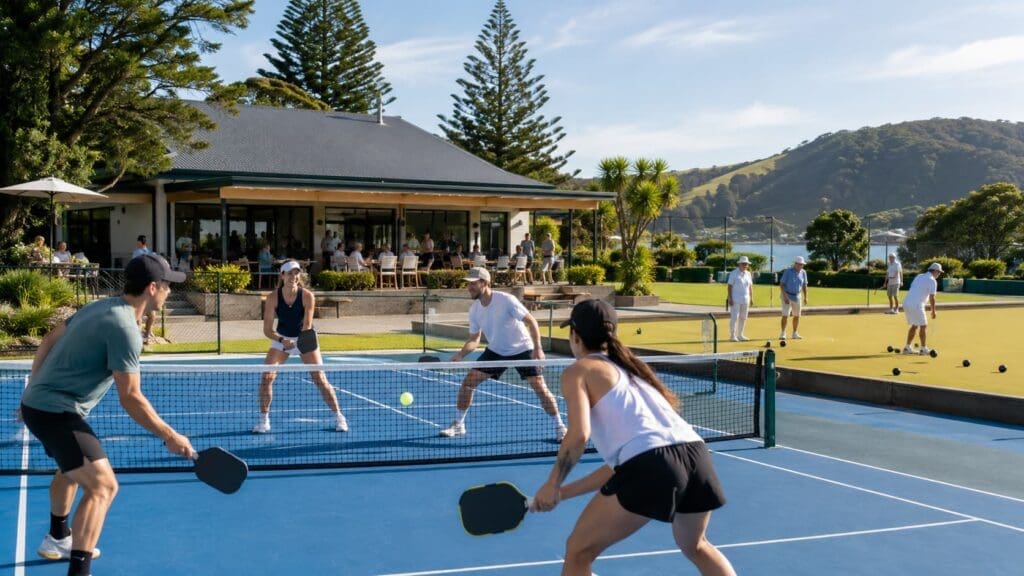
Bowls clubs have always been important community spaces. They offer sport, social connection, competition, clubrooms, hospitality and a strong local identity. But many clubs are now facing the same challenge: how do you bring in younger members without losing the character of the club?
One of the best answers is pickleball.
Pickleball is social, easy to learn, affordable to play and suitable for a wide range of ages. It does not require the same physical commitment as tennis, but it still offers fast rallies, fun competition and a strong social atmosphere. For bowls clubs, this creates a major opportunity.
Instead of seeing pickleball as a replacement for bowls, clubs should see it as an extra participation stream. It can help bring new people through the doors, increase bar and food revenue, activate quiet times, and introduce younger families and working-age adults to the club.
Bowls clubs already have many of the things pickleball players need: open space, clubrooms, parking, seating, lighting potential, toilets, social areas and a community-focused environment.
Many clubs also have underused outdoor areas, spare green space, older hardstand zones, carpark edges, unused tennis areas or room beside existing facilities. These areas can be turned into pickleball courts without the club needing to build a full new sports complex.
Pickleball works because it is easy for beginners to enjoy quickly. A new player can pick up a paddle and have a fun rally within minutes. That makes it perfect for social nights, corporate events, open days, casual memberships and family sessions.
For bowls clubs looking to attract younger people, the key is not just adding a court. It is creating a new reason for people to visit the club.
Many younger adults are not looking for traditional club membership in the old style. They want flexibility, social connection, casual sport, food, drinks, events and an easy way to join in.
Pickleball fits that perfectly.
A bowls club can create:
This gives younger members a soft entry into the club. They may arrive for pickleball first, then stay for food, drinks, events, bowls, memberships and social functions.
That is where the real value sits.
One of the biggest advantages for bowls clubs is scheduling. Pickleball can be used at times when the club is normally quieter.
For example:
This creates more activity without interfering with core bowls programmes.
A club does not need to change its identity. It can simply add a new sport that brings in a different audience.
Some bowls members may worry that pickleball means losing the traditional focus of the club. That does not need to happen.
The strongest approach is to position pickleball as a support for the club, not a replacement for bowls.
Pickleball can help:
In many cases, the future of clubs will come from becoming multi-use community venues. Bowls remains the foundation, while pickleball adds energy, flexibility and new revenue.
There are several ways a bowls club can add pickleball, depending on the available space, budget and long-term plans.
Roll-out pickleball mats are a strong option for clubs that want a faster, lower-disruption setup. These systems can be used for temporary, semi-permanent or event-based courts.
They are ideal for clubs wanting to test demand before committing to a full permanent surface. A club could run open days, trial leagues or weekend sessions to see how many players are interested.
Roll-out mats are especially useful where a club wants flexibility. They can be installed over suitable hard surfaces and provide a clear pickleball playing area without major construction.
Interlocking sports tiles are another practical option. These are popular because they are fast to install, drain well, provide a clean sports finish and can be used for multi-sport layouts.
For bowls clubs, modular tiles can be used to create dedicated pickleball courts or multi-use areas that can support pickleball, futsal, basketball, netball and general community activity.
This is a strong long-term option for clubs that want to create a permanent outdoor sports zone.
Acrylic surfacing gives a more traditional hard-court finish. This can be a good choice where the club has an existing concrete or asphalt base and wants a more permanent court installation.
However, it generally requires more preparation and is less flexible than modular or roll-out options.
A bowls club does not need to think only in terms of one sport. A well-planned court area can include pickleball lines while also supporting other community uses.
This opens the door to:
The more uses a space has, the easier it is to justify the investment.
Pickleball can create direct and indirect income for bowls clubs.
Direct income may come from:
Indirect income can be just as valuable:
For many clubs, the biggest benefit is not just the court hire. It is the extra life that pickleball brings into the venue.
A quiet clubroom becomes active. A spare outdoor area becomes useful. A club known mainly by older members starts to look more open, modern and community-focused.
Another reason pickleball suits bowls clubs is that it is highly marketable.
It photographs well. It is colourful. It looks fun. It is easy to explain. It works for short-form social media content. It gives clubs a reason to post online, invite locals, run events and reconnect with the wider community.
Simple marketing ideas include:
These types of events are low-pressure and easy for new people to join.
That matters because many younger members will not walk into a traditional club environment unless there is a simple reason to do so.
Pickleball gives them that reason.
Bowls clubs do not need to make a huge investment on day one.
A smart approach is:
This allows the club to test the opportunity before committing to a major build.
For many clubs, one or two courts can be enough to start. Once players begin turning up regularly, the club can consider more courts, lighting, seating, shade, fencing, windscreens or weather protection.
Before adding pickleball, bowls clubs should think through:
The best results come when the court area feels connected to the clubrooms. Players should be able to finish a game and naturally move into the bar, café, seating area or social space.
That connection is where the commercial value grows.
Bowls clubs have strong foundations: land, community history, facilities, volunteers and social connection. Pickleball adds a new layer.
It can bring younger adults, families, corporate groups, casual players and new members into the club environment.
It can create revenue without removing the club’s core identity.
It can turn underused space into active space.
Most importantly, it gives bowls clubs a way to stay relevant to the next generation.
The future of bowls clubs may not be bowls alone. It may be bowls plus social sport, events, hospitality and flexible community use.
Pickleball is one of the easiest ways to start that shift.
For bowls clubs looking to attract younger members, pickleball is not just another sports trend. It is a practical club growth strategy.
It is affordable to start, easy to promote, simple for beginners and highly social. With the right court surface and a strong event programme, bowls clubs can use pickleball to create new income, new energy and a stronger future.
Rather than waiting for younger members to discover the club, pickleball gives them a reason to walk through the gate.


