
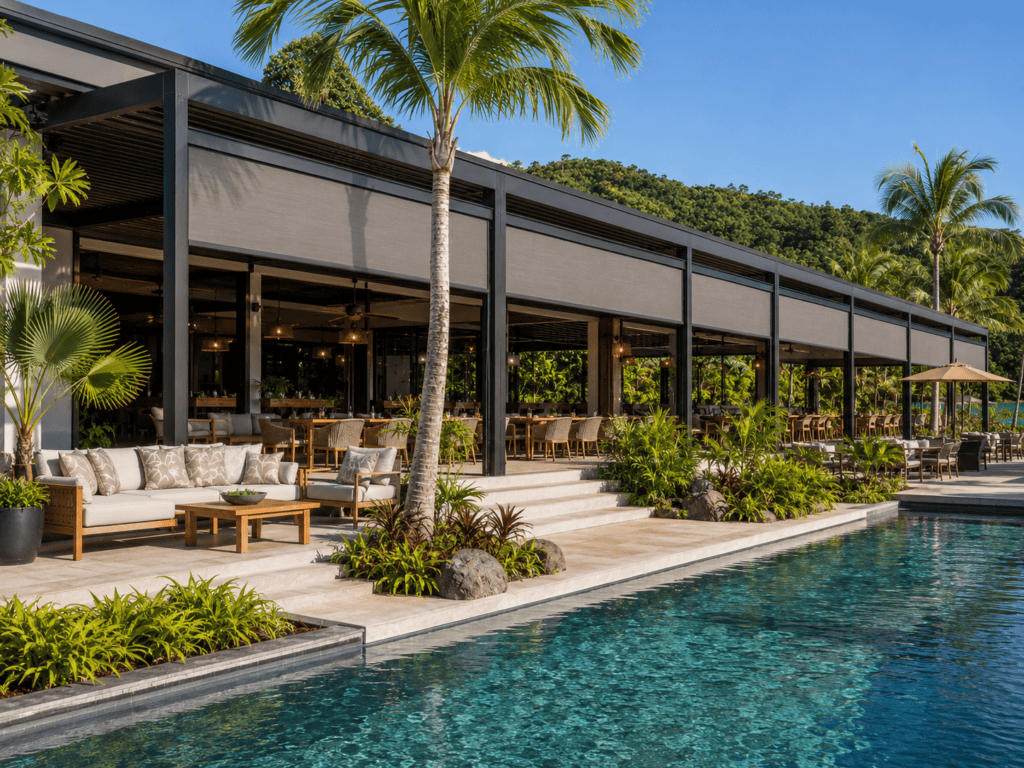
Resorts often add pergolas and outdoor blinds gradually. One villa receives a motorised louvre roof, another gets a fixed canopy, and a third has blinds supplied several years later by a different contractor.
Although this approach can solve immediate problems, it can create long-term issues with appearance, spare parts, maintenance, staff training and future expansion.
Standardising outdoor structures across multiple villas gives resort operators a clear system for specifying, purchasing, installing and maintaining pergolas and outdoor blinds throughout the property.
A resort may have dozens of villas with slightly different layouts, orientations and guest requirements. The structures do not necessarily need to be identical, but they should follow the same core design and specification.
A standardised system can provide:
This is particularly valuable for resorts that are being developed in stages or planning to refurbish villas over several years.
The first step is to establish a written outdoor structure standard for the property.
This document should define the preferred:
The standard can then be issued to architects, contractors, resort managers and purchasing teams whenever new villas are constructed or existing villas are refurbished.
Not every villa will have exactly the same outdoor space. However, most resort projects can be covered by two or three standard pergola configurations.
A standard villa pergola may suit smaller patios, private decks and accommodation units with similar layouts.
A typical specification could include:
Premium villas, beachfront rooms and larger suites may require a larger structure with additional features.
These may include:
The premium configuration can retain the same frame colour, controls, blind fabric and general design language as the standard villas.
Restaurants, pool areas and common spaces may require larger spans or more complex layouts.
These structures can still use the same:
This creates a consistent resort-wide appearance without forcing every structure to be the same size.
Using one primary frame colour is one of the easiest ways to create visual consistency.
Black, white and grey are practical options because they can work with a wide range of exterior finishes, roofing materials and landscaping styles.
A resort may choose:
Restricting the number of colours also makes touch-up work, replacement parts and future extensions easier to manage.
Custom colours can still be used where required, but they should be recorded using the exact powder-coat reference rather than a general description such as “dark grey”.
Outdoor blinds are often added after the pergola has been installed. Planning them from the beginning usually produces a cleaner and more reliable result.
A resort-wide blind specification should identify:
For exposed resort locations, mesh fabrics are generally more suitable than solid PVC because air can pass through the material, reducing the pressure applied to the blind.
PVC may be appropriate for sheltered restaurants, bars and protected communal areas where stronger rain protection or visibility is required.
Outdoor mesh fabrics are available in different openness levels. This affects visibility, airflow, privacy, glare and solar control.
A more open fabric provides:
It may be suitable for villas where the blind is mainly used for sun and glare control.
A tighter mesh provides:
It may suit villas positioned close together or outdoor spaces exposed to strong afternoon sun.
Rather than selecting different fabrics for every villa, resorts can approve two standard options, such as a general-purpose mesh and a privacy-focused mesh.
Guests should not need different instructions in every villa.
Using the same motor and control system throughout the resort allows staff to provide consistent operating information and simplifies troubleshooting.
Possible control options include:
Controls should be clearly labelled, and guest instructions should explain when blinds must be retracted.
Outdoor blinds should generally be raised during severe weather, even when wind sensors or automatic controls are installed.
Motorised pergolas, lighting and blinds require power in the correct locations.
Electrical requirements should be included in the villa construction or refurbishment drawings rather than added after the exterior finishes are complete.
The standard electrical plan should show:
The electrical contractor should also confirm the appropriate requirements for the local environment, including coastal conditions and outdoor protection ratings.
Drainage should be treated as part of the building design.
For opening louvre roofs, rainwater is normally collected within the perimeter gutters and directed into nominated posts. From there, it travels down through the post drainage system.
The project team should determine whether the water will:
Using the same drainage detail across the resort helps prevent contractors from creating different solutions at each villa.
A resort-standard installation package can include:
These drawings can then be adjusted for each villa rather than redrawn from the beginning.
Site-specific engineering, wind loading and structural checks may still be required, particularly in cyclone-prone or exposed coastal locations.
Standardisation does not mean ignoring the differences between villas.
Before manufacture, each location should still be checked for:
A standard system provides the starting point, while the final measurements ensure the pergola fits the individual villa.
Resorts in New Zealand, Fiji, Samoa and other Pacific locations may be exposed to salt air, strong sunlight, heavy rain, humidity and high winds.
Specifications should consider:
Regular rinsing and cleaning may also be required in coastal environments to reduce the build-up of salt and airborne contaminants.
A standardised resort system makes it practical to keep a small number of commonly used components on site.
These may include:
Resort maintenance staff should also have access to product manuals, wiring information and supplier contact details.
Each pergola and blind installation should be recorded in the resort’s asset-management system.
The record can include:
This information becomes increasingly valuable as the resort expands or the original project team changes.
Many resorts cannot upgrade every villa at once.
A staged programme may involve:
A pilot installation can identify issues with dimensions, operation, drainage, furniture placement and guest instructions before the system is rolled out across the property.
For island resort projects, shipping can represent a significant part of the total project cost.
Standard sizes and repeated components can help improve packing and container planning.
The purchasing team may be able to combine:
Accurate staging is important so that components for each villa are clearly identified and can be located easily after arrival.
Before ordering, the resort should confirm responsibility for:
A supply-only pergola package still requires suitable local contractors to complete the structural, electrical and drainage work.
Clearly defining these responsibilities reduces the risk of gaps between the supplier, builder, installer and resort team.
Before rolling out pergolas and outdoor blinds across multiple villas, confirm:
Standardising pergolas and outdoor blinds allows resorts to create a consistent guest experience while reducing the complexity of purchasing, installation and maintenance.
The best approach is usually not to force one identical structure onto every villa. Instead, the resort can establish a small family of approved configurations that use the same colours, components, controls, drainage principles and maintenance procedures.
Apollo NZ can assist with supply-only pergola and outdoor blind packages for resorts, hotels, villa developments and accommodation projects throughout New Zealand and the Pacific Islands.
Projects can be developed around standard villa sizes, premium accommodation areas and larger shared hospitality spaces, with made-to-measure options available where required.


