
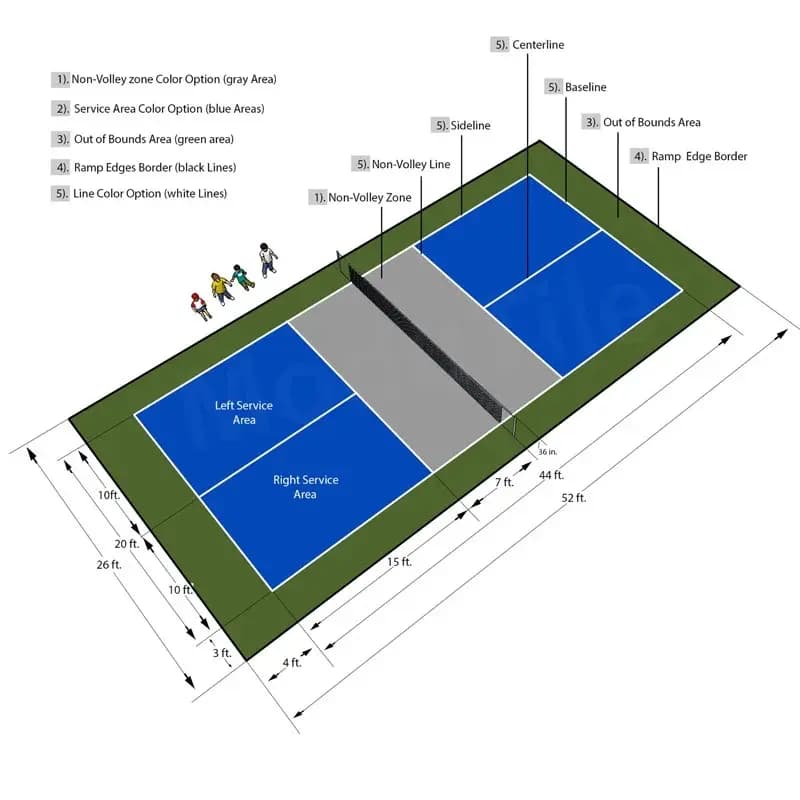
In the realm of athletic infrastructure, the transition from static, permanent installations to high-performance modular systems represents a significant shift in material engineering. Specifically, within the rapidly expanding discipline of pickleball, the requirements for surface performance have evolved beyond the capabilities of traditional poured acrylic or standard concrete.
The engineering behind professional roll-out sports flooring is not merely a matter of convenience; it is a sophisticated application of point-elasticity, multi-layer polymer chemistry, and mechanical stability. This article examines the structural anatomy of these surfaces, the physics of ball-to-surface interaction, and the technical advantages of roll-out deployment over conventional curing methods.
A professional-grade sports roll is a composite structure, typically ranging from 4.5mm to 8.0mm in thickness. Unlike a single-material substrate, these rolls are engineered through a lamination process that bonds distinct functional layers, each serving a specific mechanical purpose.
The uppermost layer is a high-density PVC (polyvinyl chloride) or polyurethane-treated skin. This layer is engineered for two primary variables: durability and coefficient of friction.
The most common failure point in inferior roll-out flooring is "creeping" or dimensional distortion: where the floor expands or ripples due to temperature fluctuations or heavy foot traffic.
To mitigate this, high-performance rolls incorporate a double-layered fiberglass mesh. This non-woven grid acts as the structural skeleton of the roll. By sandwiching the mesh between polymer layers, engineers achieve a high level of dimensional stability. This ensures that once the floor is deployed and seamed, it remains perfectly flat, regardless of the thermal expansion and contraction cycles of the building.
The base of the roll is where the "elasticity" in modular elasticity truly resides. This layer consists of a high-density, closed-cell foam backing.
For a surface to be considered "professional," it must meet stringent criteria for ball bounce consistency. In sports like pickleball, where the ball is a low-mass, perforated plastic orb, the surface density plays a disproportionate role in the game’s mechanics.
Traditional timber gym floors are area-elastic; the impact energy is dispersed across a wide area of the subfloor. In contrast, roll-out synthetic surfaces are point-elastic.
In a point-elastic system, the deformation happens almost exclusively at the point of impact. For the athlete, this means uniform feel across the entire court. For the ball, it means the rebound is predictable regardless of whether it lands in the center of a "bay" or directly over a structural joist. Engineers measure this using the Vertical Deformation metric, ensuring the surface yields enough for safety but remains stiff enough for a true ball response.
The challenge in engineering these rolls is balancing the softness required for player safety with the hardness required for a consistent pickleball bounce. If the foam is too thick or too soft, the ball "dies" on the surface. Technical specifications for these surfaces often target a ball rebound percentage of >90% compared to a concrete baseline. This is achieved by tuning the density of the PVC wear layer to provide a hard strike-point while the foam layers handle the heavier load of the human body.
The adoption of modular roll-out systems is driven largely by the limitations of traditional acrylic coatings. For facility managers and architects, the "time-to-play" is a critical engineering metric.
Traditional hard-court surfaces involve a multi-stage application of acrylic resins over a concrete or asphalt base. This process is subject to:
Roll-out sports flooring is a "floating" system. It is not chemically bonded to the entire substrate, which allows it to bridge minor cracks in the subfloor without compromising the playing surface.
For those looking to understand the technical integration of these systems within a larger facility plan, focus on reviewing specification frameworks that compare thickness classes, density ratings, seam methods, and subfloor tolerances used in professional applications.
The material science of these surfaces also dictates their maintenance protocol. Unlike porous surfaces, high-density PVC is non-absorbent. This prevents the buildup of bacteria and moisture within the core of the material.
The shift toward modular, multi-layer roll-out flooring is a response to the need for precision, safety, and efficiency in modern sports design. By leveraging advanced polymer chemistry and multi-axial stabilization, these surfaces provide a consistent, high-performance environment that traditional materials cannot replicate.
Key Takeaways for Facility Design:
By focusing on the material science behind the surface, developers can ensure that their athletic facilities are not only aesthetically modern but also structurally superior and safer for the athletes who use them.


