
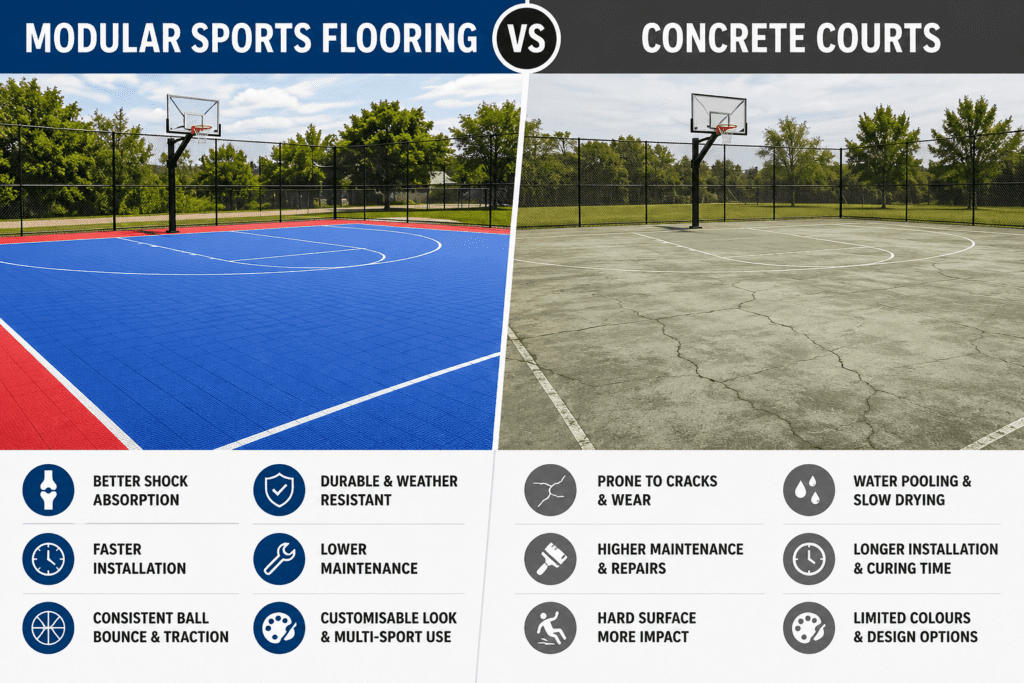
When planning a sports court, one of the most important decisions is choosing the playing surface. While traditional concrete courts have been the standard for decades, modern modular sports flooring systems are rapidly becoming the preferred choice for schools, sports clubs, community facilities, and residential courts.
Both options have advantages, but the right choice depends on your budget, performance expectations, maintenance requirements, and long-term goals.
Concrete courts consist of a poured concrete slab, often finished with paint or acrylic coatings. They provide a hard, durable surface suitable for a range of sports.
Common applications include:
Modular sports flooring uses interlocking tiles installed over a suitable base. These systems are designed specifically for sports performance and athlete comfort.
Common applications include:
One of the biggest differences between the two surfaces is impact absorption.
Concrete offers virtually no shock absorption. Every jump, sprint, and landing transfers force directly back through an athlete's feet, knees, hips, and lower back.
Potential drawbacks include:
Modern modular sports tiles are designed with cushioning structures underneath the playing surface.
Benefits include:
For schools and community facilities where players of varying ages use the court, this can be a significant advantage.
Concrete provides a predictable bounce but can become uneven as cracks develop.
Modular flooring is engineered to provide consistent ball response while maintaining athlete comfort.
Concrete coatings can become slippery when wet and may wear over time.
Quality modular flooring systems offer:
Concrete is durable but can develop:
Freeze-thaw cycles and ground movement can accelerate deterioration.
Outdoor modular systems are designed with:
Many systems allow rainwater to pass through the surface rather than pooling on top.
This often results in courts drying faster after rainfall.
A concrete court typically requires:
The complete process can take several weeks depending on weather conditions.
Modular systems are significantly faster to install.
Typical process:
Many courts can be completed in a matter of days rather than weeks.
Over time, concrete courts often require:
Maintenance is generally simpler:
Instead of repairing large sections, individual modules can often be swapped out.
Concrete is often perceived as the lower-cost option initially.
However, that comparison can be misleading because many sports facilities eventually add:
Modular flooring may have a higher upfront investment but often delivers savings through:
When considering the full lifecycle of the court, the cost difference can narrow considerably.
Concrete surfaces can support multiple sports, but changing layouts or creating specialist areas often requires repainting.
Many modular systems are specifically designed for multi-sport use.
Benefits include:
This makes them particularly attractive for schools and community facilities.
Options are generally limited to paint colours and line markings.
Modern sports flooring can offer:
This creates a more professional and visually appealing facility.
Modular flooring systems can offer sustainability advantages including:
Concrete production remains one of the larger contributors to construction-related carbon emissions worldwide.
✓ Lowest upfront cost is the primary goal
✓ Sports performance is less important
✓ The court is for general recreation only
✓ Long-term comfort is not a major consideration
✓ Player comfort matters
✓ Injury reduction is a priority
✓ The court will see regular use
✓ Faster installation is important
✓ You want a professional sports experience
✓ Lower maintenance is preferred
✓ Multi-sport functionality is required
Concrete courts have served sports facilities well for generations, but advances in modular sports flooring technology have changed what is possible for modern courts.
For schools, sports clubs, councils, and homeowners looking to create a safer, more comfortable, and higher-performing playing surface, modular sports flooring often delivers significant advantages over traditional concrete courts.
While concrete remains a viable option for some projects, modular sports flooring provides a future-focused solution that combines performance, durability, aesthetics, and athlete wellbeing in a single system.


