
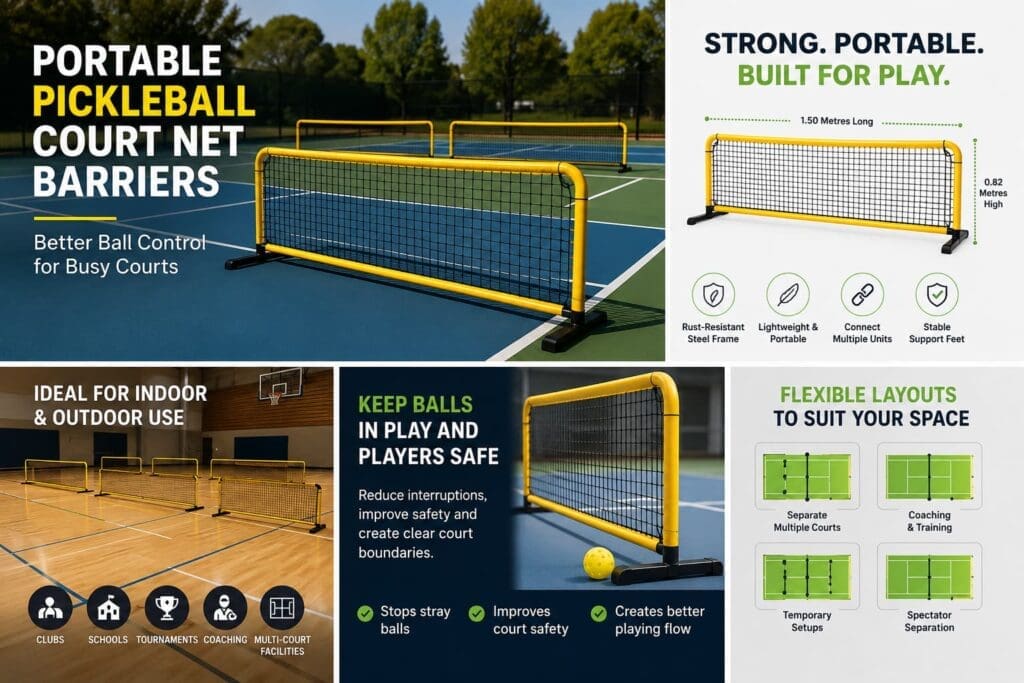
As pickleball facilities become busier, keeping each court organised can be almost as important as choosing the right playing surface. A loose ball rolling from one court into another can interrupt a rally, distract players and create an avoidable trip hazard.
Portable pickleball court net barriers provide a practical way to divide courts, control stray balls and create clearer boundaries without installing permanent fencing.
A pickleball court net barrier is a low, freestanding divider positioned around or between playing areas. Unlike the regulation net across the centre of the court, the barrier is designed to stop or slow balls that have left the active playing area.
The Apollo NZ Pickleball Court Fence Net Barrier combines a steel pipe frame with mesh netting. Each unit measures 1.50 metres long by 0.82 metres high and weighs approximately 3.2 kilograms, making it portable enough for temporary and changing court layouts.
Individual sections can be positioned separately or connected to form longer boundaries.
Pickleball is commonly played in facilities containing several courts positioned close together. During club sessions, coaching programmes and tournaments, balls can regularly travel beyond their intended court.
Without suitable separation, players may have to stop while balls are retrieved from neighbouring courts. More importantly, a ball entering an active playing area can become a safety concern when players are moving quickly or stepping backwards.
USA Pickleball’s court-construction guidance identifies ball containment as an important purpose of court fencing and recommends that fencing be rust-resistant and free from projections that could injure players.
Portable barriers offer another layer of ball control within the wider court area, particularly between adjoining courts.
Permanent fencing is appropriate around the outside of many sports facilities, but it may not provide the internal separation needed between individual courts.
Portable net barriers can be repositioned according to the day’s programme. A sports centre might use them to:
This flexibility is especially useful for schools, community centres and recreation facilities that use the same space for multiple activities.
Not every facility can drill into its playing surface or install permanent posts. Indoor gymnasiums, leased venues, event spaces and shared courts may need equipment that can be removed after each session.
The Apollo NZ barrier uses stable support feet and a lightweight modular frame, allowing it to be positioned without permanent attachment to the court. Its portable design also makes the sections easier to move into storage when the area is required for another sport.
This makes the system suitable for both regular club use and occasional events.
Court equipment needs to be visible enough for players to recognise it while they are concentrating on the ball and their opponents.
The barrier’s yellow frame provides a clearly defined edge, while the mesh panel maintains visibility through and around the divider. This helps create separation without completely closing off the surrounding facility.
Mesh construction can also allow more airflow than a solid panel, which can be beneficial in indoor sports halls and outdoor court environments.
The barrier has a rust-resistant steel frame and is intended for indoor and outdoor applications.
Possible locations include:
For outdoor facilities, barriers should still be positioned and stored appropriately for the site’s wind exposure. Lightweight portable equipment should not be treated as permanent wind fencing.
Portable court dividers and permanent perimeter fencing perform related but different jobs.
Permanent fencing generally surrounds the overall court area and is designed to contain balls that travel farther from play. Official construction guidance recommends taller backstops and sidestops for permanent pickleball court fencing.
A portable 0.82-metre barrier is better suited to internal court separation, controlling low-moving balls and defining temporary boundaries. It should therefore be viewed as a complement to permanent perimeter fencing rather than a direct replacement where full-height containment is required.
Before ordering portable court barriers, consider how the facility normally operates.
Map the areas where balls most frequently pass between courts. Internal sidelines, shared walkways and spaces behind court baselines are common starting points.
Each Apollo NZ section is 1.50 metres long. The modular format allows multiple sections to be used together to suit different court arrangements.
Leave suitable openings for players, coaches and officials. Barriers should guide movement rather than create narrow or obstructed access routes.
Do not position barriers inside the required playing and run-off area. A regulation pickleball court measures 6.10 metres by 13.41 metres, while the recommended total playing surface is larger so players have room beyond the marked lines.
Plan where the units will be stored when not in use. Their portable construction makes them easier to relocate, but a dry and organised storage area will help protect the frames and mesh.
Portable pickleball court net barriers are a relatively simple addition, but they can make a noticeable difference to how a busy facility functions.
By controlling stray balls, defining individual playing zones and allowing layouts to be changed without permanent construction, they support smoother club sessions, coaching programmes and tournaments.
The Apollo NZ Pickleball Court Fence Net Barrier features a durable steel pipe frame, mesh netting, stable feet and modular construction. Units are packaged six per carton, with a minimum order of 12 units, making the system particularly suitable for clubs, schools and multi-court facilities.


