
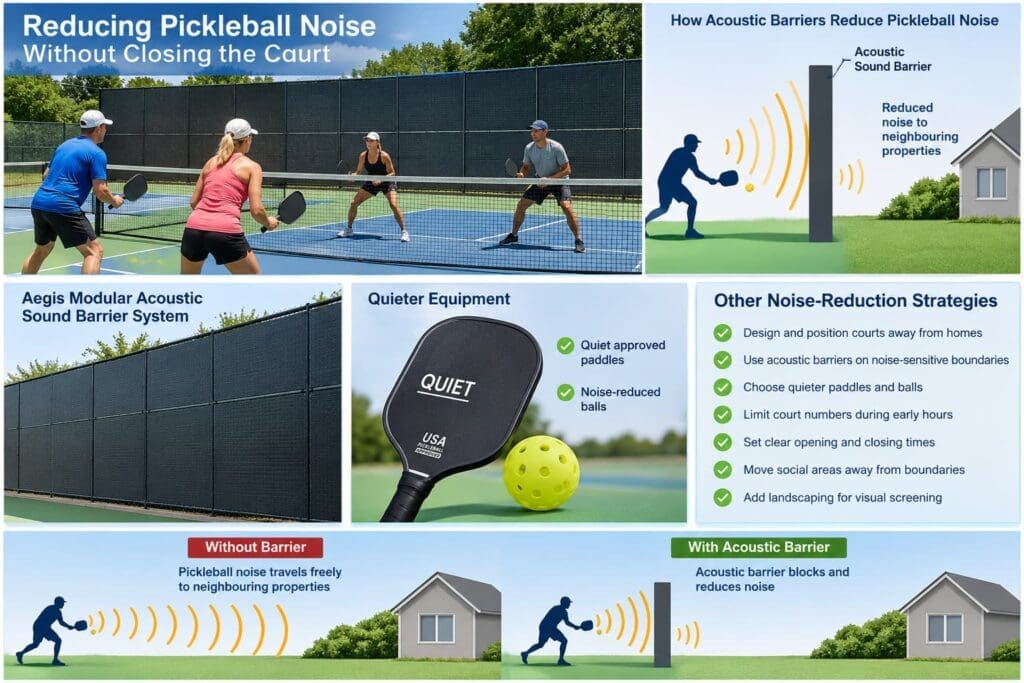
Pickleball courts are becoming increasingly popular at sports clubs, schools, retirement villages, holiday parks and community recreation facilities. They are relatively compact, accessible to a wide range of players and can often be added to existing tennis courts or multi-sport areas.
However, the distinctive sound of a pickleball striking a paddle can create concerns when courts are positioned near homes, accommodation units, offices or other noise-sensitive areas.
The answer does not necessarily need to be reduced playing hours, relocating the court or closing it completely. A combination of acoustic barriers, quieter equipment, intelligent court management and site-specific planning can substantially reduce the impact of pickleball noise while allowing the facility to remain active.
Pickleball noise is different from continuous background sound such as traffic, ventilation equipment or general conversation.
Each paddle strike creates a brief and distinctive impact sound. During a busy doubles match, these impacts may occur repeatedly for long periods. When several courts are operating simultaneously, the number of individual sound events can increase significantly.
The issue is therefore not simply how loud one paddle strike may be. Noise perception can also be influenced by:
Acoustic research increasingly recognises that average decibel readings alone may not fully represent how repetitive pickleball impacts are experienced by nearby residents.
Before purchasing barriers or changing the court layout, it is useful to understand where the sound is travelling.
A basic assessment should consider:
The most important areas are normally the direct paths between the playing surface and nearby noise-sensitive properties.
A barrier is generally most effective when it blocks the direct line of sight between the sound source and the person receiving the sound. If a neighbouring house sits considerably above the court, a standard-height fence-mounted barrier may provide less benefit because the sound can travel over it.
For larger facilities or courts located close to residential boundaries, an assessment by an acoustic consultant may help determine the correct barrier height, position and construction.
One of the most practical ways to manage an existing pickleball court is to install an acoustic barrier along the sides facing neighbouring properties.
A proper acoustic barrier is different from a standard privacy screen or lightweight court windscreen. It should provide sufficient mass, continuous coverage and suitable acoustic performance.
Effective barrier design generally includes:
The barrier needs to interrupt the direct sound path between the court and the neighbouring property.
The required height depends on the court elevation, distance to the receiver and height of surrounding buildings. Recent Canadian guidance recommends barriers of at least three metres above the court surface in certain situations, with the final design based on the site and neighbouring receivers.
Simply increasing barrier height without examining the site is not always the best approach. A properly positioned barrier can sometimes be more effective than a taller barrier installed in the wrong location.
Sound can travel through openings around posts, underneath panels and through gate areas.
Acoustic barriers should be as continuous as practical. Particular attention should be given to:
Even small openings can reduce the performance of an otherwise well-designed barrier.
Thin shade cloth and conventional windscreens may provide visual screening and some wind reduction, but they should not automatically be treated as acoustic barriers.
A noise-control system normally requires a dense construction that restricts direct sound transmission. Depending on the project, this may involve solid modular panels, composite acoustic materials or specialised fence-mounted acoustic products.
A solid reflective barrier may redirect sound away from one property but reflect it towards another part of the court or surrounding area.
Where appropriate, sound-absorbing materials can be incorporated on the court-facing side. This helps reduce reflections and limits the build-up of sound inside a partially enclosed court.
This is particularly important when barriers are being installed on several sides of the playing area.
The Aegis Modular Acoustic Sound Barrier System can be considered for pickleball and tennis facilities where standard fencing does not provide adequate noise control.
A modular system allows the barrier configuration to be adapted to the court rather than treating every project as identical.
Potential applications include:
A modular barrier can be positioned along the most noise-sensitive boundaries while maintaining suitable court access, airflow and visibility where required.
The final panel arrangement, support structure, wind loading, foundations and acoustic treatment must be determined for the individual site.
Court infrastructure is only one part of the solution. The sound can also be reduced at its source.
Quieter paddles and balls are being developed specifically for residential and community play. USA Pickleball now operates both Quiet Category and Noise-Reduced equipment programmes for products intended to lower acoustic output while retaining suitable playing characteristics.
Facilities can introduce quieter equipment through:
Equipment changes may not resolve every noise issue by themselves, but they can complement a well-designed barrier system.
For community facilities, equipment policies may be easier to implement initially during social play, coaching sessions or off-peak periods rather than competitive tournaments.
When a new facility is being planned, court orientation should be considered before construction begins.
The position of the playing area can influence where the strongest and most frequent sound travels. Where space permits, designers may be able to:
Distance remains an important form of noise control. Even a modest increase in separation can make other measures more effective.
For existing courts, complete reorientation may not be practical. However, changing which areas are used for player waiting, coaching, ball machines and social gathering can still reduce the overall disturbance.
A four-court facility should not be treated as four unrelated individual courts.
When multiple games operate simultaneously, the combined number of paddle impacts can become the main issue. Barrier placement should therefore be considered across the entire facility.
Possible strategies include:
Internal court dividers can improve player safety and ball containment, but they may not replace a properly designed external acoustic barrier.
Noise reduction does not have to mean closing the court. Clear operating controls can provide neighbours with predictable quiet periods while preserving most playing access.
Common measures include:
Operating controls are most effective when they are clearly communicated and consistently applied.
Leaving hours informal can create uncertainty for both players and neighbours. A published schedule allows everyone to understand when the court will be active and when quieter periods will occur.
Trees, hedges and planted screening can make a court more visually attractive and may improve how the development is perceived by neighbouring properties.
However, a narrow row of plants should not be expected to provide the same performance as a purpose-built acoustic barrier.
Landscaping works best as part of a wider solution. It can be used to:
Where space permits, deep and densely planted landscape zones may offer some additional benefit, but they should not be the primary noise-control measure.
A conventional mesh windscreen is useful for reducing wind and improving ball visibility. It does not necessarily have enough mass to block pickleball impact noise.
A barrier suspended above the ground can allow sound to pass directly underneath it.
Depending on the site, a barrier may perform better when it is positioned closer to the sound source or receiver. The location should be selected as part of the acoustic design.
A barrier may block ground-floor receivers while leaving upper-storey windows and balconies exposed.
Surrounding the court with hard, reflective surfaces can create additional echoes and redirect sound. Absorptive treatment may be required.
A single maximum reading does not explain the cumulative effect of several courts operating for multiple hours. The frequency, duration and character of the impacts also matter.
Early consultation and minor changes are normally easier than responding after conflict has developed.
There is rarely one product or policy that solves every pickleball noise issue.
The most effective approach is usually a combination of:
This approach allows facilities to address the actual causes of the problem without immediately sacrificing court availability.
Closing a court may stop the noise, but it also removes a valuable recreation facility from the community.
A better objective is to make the court compatible with its surroundings.
Purpose-built acoustic barriers, quieter playing equipment and practical facility management can help sports clubs, schools, councils, retirement villages and accommodation providers retain their pickleball courts while reducing the effect on nearby properties.
Every site is different. Barrier height, material, placement, structural support and sound absorption should be selected according to the court layout and surrounding environment.
Apollo NZ can assist with modular sports-court barrier options, court surfacing and associated pickleball infrastructure for new and existing facilities.
Complete elimination is unlikely while the court is operating. The practical goal is to reduce the sound reaching nearby properties and make the remaining noise less intrusive.
A standard mesh windscreen may provide limited acoustic benefit, but it is not normally a substitute for a dense, purpose-built sound barrier.
There is no universal height. The correct height depends on the court level, distance to neighbouring properties, surrounding terrain and the height of nearby windows or balconies. Some current guidance uses approximately three metres as a starting point in suitable applications, but site-specific assessment remains important.
This may be possible, but the fence and foundations must be checked for the additional weight and wind load. Solid barriers can place substantially greater forces on posts than open mesh fencing.
Certified quiet and noise-reduced products are specifically intended to reduce acoustic output. Their overall benefit will depend on how many players use them and whether other noise paths remain untreated.
Landscaping can improve appearance and privacy, but a normal hedge or narrow planting strip is unlikely to perform like a properly constructed acoustic barrier.
Not always. Targeted barriers along the boundaries facing sensitive properties may be sufficient. Full or partial enclosure must also account for sound reflections, wind loading, visibility, access and ventilation.
It is particularly valuable for multi-court facilities, elevated sites, courts close to homes and projects that have already received complaints.


