
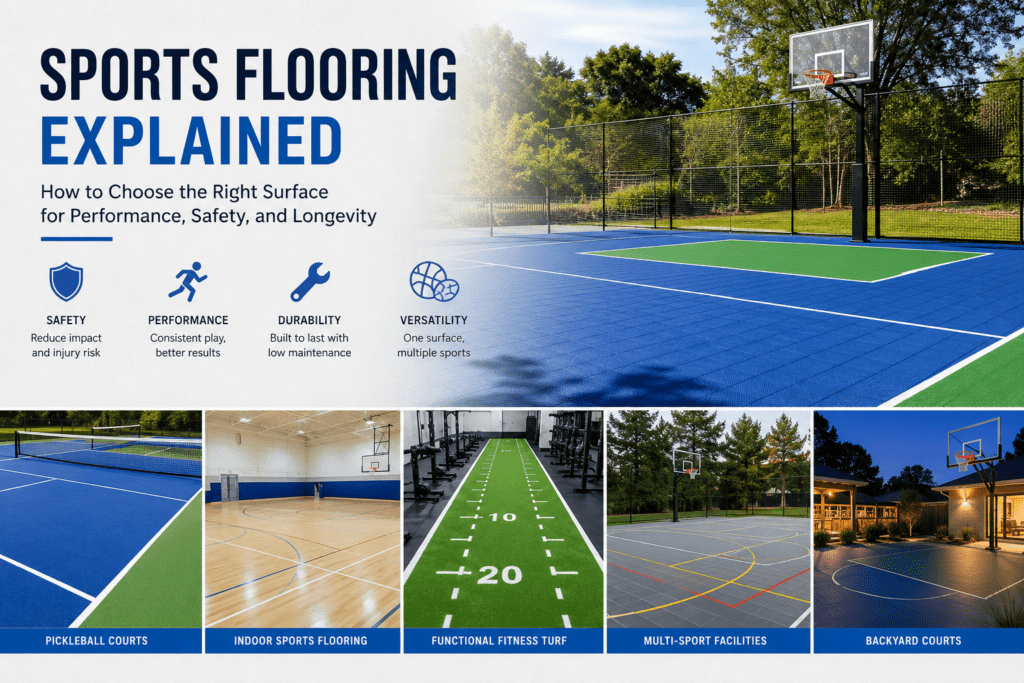
The playing surface is often the most overlooked part of any sporting facility, yet it has a greater impact on athlete performance, safety, maintenance costs, and long-term usability than almost any other component.
Whether you're developing a school sports court, community recreation area, commercial gym, pickleball facility, or backyard sports space, understanding sports flooring options is essential to creating a successful project.
Modern sports flooring has evolved significantly over the last decade. Today's surfaces are designed not only to withstand heavy use but also to improve player comfort, reduce injury risk, and support multiple activities within the same space.
Many people focus on goals, hoops, nets, lighting, or fencing when planning a sports facility. However, the surface underneath players influences every movement they make.
A quality sports surface helps provide:
Poor surface selection can lead to increased wear, player fatigue, inconsistent performance, and higher long-term maintenance costs.
The right flooring creates a better experience for athletes of all ages and skill levels.
Outdoor sports facilities face challenges that indoor venues do not.
Surfaces must withstand:
Because of these factors, many modern outdoor facilities are moving toward modular sports flooring systems.
Interlocking sports tiles have become one of the fastest-growing segments of the sports flooring industry.
These systems are manufactured using high-strength polypropylene and are installed over a solid base such as concrete or asphalt.
The popularity of sports tiles comes from several advantages:
Unlike painted concrete, modular tiles allow water to drain through the surface.
This means courts dry faster after rain and can often return to use much sooner than traditional hard courts.
The suspended structure of many sports tiles provides a degree of shock absorption that is not available on bare concrete.
While still firm enough for ball sports, the surface can be more forgiving on knees, ankles, and hips during extended play.
If a section becomes damaged, individual tiles can often be replaced without resurfacing the entire court.
This significantly reduces maintenance costs over the life of the facility.
One of the biggest advantages of modular flooring is flexibility.
A single court can be marked for:
This makes sports tiles particularly attractive for schools and community facilities where space is limited.
Few sports have grown as rapidly as pickleball.
As participation increases, facility operators are learning that surface quality plays a major role in player satisfaction.
The ball's bounce characteristics are heavily influenced by the flooring beneath it.
A quality pickleball surface should provide:
Many dedicated pickleball facilities now choose specialised tile or sports flooring systems rather than relying solely on painted concrete.
The result is a more professional playing experience and often a longer-lasting court surface.
Indoor facilities require a different approach.
Weather is no longer the primary concern, but athlete comfort and shock absorption become more important.
PVC sports flooring is one of the most widely used surfaces in schools and indoor sports centres.
It offers an excellent balance between durability and comfort.
Common applications include:
PVC systems typically incorporate cushioning layers that help absorb impact forces generated during running, jumping, and rapid directional changes.
This can reduce fatigue during training and competition while helping create a more comfortable playing environment.
The rise of functional fitness has created demand for specialised training surfaces.
Traditional gym flooring is not always suitable for:
As a result, turf training lanes have become standard features in many modern fitness facilities.
These surfaces provide:
Many gyms now dedicate significant floor space to turf zones because of their popularity among members.
One of the most significant trends in sports facility design is the move away from single-purpose courts.
Schools, councils, and private facilities increasingly seek surfaces that can accommodate multiple sports.
The reasons are simple:
A court that supports three or four sports will generally see more use than a court designed for only one activity.
Construction costs can be spread across a wider range of users and activities.
Multi-sport facilities attract broader participation from different age groups and sporting interests.
This flexibility is particularly valuable in community spaces where funding and available land are often limited.
Performance is important, but safety should always be a priority.
Key considerations include:
Too little grip can lead to slips.
Too much grip can increase the risk of joint strain during sudden movements.
The ideal balance depends on the sport being played.
Harder surfaces generally increase impact forces on the body.
Some level of shock absorption can help improve comfort during prolonged activity.
Uneven or deteriorated surfaces increase the risk of trips and falls.
Consistency across the entire playing area is essential.
There is no single "best" sports flooring solution.
The correct choice depends on factors such as:
A school may prioritise versatility.
A pickleball club may focus on ball response.
A gym may require specialised turf systems.
Each project should begin with a clear understanding of how the space will be used both today and in the future.
Sports flooring technology continues to evolve.
Manufacturers are investing in systems that offer:
As sporting participation grows and facilities strive to maximise usage, modern flooring solutions are becoming a critical part of successful recreational environments.
The surface beneath our feet may not always attract attention, but it remains one of the most important elements in creating safe, enjoyable, and high-performing sports spaces.


