
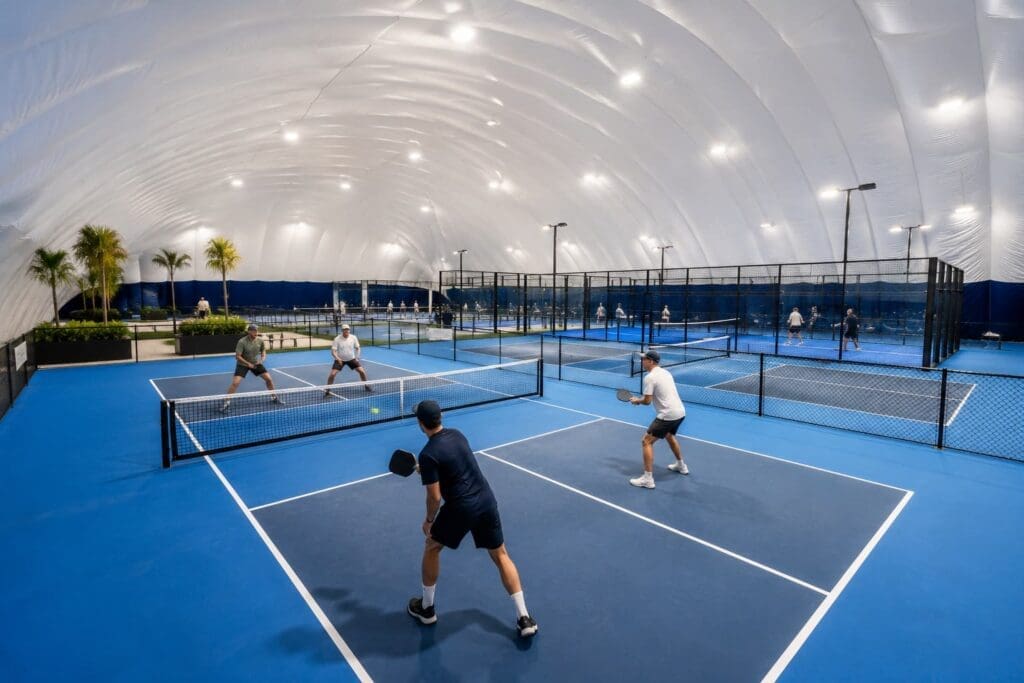
As sporting participation continues to grow across New Zealand, Australia, and the Pacific, communities, schools, clubs, and private operators are facing a common challenge: how to maximise facility usage regardless of weather conditions.
Traditional indoor stadiums can be expensive and time-consuming to build, while outdoor courts and fields are often limited by rain, wind, excessive heat, or seasonal conditions. This is where sports air domes are changing the game.
Stardock Sports Air Domes provide a modern solution that creates large, fully enclosed sporting environments without the cost and complexity of conventional buildings. By using advanced air-supported technology, these structures can cover courts, fields, and training facilities while delivering year-round usability.
A sports air dome is a large pressurised fabric structure that remains inflated through a controlled air management system. The dome creates a clear-span interior space without the need for internal support columns, allowing sporting activities to take place uninterrupted across the entire playing surface. Air-supported structures have been successfully used worldwide for sports facilities, recreation centres, and event venues for decades.
The result is a weather-protected environment that feels spacious, bright, and highly functional for athletes and spectators alike.
One of the biggest advantages of an air dome is the ability to continue training and competition regardless of weather conditions.
Rain, wind, frost, and excessive sun exposure can all disrupt outdoor sports. Air domes allow facilities to remain operational throughout the year, increasing booking availability and improving return on investment.
Compared with conventional steel-framed indoor stadiums, air domes can often be delivered at a significantly lower cost while still covering large sporting areas.
This makes them attractive for:
Traditional sports buildings can take many months to complete. Air domes can often be installed much faster, allowing facilities to begin generating revenue sooner.
This is particularly valuable for clubs looking to expand quickly in response to growing demand.
Because the structure is supported by air pressure, there are no internal columns obstructing play.
This creates uninterrupted space for:
Few sports have experienced growth like pickleball in recent years.
One challenge facing many clubs is maintaining playable court conditions throughout the year. Wind can significantly affect ball flight, while rain can quickly make courts unusable.
Sports air domes provide a controlled environment that allows players to enjoy consistent conditions regardless of the season.
For operators, this means:
Padel is one of the fastest-growing sports globally, and many successful facilities are now being developed within enclosed environments.
Air domes create the ideal setting for padel by providing:
As padel continues to expand throughout New Zealand and Australia, air dome solutions are expected to become increasingly common.
Modern sports air domes incorporate advanced engineering systems that help regulate internal pressure, ventilation, and climate conditions.
Many facilities also integrate:
These technologies help create comfortable playing environments while maintaining operational efficiency.
One of the greatest advantages of an air dome is versatility.
A single structure can accommodate a wide range of activities including:
This flexibility allows operators to maximise utilisation throughout the day and across different seasons.
Schools are increasingly seeking ways to provide reliable sporting facilities that can be used throughout the year.
An air dome can create a protected environment for:
The ability to generate additional revenue while supporting community participation makes air domes an attractive long-term investment.
As land costs increase and sporting participation continues to grow, facility operators are looking for smarter ways to maximise space and improve utilisation.
Sports air domes offer a compelling combination of affordability, flexibility, rapid installation, and year-round usability. Whether covering tennis courts, pickleball courts, padel facilities, or multi-sport venues, these innovative structures are helping redefine how sporting environments are built and operated.
For clubs, schools, and commercial operators seeking a future-focused facility solution, sports air domes represent one of the most exciting developments in modern sporting infrastructure.


