
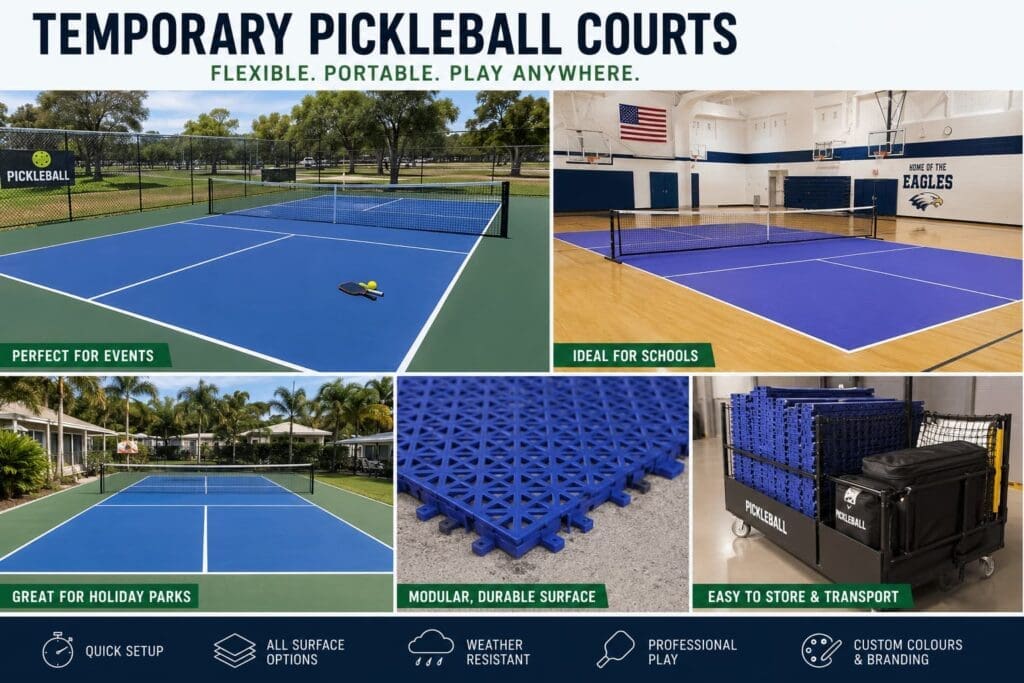
Pickleball is well suited to temporary and multi-use environments. A court can be installed for a weekend event, used during a school sports programme, or set up seasonally at a holiday park without committing the entire area to one permanent activity.
However, a temporary pickleball court still needs to provide a safe, consistent and enjoyable playing experience. Simply placing a portable net on an open area is rarely enough. The underlying surface, court dimensions, line visibility, drainage, storage and intended frequency of use all influence which system will work best.
For schools, event organisers, councils, campgrounds and holiday parks, the right temporary court can introduce a popular new activity while preserving the flexibility of an existing space.
A temporary pickleball court is a playing area that can be installed without permanently converting the site into a dedicated pickleball facility.
The system may include:
Some systems are removed after every event. Others remain in place for several weeks or an entire summer season before being packed away.
The correct solution depends on how frequently the court will be used, how quickly it must be installed and whether the site needs to return to another purpose afterwards.
The marked playing court measures 6.10 metres wide by 13.41 metres long for both singles and doubles. A larger overall area is needed around the lines so players have room to serve, move backwards and safely chase the ball.
This additional space is important. A court may technically fit inside a hall, car park or recreation area while still being too restricted for comfortable play.
Before purchasing a temporary court, measure:
Outdoor courts are generally best positioned north–south where possible, helping reduce the amount of low morning or afternoon sun facing directly into players’ eyes.
A full site assessment should take place before the surface is manufactured or court lines are selected.
There is no single surface that suits every school, event or holiday park. The three main approaches offer different levels of portability, performance and investment.
Roll-out surfaces are supplied in sections that are positioned across an existing hard base and joined together.
They can provide:
Roll-out systems can be particularly effective for exhibitions, indoor events, seasonal activations and facilities that want the court to look like a dedicated sports area.
The condition of the surface underneath remains critical. Concrete, asphalt or a suitable indoor sports floor normally provides the most stable base. Cracks, depressions and changes in level may be visible or noticeable through the finished court.
Large rolls can also be heavy. Buyers need to consider how many staff members will be required for installation, whether mechanical assistance is needed and where the rolls will be stored.
Modular sports tiles connect to create a reusable playing surface. They can be installed over an appropriately prepared hard base and taken apart when the area is needed for something else.
Potential advantages include:
Modular tiles can suit schools, recreation centres and holiday parks that expect to use the court repeatedly.
The base must still be firm, stable and level. Interlocking tiles do not correct a poorly prepared site. Installation over soft ground, loose gravel or uneven grass can result in movement, separation or an inconsistent bounce.
Ball response, surface texture and expansion requirements also vary between tile products. A buyer should request a sample or play-test an installed court rather than choosing entirely from photographs.
The simplest option is to add removable pickleball lines and a portable net to an existing tennis court, basketball court, hall or sealed recreation area.
This approach offers:
Temporary lines can be applied with specialist court tape, removable marking products or other systems approved for the existing floor.
Ordinary household tape should be avoided. It may lift during play, leave adhesive residue, damage coatings or create a trip hazard.
This approach also creates the possibility of several sets of sports markings occupying the same area. Contrasting colours and clear instructions help players distinguish the pickleball lines from existing tennis, netball or basketball markings.
Pickleball can work well at community festivals, corporate events, sports expos, holiday programmes and promotional activations.
An event court needs to be visually clear, quick to understand and able to handle repeated use by people with different levels of experience.
Important planning considerations include:
The organiser should know:
A system that takes most of a day to install may not be suitable for a short event unless it is assembled the day before.
Leave room for people to enter and exit the court without crossing active play. Racket and ball collection, queues, seating and introductory coaching should be positioned away from the court boundary.
Ball-containment netting may be useful where the court is near stalls, roads, pedestrians or other activities.
A temporary court can become a highly visible part of an event. Surface colours, perimeter signage, banners and removable logos can help the installation look intentional rather than improvised.
Branding must not interfere with line visibility or make the playing surface visually confusing.
Outdoor event courts need a wet-weather plan. Organisers should establish whether the surface can remain outside, how quickly it dries and what wind conditions may affect nets, fencing or signage.
Standing water should be removed before play resumes.
Schools often have limited outdoor space, with the same area used for assemblies, physical education, lunch breaks and several different sports.
A temporary pickleball system allows the school to introduce the game without losing that flexibility.
Pickleball can also be played as doubles, allowing more students to participate within a relatively compact area.
Schools should consider:
Court dimensions can remain standard while sessions are adapted using softer balls, lower-intensity drills or shorter games. Younger beginners may initially work in smaller teaching zones before moving onto a complete court.
The playing area should be inspected before each session. Staff should look for:
Edge ramps or clearly visible borders can help reduce the risk of players catching a foot on a modular surface transition.
School storage areas are often limited. The court supplier should provide the packed dimensions and approximate component weights before an order is placed.
Nets, paddles and balls may fit inside a sports cupboard, while roll-out surfaces or modular tiles may require a dedicated storeroom, trolley, pallet space or covered container.
A larger tennis or recreation area may accommodate more than one pickleball court. However, courts should not be squeezed together simply to increase capacity.
Adequate separation is needed between games so players do not run into neighbouring courts or retrieve balls through active play.
Pickleball can add a social recreation option for families, groups, retirees and longer-stay guests. It is relatively easy for beginners to try, while experienced players can still enjoy competitive games.
Temporary or seasonal courts may be particularly useful where:
For accommodation providers, appearance and ease of operation matter as much as the court itself.
A system should be simple enough for staff to inspect, open and close. Clear rules should explain operating hours, bookings, equipment collection and whether children require supervision.
Noise should also be considered. Pickleball creates a distinctive repeated impact sound, so courts should be positioned thoughtfully in relation to cabins, campsites, dining areas and neighbouring properties.
Reasonable playing hours, landscape screening and good site selection can help reduce disruption.
A temporary sports surface performs only as well as the base beneath it.
Suitable bases may include:
Potentially unsuitable bases include:
A temporary court should not be expected to bridge major cracks, holes or height differences. These issues should be repaired or addressed before installation.
For outdoor modular and roll-out systems, drainage paths must remain open. Water trapped underneath the surface can cause movement, staining, odour and longer drying times.
A regulation pickleball net is 91.4 centimetres high at the sidelines and 86.4 centimetres high at the centre.
Portable nets vary significantly in stability and durability. Lightweight recreational nets may be suitable for supervised school sessions, while commercial facilities may need stronger frames capable of being assembled repeatedly.
Look for:
Buyers should also consider how paddles and balls will be stored, issued and replaced. Outdoor balls and indoor balls have different characteristics, so equipment should suit the intended location.
A temporary court should arrive with clear installation instructions.
For larger systems, the supplier may provide the initial installation or train the customer’s staff. This helps ensure that surface sections are aligned correctly and that expansion gaps, edges and joins are handled properly.
The installation process should be documented with:
Schools and holiday parks should avoid relying on one staff member who is the only person who knows how the court works. At least two or three team members should understand the setup and inspection process.
Storage is frequently overlooked during purchasing.
Before choosing a system, ask:
A court that is easy to install but difficult to store may become inconvenient after the first season.
Temporary does not mean maintenance-free.
A simple maintenance programme may include:
Harsh chemicals and high-pressure cleaning may damage some sports surfaces. Cleaning methods should follow the supplier’s recommendations.
Potential buyers should ask the supplier:
The answers make it easier to compare systems on their complete operating cost rather than the purchase price alone.
A temporary court can be a strong option when an organisation wants to test demand, share a multi-use space or offer pickleball only at certain times of the year.
It is especially useful for:
For locations expecting daily, long-term use, a permanent court may eventually offer better convenience. Temporary systems can still provide a practical first stage, allowing the operator to understand participation levels before investing in a dedicated facility.
The best temporary pickleball courts are planned as complete recreation systems.
The surface must suit the base. The court must have sufficient surrounding space. Nets need to remain stable. Edges and joins must be safe. Staff need to understand installation, and the entire system needs somewhere suitable to be stored.
When these factors are considered from the beginning, a temporary court can provide events, schools and holiday parks with a flexible, attractive and highly usable activity—without permanently giving up valuable space.


