
There is a specific, somewhat rhythmic sound that has defined the "luxury" backyard for the last decade: the clack-clack-clack of a manual hand crank. You’ve seen it: the homeowner standing by a pillar, rotating a metal wand with the intensity of someone churning butter in the 1800s, all to move a few aluminum louvres just enough to stop the sun from hitting their eyes.
It was a functional solution for a while. But in the context of modern architectural design, the manual crank is starting to look a lot like the flip-phone: nostalgic, perhaps, but fundamentally out of step with how we actually live.
We are currently witnessing a massive shift in the DIY louvre kitset market. What used to be an expensive, custom-integrated luxury: motorisation: has now become the baseline. The industry is moving away from mechanical "clunk" and toward integrated smart systems. Here is why "Smart" isn’t just an upgrade anymore; it’s the new standard for the modern outdoor room.
Design is as much about how a space feels as how it looks. A high-end outdoor area loses its "premium" edge the moment you have to exert physical effort to adjust it.
The manual DIY louvre kitset has several inherent points of friction:
In contrast, a motorised system provides a level of structural precision that human hands simply can't match. The movement is fluid, the stopping points are digitally calibrated, and the hardware is tucked away, invisible to the eye.

In the world of wholesale louvre roofs, the conversation has changed from "Can we motorise this?" to "How smart is the motor?" The entry of Tuya-enabled systems into the kitset market has democratised high-end automation.
Tuya is essentially the universal language of the smart home. By integrating this as a standard feature, a louvre system is no longer a standalone piece of furniture; it’s a functional component of the home’s ecosystem.
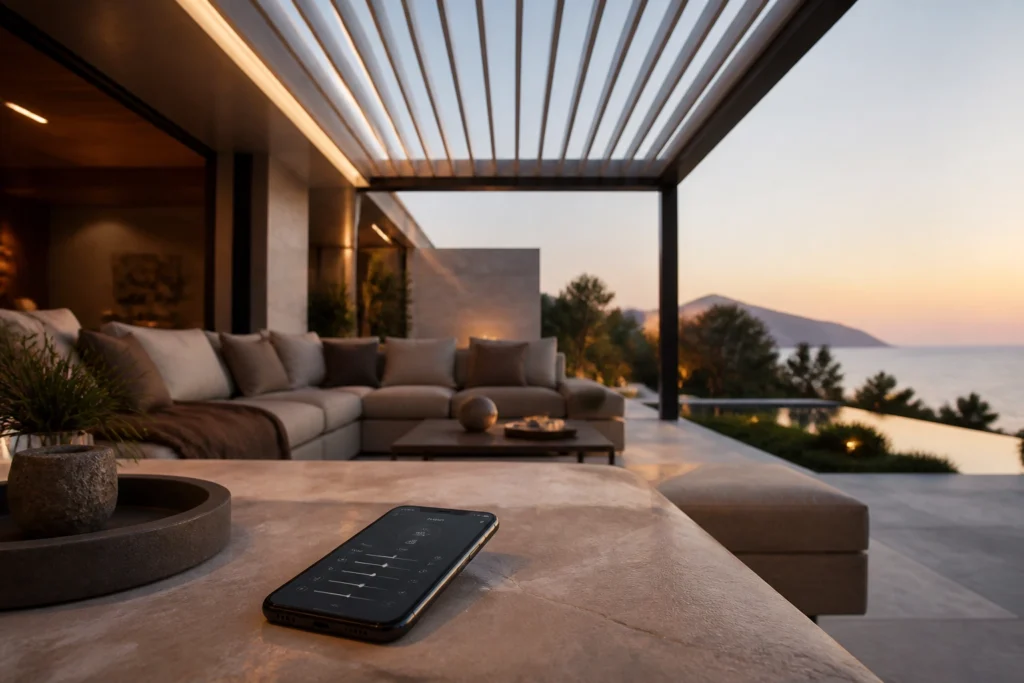
It sounds like a novelty until you’re sitting at the dinner table and the sun starts to dip below the roofline. Instead of getting up and interrupting the conversation, a quick tap on your phone (or a voice command to Alexa or Google Home) tilts the blades to the perfect angle.
This is the "set it and forget it" lifestyle. You can program schedules: louvres open at 8:00 AM to let the morning light into the house, and closed at 5:00 PM to retain heat as the evening cools down. It turns a static structure into a dynamic environment that reacts to your schedule.

If smart integration is the brain of the modern DIY louvre kitset, the rain sensor is its survival instinct. Historically, rain sensors were a pricey add-on that required specialized electrical work. Today, they are being integrated into the standard kitset package.
The value of a rain sensor isn't just about keeping the deck dry; it’s about the freedom to leave the house. We’ve all had that moment at work or the grocery store when the sky turns grey and you realise you left the louvres wide open over your outdoor gym or expensive swim spa setup.
With a rain sensor-enabled system:
This level of autonomy is what separates a modern outdoor "room" from a simple "pergola." It’s about creating a space that looks after itself.
There’s a common misconception that "kitset" implies a compromise in quality or technology. That might have been true five years ago, but the latest generation of wholesale louvre roofs is engineered with the same precision as custom architectural installs.
The move to motorised systems has actually made the DIY process cleaner. Instead of complex mechanical linkages for a manual crank, these systems often use internalised motors and simple "plug-and-play" wiring. For the homeowner, it means a faster build with a more professional finish.
The shift toward smart louvres is part of a larger trend in outdoor design where every element is becoming more adaptive. We are seeing homeowners pair their automated roofs with other high-end modular solutions.
The goal is to create an environment that is low-maintenance but high-performance. When your roof, your pool, and your lighting are all designed to work with you rather than requiring your constant attention, the "work" of owning a home begins to disappear.

When you operate a louvre roof manually, you’re guessing the angle. When you use a motorised system, you’re operating with degree-level precision. This matters for more than just comfort; it matters for the longevity of the structure.
Modern smart systems include:
The era of the crank is over because the way we value our time has changed. We no longer want to "manage" our homes; we want our homes to manage themselves.
The transition to motorised, Tuya-enabled DIY louvre kitsets with integrated rain sensors represents a coming-of-age for the outdoor industry. It moves the product out of the "hardware store" category and into the "architectural technology" category.
By choosing a smart system as your standard, you are investing in:
The outdoor room is no longer just a deck with a roof; it’s an intelligent, adaptive extension of the modern home. If you’re still reaching for a manual crank, you’re living in the past. The future of outdoor design is automated, it’s integrated, and it’s remarkably easy to live with.


