
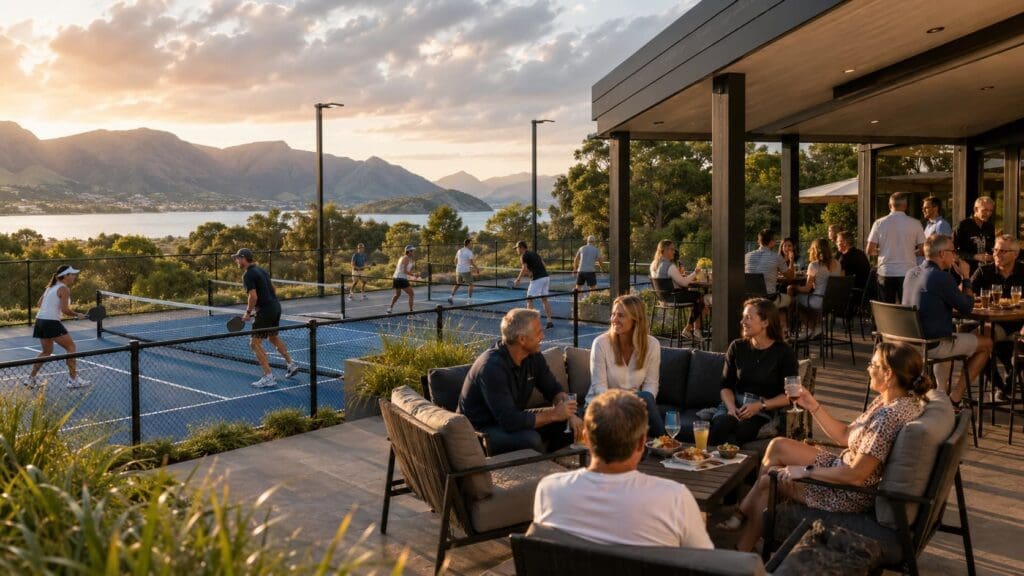
Sports clubs are changing. For decades, many clubs were built around one main sport, fixed competition days and a traditional membership model. That worked well for a long time, but the way people spend their free time has shifted.
Today, people want more than a game. They want social connection, casual activity, food, drinks, events and a reason to stay after they play.
This is where the next big opportunity sits for tennis clubs, bowls clubs, golf clubs, community clubs and multi-sport venues across New Zealand.
The future of sports clubs is not just sport. It is social play.
Many clubs are dealing with the same challenges:
A club that only makes money when members play organised games is leaving a lot of value on the table.
The clubs that grow over the next decade will be the ones that become more flexible. They will use their space better, welcome casual players, offer food and drinks, and create an atmosphere people want to be part of.
Pickleball is one of the best opportunities for clubs because it is easy to learn, social and suitable for a wide range of ages and fitness levels.
It is played on a smaller court than tennis, which makes it less intimidating for beginners. It also works well for doubles, short games, social sessions, corporate events and mixed-age groups. Auckland Leisure describes pickleball as a hybrid of tennis, table tennis and badminton, played with a paddle and plastic ball.
For clubs, the appeal is simple: pickleball can turn underused space into a revenue-generating asset.
A single tennis court can often be converted or line-marked to allow multiple pickleball courts. Bowls clubs can use spare outdoor or covered areas for social pickleball. Community clubs can add courts for casual bookings, open days, leagues, coaching and events.
Court hire is only one part of the opportunity. The bigger value comes from what happens around the court.
A player may come for a 45-minute game, but if the club has the right setup, they may stay for food, drinks and social time afterwards.
That creates multiple revenue streams:
This is why pickleball should not be seen as just another sport. It should be seen as a social activation tool.
The most successful future clubs will feel more like a social venue with sport attached.
That does not mean every club needs a full restaurant. It could be as simple as:
Food and drinks give people a reason to stay longer. They also make the club more attractive to non-players, partners, families and spectators.
A club that can combine sport, food and a relaxed atmosphere becomes more than a club. It becomes a local meeting place.
Traditional membership can feel like a big commitment, especially for younger people or casual players.
Social play is different.
Instead of asking someone to join first, clubs can invite them to try the experience:
“Come down on Thursday night, play a few casual games, grab some food and meet people.”
That is a much easier entry point.
Once people feel comfortable, they are more likely to book courts, attend events, join leagues or become members. Social play becomes the pathway into long-term club involvement.
Bowls clubs have one of the biggest opportunities.
Many bowls clubs have large outdoor areas, clubrooms, kitchens, bars, parking and established community facilities. However, some are also facing ageing membership and reduced participation from younger groups.
Adding pickleball can help bowls clubs bring in new people without losing their existing identity.
Pickleball can work alongside bowls because it attracts:
A bowls club that adds pickleball is not replacing bowls. It is widening its audience.
Tennis clubs are also well positioned. They already have court infrastructure, fencing, lighting and a racquet-sport culture.
Pickleball can help tennis clubs use quieter time slots, attract beginners and bring back people who may have found tennis too difficult, too physical or too competitive.
It can also introduce a new type of event programming, including:
The key is not to view pickleball as a threat to tennis. It can be an extra product that brings more people through the gate.
In New Zealand, weather can quickly disrupt outdoor sport. Rain, wind, harsh sun and winter conditions all reduce how often clubs can use their facilities.
This is why covered outdoor spaces will become more important for clubs that want regular bookings and social events.
A covered pickleball or multi-sport area can help clubs:
Weather protection does not always need to mean a full indoor stadium. Options can include roof structures, louvre systems, covered seating, outdoor blinds, shade systems or semi-covered court areas.
The goal is simple: make the club usable more often.
One of the biggest barriers for clubs is construction cost. Traditional court builds can be expensive, slow and disruptive.
Modular sports flooring and roll-out court surfaces can make it easier for clubs to add pickleball or multi-sport use without a major rebuild.
Depending on the site, clubs may be able to use:
This gives clubs more flexibility. They can test demand, run pilot programmes and expand once the numbers make sense.
The sports club of the future may look less like a traditional single-sport venue and more like a community hub.
It may include:
The winning formula is not complicated.
Give people a fun reason to come down, an easy game to play, and a comfortable place to stay afterwards.
Sports clubs do not need to abandon their history to grow. They need to add new reasons for people to visit.
Pickleball, food, drinks and social play offer a powerful combination. They help clubs attract new people, increase revenue, use space more effectively and create a stronger community atmosphere.
For clubs with underused courts, greens, clubrooms or outdoor areas, the opportunity is clear.
The future club is not just where people go to play.
It is where they go to connect.


