
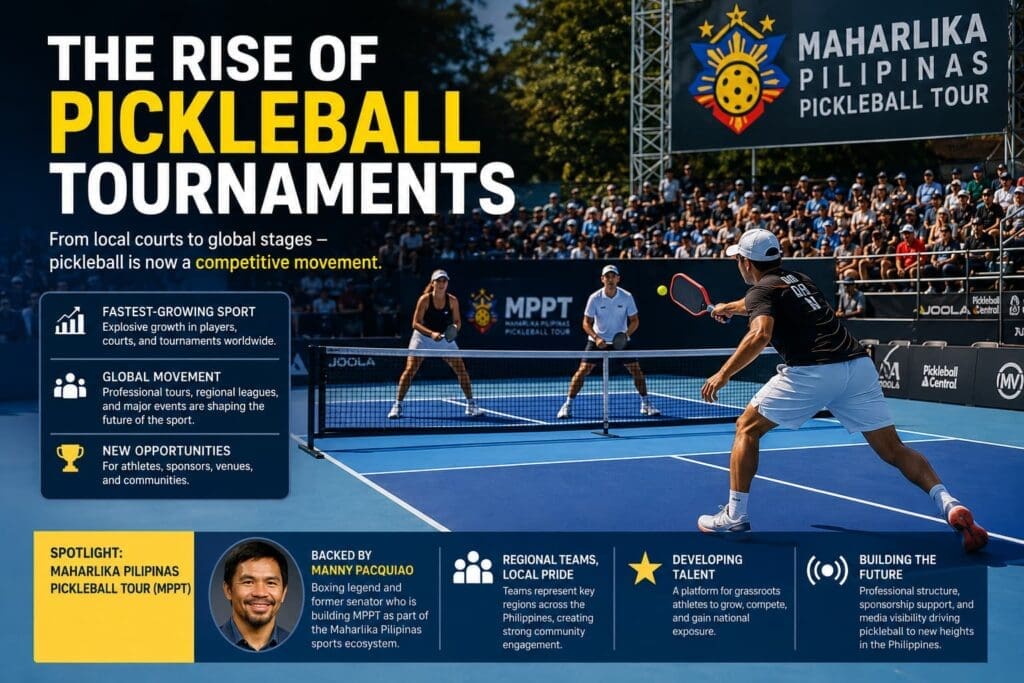
Pickleball is no longer just a recreational pastime played at retirement communities and local clubs. Over the last few years, the sport has evolved into one of the fastest-growing competitive sports in the world, with professional tours, regional championships, corporate sponsorships, dedicated venues, streaming coverage, and rapidly increasing participation numbers.
What was once viewed as a casual social game has now become a serious competitive platform attracting athletes, investors, sporting organisations, hospitality venues, developers, and international audiences.
Across North America, Asia-Pacific, Europe, and emerging markets, pickleball tournaments are becoming major sporting and entertainment events.
Several factors are driving the rapid rise of competitive pickleball:
One of pickleball’s greatest strengths is how easy it is to learn. Players of all ages can quickly become competitive, which creates a much larger participant base compared to many traditional sports.
Unlike sports that require years of technical development before tournament participation becomes enjoyable, pickleball allows beginners to enter local events relatively quickly.
Pickleball courts require significantly less space than tennis courts, making it easier and more economical for clubs, schools, hospitality venues, and developers to install multiple courts.
This has created an environment where tournament hosting becomes more commercially viable.
In many facilities:
Pickleball sits in a unique position between serious sport and social recreation.
Tournament weekends often combine:
This hybrid model has made pickleball tournaments extremely attractive for clubs and commercial venues.
Professional leagues and tournament circuits are now expanding rapidly worldwide.
This includes:
The result is a sport transitioning from grassroots recreation into a structured competitive ecosystem.
While North America remains the largest pickleball market, the Asia-Pacific region is seeing explosive growth.
Countries including:
are all experiencing rapid expansion in court construction, club formation, and tournament activity.
One particularly interesting example is the Maharlika Pilipinas Pickleball Tour.
Maharlika Pilipinas Pickleball Tour
The Maharlika Pilipinas Pickleball Tour (MPPT) represents one of the strongest examples of how competitive pickleball is expanding throughout Southeast Asia.
One of the major reasons the MPPT has gained immediate attention is because it is being backed by Filipino boxing legend and former senator Manny Pacquiao.
Pacquiao is not simply endorsing the league — he is helping build it as part of the wider “Maharlika Pilipinas” sports ecosystem that already includes successful basketball and volleyball leagues.
The MPPT follows a regional franchise-style structure designed around:
The Philippines has quickly become one of the most active pickleball growth markets in Asia, and the MPPT demonstrates how tournament ecosystems can accelerate the development of the sport nationally.
The league is also helping establish:
The involvement of a globally recognised sporting figure like Pacquiao gives the MPPT:
This mirrors what occurred in the early development stages of professional pickleball in the United States.
As more regional tours emerge globally, pickleball is beginning to resemble the development trajectory previously seen in sports such as padel and esports — rapidly expanding from niche participation into a mainstream commercial sporting category.
The rise of tournaments is directly influencing the construction of new pickleball venues.
Facilities are increasingly being designed specifically for:
Commercial venues are recognising that pickleball creates:
This is why many hospitality operators are now integrating pickleball with:
The “pickleball social venue” model is becoming one of the fastest-growing segments within the recreation industry.
As tournament standards rise, so do expectations around infrastructure and playing surfaces.
Modern tournament facilities increasingly focus on:
Dedicated pickleball flooring systems are becoming more common, including:
High-performance flooring improves:
Portable flooring systems are also allowing tournaments to temporarily convert:
into high-quality competition environments.
Tournament events increasingly include:
This creates a more professional spectator experience while helping tournaments reach wider online audiences.
The growth of tournaments is critical because organised competition creates long-term sustainability for any sport.
Tournaments help drive:
Without organised competition, sports often remain recreational activities only.
Pickleball is now moving beyond that phase.
The rise of regional tours, professional leagues, and commercial tournament venues signals that pickleball is becoming a legitimate global sports industry.
The next decade will likely see:
The sport’s combination of accessibility, social engagement, and competitive depth gives it a unique growth profile rarely seen in modern sport.
For facility operators, developers, sporting organisations, and investors, pickleball is no longer a trend to observe from the sidelines.
It is becoming a permanent part of the global sports and recreation landscape.
And tournaments are leading that transformation.


