
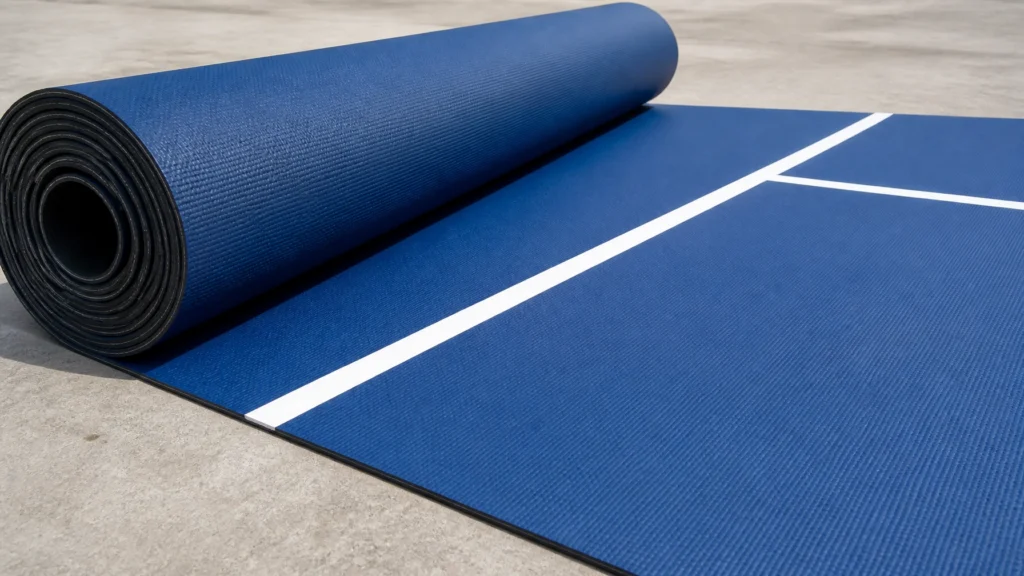
The landscape of recreational sports is undergoing a significant shift. Driven by the unprecedented rise of pickleball, community planners, property owners, and educational institutions are facing a common challenge: a shortage of dedicated infrastructure. Traditionally, the growth of a sport is limited by the availability of permanent facilities, concrete poured, fences erected, and surfaces painted. However, the emergence of portable pickleball mats has fundamentally decoupled the game from the requirement of permanent construction.
By allowing the game to be played on virtually any flat, hard surface, these portable systems are democratizing access to the sport and redefining how we think about multi-use spaces.
As pickleball continues its trajectory as one of the fastest-growing sports globally, the demand for court time has far exceeded the supply of permanent courts. In many urban and suburban areas, the lead time for site permits and construction can span months or even years. Portable court systems address this "infrastructure gap" by providing an immediate, high-quality playing surface that can be deployed in a matter of hours.
These systems are not merely temporary placeholders; they are highly engineered surfaces designed to replicate the bounce, friction, and safety characteristics of a professional acrylic court. Whether utilized in a parking lot, a multi-purpose gym, or a residential driveway, these mats provide the consistency required for competitive play without the permanence of traditional asphalt or concrete court installations.
The success of a portable court relies on the engineering of its materials. Unlike basic vinyl rolls, professional-grade portable mats utilize advanced polymers and composite structures to ensure durability and performance. There are two primary categories of portable systems currently dominating the market:
Both systems are engineered to manage thermal expansion and contraction, ensuring that the playing surface remains flat and stable regardless of temperature fluctuations.
The surge in popularity of these systems is driven by several practical and economic factors that appeal to both individual players and large-scale facility managers.
Building a permanent pickleball court involves significant capital expenditure, including excavation, base preparation, surfacing, and fencing. Portable mats represent a fraction of that cost. For schools or community centers with existing flat surfaces, the investment is limited strictly to the surface material itself, eliminating the need for heavy machinery or specialized contractors.
The "any surface" promise is the core value proposition. A portable mat can transform a tennis court into four pickleball courts for a weekend tournament and then be removed to restore the original function of the space. This versatility is essential for multi-use facilities that must cater to various sports and events within a single footprint.
In densely populated urban areas where land is at a premium, portable mats allow for the creative use of space. Rooftops, underutilized warehouse floors, and even hotel event halls can be converted into active sports hubs. This flexibility ensures that the sport can grow in environments where traditional court construction is physically impossible.

While the technical advantages of portable mats are clear, their impact on human development and community health is equally significant. By bringing the game to schools and community centers, portable systems are fostering physical literacy and social growth in ways that permanent infrastructure often cannot.
For younger players and students, access to a consistent, high-quality surface is crucial for developing "physical literacy", the confidence and competence to move effectively. Pickleball requires a unique combination of:
Portable mats allow schools to integrate these physical benefits into their curriculum without a permanent commitment of playground space. Because the mats can be rolled up and stored, the "gym" remains a flexible learning environment.
Pickleball is inherently social due to the proximity of players and the fast-paced nature of the game. Portable courts act as "pop-up" community hubs. In retirement communities or residential complexes, these mats facilitate intergenerational play, bringing together different age groups in a shared physical activity. This social connectivity is a powerful tool against isolation and a driver for community cohesion.
To ensure the longevity of a portable mat and the safety of the players, proper surface preparation is essential. While the mats can be placed on "any" surface, that surface must meet certain technical criteria.

Deciding between a modular tile system and a roll-out mat depends largely on the intended use case and the environment.
For most residential applications or outdoor community spaces, modular tiles are often preferred for their ease of installation and superior drainage capabilities. For professional tournaments or high-end indoor facilities, roll-out mats are the standard due to their seamless aesthetics.
One of the misconceptions about portable systems is that they are fragile. In reality, modern portable mats are designed for heavy-duty use. High-impact polypropylene tiles are often UV-stabilized to prevent fading and brittleness in the sun, while roll-out systems use high-density wear layers to resist scuffing from court shoes.
Maintenance is straightforward:
The rise of portable pickleball mats is more than a trend; it is a structural evolution in the sports industry. By providing a high-performance, cost-effective, and versatile alternative to permanent construction, these systems have removed the primary barrier to entry for the sport: the court itself.
Whether the goal is to enhance a school’s physical education program, provide a recreational outlet for a residential complex, or facilitate a high-level tournament in a unique location, portable mats offer a professional solution that adapts to the environment rather than forcing the environment to adapt to the sport. As we look toward the future of urban planning and recreational design, the flexibility of portable infrastructure will undoubtedly play a central role in keeping communities active and connected.


