
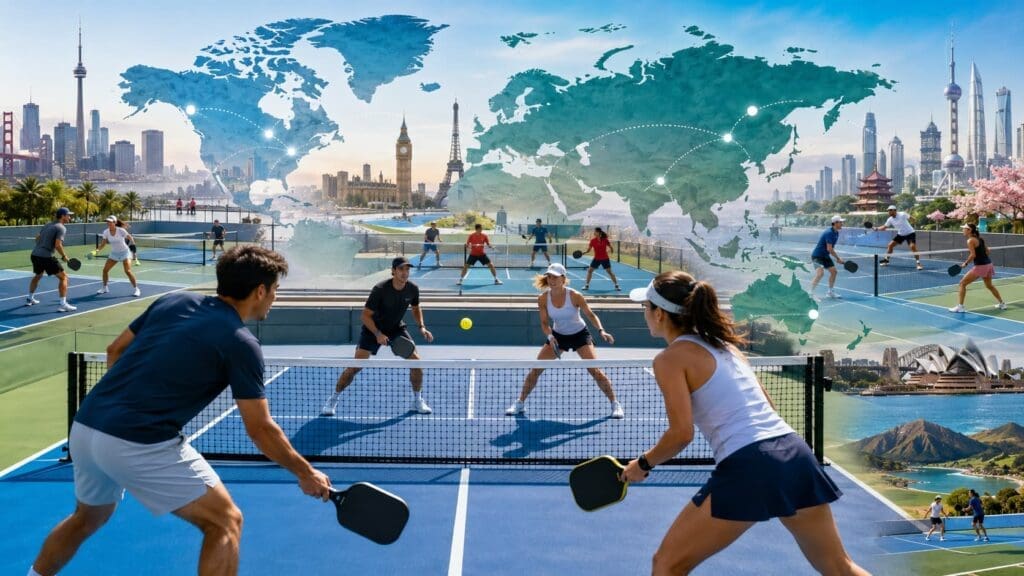
Pickleball has moved from being a North American backyard game to one of the fastest-growing sports in the world. Its rise is being driven by a simple mix: easy rules, smaller courts, lower entry cost, strong social appeal, and the ability to fit into existing tennis courts, school gyms, club spaces, community halls, retirement villages, resorts and residential backyards.
Across the world, the sport is developing in different ways. In some countries it is already a mainstream participation sport. In others, it is still at the early club-building stage. What is clear is that pickleball is no longer a short-term trend. It is becoming part of the global sports and recreation market.
The United States remains the centre of the pickleball boom. According to SFIA, 24.3 million Americans played pickleball in 2025, with participation growing 171.8% from 2022 to 2025.
Court development has followed that demand. USA Pickleball reported that the Pickleheads database reached 82,613 known courts and 18,258 playing locations nationwide in its 2025 growth report.
The United States is now moving beyond casual participation. Purpose-built indoor venues, private pickleball clubs, social leagues, tournaments, coaching programmes, branded equipment, professional tours and hospitality-style venues are all growing. Pickleball is becoming both a sport and a commercial recreation category.
Canada has become one of the strongest pickleball countries outside the United States. Pickleball Canada’s 2025 survey reported a 57% increase in participation over three years and 15% growth since 2024. The biggest recent growth was in the 35–54 age group, showing that the sport is expanding well beyond older players.
Canada’s growth is heavily club-based. Local associations, indoor centres, municipal courts and community recreation programmes are helping the sport spread into both large cities and smaller towns. Like the United States, Canada is now dealing with one of the biggest challenges in pickleball: providing enough court space to match demand.
Australia is quickly becoming one of the most important pickleball markets in the Asia-Pacific region. Pickleball Australia reported more than 96,000 regular players and 23,000 financial members nationally.
The Australian market is growing through tennis clubs, multi-sport centres, retirement communities, schools, councils and private sports venues. It is also seeing strong commercial interest, with court conversions, indoor centres and home courts becoming more common.
For New Zealand clubs, Australia is a useful comparison. The climate, club structure and outdoor sports culture are similar, which suggests pickleball has strong room to grow locally as more facilities understand how easy it can be to add courts.
Pickleball in New Zealand is still smaller than in the United States, Canada and Australia, but it is developing quickly. A major milestone came on 27 November 2025, when pickleball was officially accredited by Sport NZ and the Pickleball New Zealand Association was recognised as the national governing body.
This recognition matters because it gives the sport more structure. It helps support clubs, pathways, tournaments, volunteers and long-term development.
In New Zealand, pickleball suits a wide range of facilities, including tennis clubs, bowls clubs, schools, retirement villages, community centres and residential properties. Because the court is smaller than a tennis court, it is easier to fit into underused spaces. This makes it attractive for clubs looking to bring in new members, schools wanting flexible PE spaces, and homeowners wanting a backyard court that can be used by the whole family.
The United Kingdom has seen pickleball move from a niche activity to an officially recognised sport. In December 2024, the four home nation sports councils recognised pickleball as a sport, and Sport England recognised Pickleball England as the national governing body in England.
This gives the sport stronger credibility and opens the door for more organised growth through clubs, coaching, events and funding pathways.
Across Europe, pickleball is also becoming more organised. The European Pickleball Federation was founded in 2023 and has 25 member countries, according to Pickleball England. Countries such as Spain, Italy, France, Germany, the Netherlands and Ireland are seeing more clubs, tournaments and dedicated venues appear.
Europe is interesting because pickleball is growing alongside padel. In many countries, padel is already very strong, but pickleball offers a lower-cost, easier-to-learn option that can work in smaller community and club environments.
Spain is already one of the world’s strongest padel countries, but pickleball is starting to find its own place. Spanish media has reported around 20,000 pickleball players in Spain, with a national circuit beginning to develop.
Spain shows how pickleball can grow even in countries where other racquet sports are already popular. The smaller court, social format and quick learning curve make it attractive to people who may not want the speed, cost or technical demands of tennis or padel.
India is one of the most exciting future pickleball markets. The sport is still developing, but infrastructure and investment are growing quickly. IBEF reported that India had around 200 operational pickleball courts in early 2024, increasing to about 1,200 courts by the first half of 2025.
India’s growth is being driven by urban sports centres, private court operators, schools, corporates, leagues and younger players looking for new social sports. The country’s large population means that even a small percentage of participation can create huge demand for courts, coaching and equipment.
Asia could become one of the biggest long-term pickleball regions. A 2025 UPA Asia and YouGov Singapore study reported very high awareness and trial rates in several Asian markets, including Vietnam, Singapore, India and China. The same research said Vietnam had the highest percentage of respondents with pickleball experience, while India had the largest number of frequent players in the survey’s estimates.
These figures should be treated as survey-based estimates rather than official federation counts, but they still show the direction of travel: pickleball is gaining attention quickly across Asia.
Countries such as Vietnam, China, Singapore, Malaysia, Thailand, the Philippines and India are likely to see more court construction, organised tournaments and commercial venue development over the next few years.
The reasons for pickleball’s global growth are consistent across countries.
It is easy to learn, which means new players can enjoy a game quickly. It uses a smaller court, so clubs can fit multiple pickleball courts into areas that may only hold one tennis court. It is highly social, making it ideal for community clubs, schools, retirement villages and mixed-age groups. It can be played indoors or outdoors, which helps facilities run sessions year-round. It also works well for multi-use spaces, including modular sports flooring, roll-out court mats and converted tennis or netball areas.
For clubs and councils, pickleball is attractive because it can increase usage of existing spaces. For schools, it provides a low-barrier PE activity. For homeowners, it offers a practical backyard sport that can be used by kids, adults and visitors.
As pickleball grows, the quality of courts becomes more important. Early growth often happens on shared courts, temporary lines and basic surfaces. As participation increases, players and clubs start looking for better playing experiences.
This is where proper court planning matters. Clubs need to think about surface choice, line marking, drainage, lighting, fencing, spacing, wind protection and whether the court will be permanent, semi-permanent or multi-use.
Modular sports tiles and roll-out pickleball mats are becoming popular because they allow clubs, schools and venues to add pickleball faster than traditional construction in many cases. For existing tennis courts or concrete areas, these systems can help create a cleaner, more consistent playing area without needing a full rebuild.
Pickleball is developing differently in each country, but the global pattern is clear. The United States is leading with mass participation and commercial venues. Canada is building strong community and club systems. Australia is expanding quickly through clubs, councils and private venues. New Zealand is moving into a more formal growth phase after national recognition. Europe is building structure through federations and tournaments. Asia is showing huge long-term potential, especially in India, Vietnam and China.
The next stage of pickleball growth will be about facilities. More players will need more courts. More clubs will need flexible surfaces. More schools will look for multi-sport options. More homeowners will consider backyard courts. More recreation venues will combine pickleball with food, events, coaching and social play.
Pickleball’s success comes from being simple, social and adaptable. That is why it is growing around the world — and why it is likely to keep becoming part of modern sports facility planning.


