
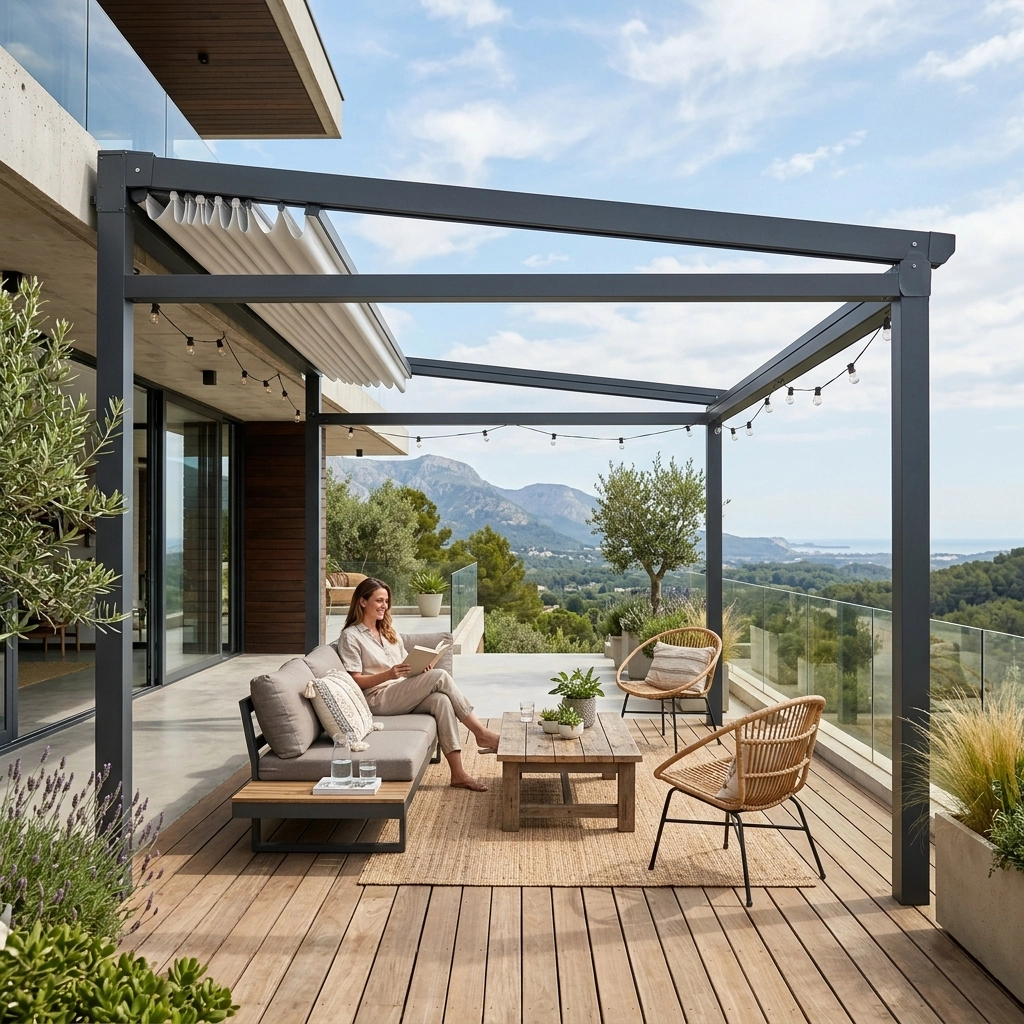
Let’s be honest: New Zealand weather has commitment issues. One minute you’re prepping a long lunch under a clear blue sky, and the next, a sudden Tasman squall is threatening to turn your wagyu sliders into soggy disappointments.
For years, the solution was a choice between two extremes: a permanent roof that blocked the sun even on the best days, or a flimsy umbrella that would inevitably end up in your neighbor’s pool the moment the wind hit 20 knots.
The middle ground has finally arrived, and it’s smarter than most of the houses it’s attached to. Retractable PVC pergolas are shifting the paradigm from static structures to adaptive environments. In the world of high-end design, we call this "optionality." You aren’t just buying a roof; you’re buying the ability to decide exactly how much of the sky you want to deal with at any given moment.
Traditional luxury pergolas in NZ have long relied on fixed louvres or solid timber. While beautiful, they are "always on." A retractable PVC system uses a high-tensile, 3-layer fabric membrane that disappears when you don't need it.
This isn't the PVC you find in cheap plumbing. We’re talking about an architectural-grade technical textile. It’s UV-resistant, 100% waterproof, and: perhaps most importantly for the Kiwi lifestyle: it’s designed to handle the high wind loads that come with coastal living.
One of the biggest gripes in modern architecture is the "forest of posts." If you’ve spent a fortune on floor-to-ceiling glass to capture a view of the Hauraki Gulf or the Southern Alps, the last thing you want is a 100mm aluminium post right in the center of your sightline.
The new generation of retractable roof systems offers "column-free" options that feel like a feat of engineering magic. By utilizing heavy-duty wall brackets and reinforced internal rafter profiles, these systems can cantilever or suspend across massive spans.
For the minimalist, this is the Holy Grail. You get a seamless transition from the indoor living room to the outdoor deck with zero vertical obstructions. It’s "stealth mode" architecture: now you see it, now you don’t.
If a system isn't easy to use, it won't be used. High-end outdoor shading solutions have moved far beyond the manual hand crank. Today’s retractable pergolas are fully motorized, usually powered by European-engineered tubular motors that are hidden inside the drive tube.
But it’s not just about a remote control. Integration into smart home ecosystems is now the standard.
The problem with many retractable awnings is that they often look like an afterthought: a bag of fabric bolted onto a beautiful house. The modern retractable PVC pergola is designed to be an extension of the building’s DNA.
Whether it’s a matte black frame that matches the joinery of a contemporary home or a recessed system built into a concrete soffit, the goal is "structural harmony."
When retracted, the fabric bundles neatly under a slim aerodynamic hood or inside a structural "box," maintaining the clean lines of the roofline. When deployed, the tensioning system ensures the fabric is drum-tight, mimicking the look of a solid structure.
Luxury used to be about what you owned; now, it’s about how you feel in your space. Adaptive living is the ability to manipulate your environment to suit your mood.
This flexibility effectively doubles the usable square footage of a home without the cost or red tape of a traditional extension. In the NZ property market, that’s not just a lifestyle upgrade; it’s a smart financial play.
While residential homeowners love the tech, the hospitality industry is where these systems truly shine. For a restaurant or bar, a rainy Friday night can mean thousands of dollars in lost revenue if the terrace is unusable.
A retractable roof system allows a venue to "guarantee" a space regardless of the forecast. The ability to enclose the sides with integrated Ziptrak blinds or glass sliding doors turns a seasonal patio into a year-round revenue generator.
The "Sky is Optional" philosophy means the venue can be an open-air rooftop bar at 5:00 PM and a wind-proof, heated dining room by 8:00 PM. That level of agility is why retractable PVC systems are quickly replacing fixed umbrellas and traditional awnings in New Zealand’s top dining precincts.
If you are specifying a system for a project or upgrading your own home, keep these non-negotiables in mind:
The era of static outdoor design is over. As we spend more time at home and demand more from our outdoor spaces, the "Sky is Optional" approach is no longer a luxury: it’s a necessity for modern living.
By combining the structural integrity of a pergola with the flexibility of a retractable awning, PVC systems offer a middle ground that doesn't compromise on aesthetics or performance. Whether you’re looking for a column-free masterpiece to preserve a view or a heavy-duty commercial cover to beat the weather, the message is clear: don't let the forecast dictate how you live. Control the sky, and the rest will follow.


