
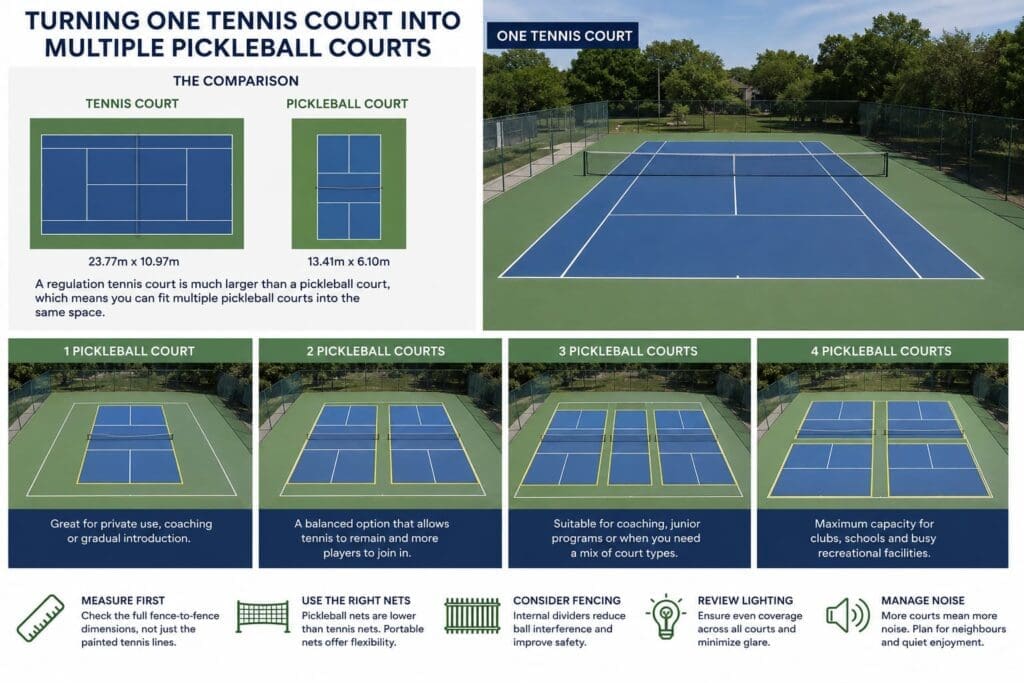
An underused tennis court can become a highly active multi-court pickleball facility without requiring an entirely new sports area.
Because a pickleball court is considerably smaller than a tennis court, one suitably sized tennis-court enclosure can potentially accommodate two, three or four pickleball courts. The best configuration depends on the existing dimensions, whether tennis must remain available, the expected number of players and how much safety space is required around each court.
The challenge is not simply fitting more lines onto the surface. A successful conversion must also consider run-off space, net placement, fencing, drainage, lighting, access and the risk of visual confusion.
A regulation pickleball court measures:
These dimensions refer to the marked playing area. Additional space is required behind the baselines and outside the sidelines.
USA Pickleball recommends a minimum total playing surface of approximately 9.14 × 18.29 metres for each court. A preferred footprint of approximately 10.36 × 19.51 metres provides more generous movement space.
For comparison, a regulation doubles tennis court is 10.97 metres wide and 23.77 metres long. A full outdoor tennis enclosure is often larger because it includes run-off areas beyond the court lines.
This means that the complete fenced area—not just the painted tennis lines—must be measured before deciding how many pickleball courts can be installed.
Marking a single pickleball court is the simplest option.
The court can usually be centred within the existing tennis area, providing generous space around all four sides. This can work well for:
A single court is unlikely to make full use of the available area, but it provides excellent safety margins and reduces potential interference from adjacent games.
The existing tennis net should not automatically be treated as a regulation pickleball net. A tennis net is approximately 0.914 metres high at its centre, while a pickleball net should be approximately 0.864 metres at the centre and 0.914 metres at the sidelines. A dedicated portable pickleball net is generally the more reliable option.
Two courts are often the best option when the facility wants to retain tennis.
They can be positioned within the existing enclosure while leaving more space between players, fences and fixed obstacles than a four-court arrangement. Two courts can accommodate up to eight doubles players at one time without making the site feel excessively crowded.
This layout is particularly suitable for:
Portable nets and removable or discreetly painted court lines allow the area to switch between sports. The existing tennis net may also remain in place as a divider or ball-control barrier, depending on the chosen layout. USA Pickleball notes that portable nets can be used for temporary conversions while the tennis net remains in place.
Two courts usually provide a better shared-use compromise than trying to force the maximum possible number of courts onto the surface.
Three courts can sometimes be installed, but the layout is normally less balanced.
A common arrangement places two courts on one side of the tennis net and a single court on the other. This may suit a programme that needs:
However, three-court layouts can create uneven circulation and inconsistent clearances. One part of the enclosure may feel crowded while another remains comparatively open.
Unless there is a specific operational reason for three courts, facilities will usually find that either two spacious courts or four carefully planned courts provide a more logical layout.
Four courts provide the greatest playing capacity.
A typical configuration divides the tennis enclosure into four sections, with two pickleball courts on each side of the original tennis net. The pickleball courts generally run in the same overall direction as the tennis court.
Four courts can accommodate up to:
This configuration is attractive for clubs, resorts, schools and commercial venues where participation and court turnover are more important than preserving generous individual run-off areas.
However, four courts require careful measurement.
Four minimum pickleball footprints occupy approximately 18.29 × 36.58 metres, which corresponds closely to the overall space commonly associated with a full tennis-court enclosure. This leaves little room for measurement errors, oversized posts, gates, seating or irregular fencing.
A four-court layout should therefore be treated as a site-specific design rather than an automatic conversion.
A layout can fit mathematically and still perform poorly.
Players move beyond the painted boundaries when chasing lobs, returning wide shots or moving backwards from the kitchen line. Insufficient space can cause players to:
The recommended minimum footprint should be viewed as the starting point rather than the ideal target.
For social doubles, beginner sessions and lower-intensity play, minimum clearances may be manageable. Competitive players and faster games generally benefit from more space behind the baselines and between neighbouring courts.
Where four courts feel too restricted, two well-spaced courts may deliver a safer and more enjoyable facility.
The next decision is whether the tennis court will remain available.
A temporary setup may use:
This approach allows the venue to trial demand before committing to permanent changes. It is also useful for schools, resorts and clubs that schedule tennis and pickleball at different times.
Temporary line products should sit flat against the surface and should not create raised edges or slipping hazards.
A shared court keeps the original tennis markings while adding permanent pickleball lines in a contrasting colour.
This provides quick changeovers between sports but can make the playing surface visually busy. The line plan should be kept as simple as possible, with each sport assigned a clearly identifiable colour.
A permanent conversion may involve:
Removing old posts can leave holes or uneven sections that must be properly repaired. The finished playing area should remain smooth, consistent and free from trip hazards.
Official pickleball court lines should be approximately 50.8 millimetres wide, consistent in colour and clearly contrasting with the main playing surface. Court measurements are taken to the outside of the lines.
On a shared court, the pickleball markings should also contrast with the existing tennis lines.
For example:
Using several similar colours can make it difficult for players to identify the correct baseline or sideline during fast play.
The final line plan should be reviewed from normal player height, not only from an overhead drawing.
Each pickleball court needs a correctly positioned net.
Portable nets are generally the easiest option for temporary and shared-use facilities. They can be moved away when tennis resumes, although storage space must be provided nearby.
When selecting portable nets, consider:
Permanent nets create a cleaner playing environment but reduce the flexibility to return the area to tennis.
For a four-court permanent conversion, the existing tennis posts may interfere with the new court layout. Their position, foundations and sleeves should be checked before finalising the design.
An existing tennis court can provide a suitable base for pickleball when it is structurally sound and reasonably level.
Before adding new lines or flooring, inspect the court for:
USA Pickleball identifies asphalt and concrete as acceptable court bases and recommends considering slope, drainage, surface finish and overall construction requirements.
Small tennis-court cracks may become more noticeable in pickleball because the ball is lighter and the court is smaller. Surface defects should be repaired before the final markings or sports surface are installed.
Several surface systems can be considered.
Where the tennis surface remains in good condition, new lines may be added directly after cleaning and preparation.
This is often the simplest shared-use solution.
A complete resurfacing allows the facility to repair defects, refresh faded areas and introduce dedicated pickleball colours.
Acrylic sports coatings can provide consistent texture and ball response when correctly installed. USA Pickleball recommends 100% acrylic coatings for asphalt or concrete athletic courts.
Interlocking polypropylene tiles can be installed over a suitable hard base. They can provide drainage through the surface and allow individual damaged tiles to be replaced.
The base must still be stable, correctly prepared and suitable for the selected tile system.
Roll-out sports flooring can provide another option for temporary facilities, events or sites requiring faster installation.
USA Pickleball lists standard roll-out court systems based on a playing footprint of approximately 9.14 × 18.29 metres.
The selected surface should be assessed for outdoor exposure, moisture movement, seams, expansion and expected playing intensity.
A four-court conversion may need more than the original perimeter fence.
Without internal barriers, balls can roll into neighbouring games, causing repeated interruptions and increasing the risk of players entering an active court.
Low divider fencing or moveable barriers can help separate courts while preserving sightlines. Any barrier should have stable bases and should not project into run-off areas.
Permanent internal fences require correctly positioned gates. Players should be able to reach each court without walking through another active playing area.
Tennis lighting may not automatically suit four smaller courts.
A fitting positioned correctly for tennis could create shadows, glare or uneven coverage once the playing area is divided. The lighting plan should be reviewed against the proposed pickleball-court centres rather than relying only on the original tennis layout.
USA Pickleball recommends good-quality lighting that controls shadows and glare.
Check:
Outdoor courts should generally maintain a north–south playing orientation where practical to reduce low-angle sun in players’ eyes.
Increasing one tennis court to four pickleball courts can significantly increase the number of players and ball impacts occurring at the same time.
Before conversion, consider:
Noise planning is especially important for apartment developments, resorts, retirement communities and residential clubs.
The issue is not necessarily the sound from one court. It is the combined activity from several games operating continuously.
The original tennis gate may not work efficiently for several pickleball courts.
A multi-court facility may need:
Avoid placing seating directly behind a baseline or where waiting players must cross an active court.
Operational planning is just as important as fitting the court rectangles onto a drawing.
The right number of courts depends on the purpose of the facility.
Choose one court when:
Choose two courts when:
Choose three courts when:
Choose four courts when:
Before ordering flooring, nets or line-marking materials, complete a detailed site measure.
Record:
A scaled court plan can then show whether the desired number of courts genuinely fits.
Turning one tennis court into multiple pickleball courts can dramatically increase the use of an existing recreation area.
Four courts deliver the greatest capacity, but they are not automatically the best outcome. A crowded four-court conversion may create safety, circulation and noise problems, while two properly spaced courts can offer a more flexible and enjoyable facility.
The strongest conversions begin with accurate measurements and a clear understanding of how the site will be used. Court lines, nets, surfaces, lighting, fencing and player access should be planned as one complete system—not treated as separate additions.
When these elements are coordinated correctly, an ageing or underused tennis court can become a practical multi-court pickleball venue serving far more players throughout the day.


