
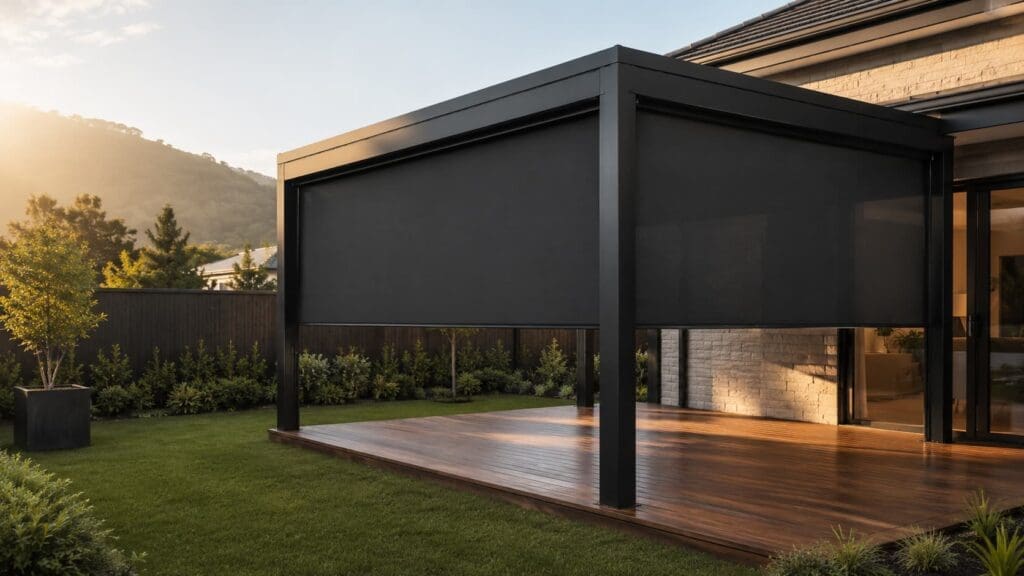
Choosing an outdoor blind is not only about selecting a colour. One of the most important decisions is the openness percentage of the mesh fabric.
The openness percentage affects how much you can see through the blind, how much sunlight enters the area, the level of daytime privacy and how freely air can move through the fabric.
A lower percentage means a tighter weave. A higher percentage means larger gaps between the fibres.
As a general rule:
However, there is no single percentage that is ideal for every outdoor area.
The openness percentage describes how much open space exists within the fabric weave.
A 5% openness mesh has approximately 5% open area, while the remaining fabric helps reduce sunlight, glare and visibility through the blind. As openness increases, the material generally becomes easier to see through and allows more light and airflow into the area.
Openness should not be confused with the percentage of UV or heat blocked. Those figures vary between fabric ranges, colours and manufacturers, so the technical specifications for the selected fabric should always be checked.
A 14–15% openness blind has a relatively open weave.
This option is suitable when preserving the view is the main priority. It allows more daylight and airflow through the blind and creates less visual separation between the covered area and the surrounding landscape.
Fabric with approximately 14% openness is commonly promoted for its natural light and strong outward visibility.
A 14–15% fabric will generally provide less privacy, glare reduction and solar protection than a tighter weave. It may not be the best option for a west-facing area exposed to strong afternoon sun.
It also provides less protection from wind-driven dust and light rain than a denser mesh.
For many New Zealand homes, 5–6% openness offers the most practical balance.
It provides reasonable outward visibility while noticeably reducing sun, glare and unwanted visibility into the outdoor area. Manufacturer guidance commonly positions fabrics around 4–5% as a balance between daylight, views and visual privacy.
A person sitting inside the covered area can normally still see outside during daylight, particularly when a darker mesh colour is selected.
At the same time, the tighter weave creates a more sheltered feeling than a 14–15% fabric.
When a customer is unsure which fabric to choose, 5–6% openness is usually the safest starting point. It gives a good combination of visibility, privacy, airflow and everyday sun control without making the outdoor area feel completely enclosed.
A 1–3% openness fabric has a very tight weave.
It is designed for situations where reducing glare, direct sunlight and visibility into the area is more important than maintaining a completely clear view.
Fabrics around 1% openness can provide strong glare control while retaining some outward visibility. However, they admit less daylight than 4–5% fabrics.
The area may feel darker when the blinds are fully lowered. Airflow will also be more restricted than with a 5%, 10% or 15% mesh.
For this reason, 1–3% openness is usually selected for a specific privacy or sun-control requirement rather than as the automatic choice for every side of a pergola.
No mesh outdoor blind should be treated as a completely waterproof wall.
A tighter weave may reduce the amount of wind-driven rain entering an area, but water can still pass through the fabric or around the blind system. Mesh fabrics are generally intended to reduce sun, glare, insects, dust and moderate weather exposure while maintaining some ventilation.
Where stronger rain protection is required, clear or tinted PVC may be considered. PVC provides a more enclosed result but offers little or no airflow and can change how heat and condensation behave inside the space.
PVC and opaque fabrics are not normally selected using mesh openness percentages in the same way.
It can influence how much air passes through the fabric, but openness percentage is not a wind rating.
A tighter mesh can reduce more wind at normal operating conditions, while a more open mesh allows more air to pass through. However, the safe performance of an outdoor blind also depends on:
Side-retained blind systems are specifically used to secure the fabric within channels and maintain tension across the opening.
Outdoor blinds should still be raised during weather conditions that exceed the system’s stated operating limits.
Fabric colour can significantly affect visibility.
Black, charcoal and dark grey fabrics usually provide the clearest outward view because the eye tends to look past the darker fibres.
Darker fabrics can therefore make the blind appear less noticeable when looking from inside the outdoor area.
White, cream and light grey fabrics can create a brighter appearance and may provide greater daytime visual screening. However, the fabric itself is often more visible when looking outward.
Phifer notes that darker shading fabrics tend to provide better outward visibility, while lighter materials can offer more privacy. Lighting conditions still affect the final result.
The mesh colour should be viewed in a real sample rather than selected from a screen alone.
Mesh blinds do not guarantee nighttime privacy.
During the day, the brighter exterior generally makes it harder to see into the shaded area. At night, this relationship can reverse. When lights are turned on inside the pergola or room, people outside may be able to see through the blind more easily.
A lower openness percentage improves screening, but it should not be treated as complete nighttime privacy.
For areas requiring full privacy, consider:
Yes. Using the same fabric on every side is not always the best solution.
For example, a pergola could use:
The colours can usually remain consistent so the blinds still look coordinated when viewed from outside.
| Main priority | Suggested openness |
|---|---|
| Maximum view and airflow | 14–15% |
| Balanced everyday performance | 5–6% |
| Greater privacy and sun reduction | 1–3% |
| Near-total visual screening | Opaque fabric |
| Clear weather enclosure | Clear or tinted PVC |
These recommendations are general. Final performance depends on the selected fabric, colour, blind size, orientation and surrounding environment.
Before ordering outdoor blinds, consider:
Answering these questions is more useful than automatically choosing the tightest available mesh.
For most residential pergolas and patios, 5–6% openness is the strongest all-round choice.
Choose 14–15% when the view and ventilation are the main priorities. Choose 1–3% when privacy, glare reduction or strong afternoon sun is the main concern.
Where different sides of the structure face different conditions, combining openness percentages may produce a better result than using one fabric throughout.


