
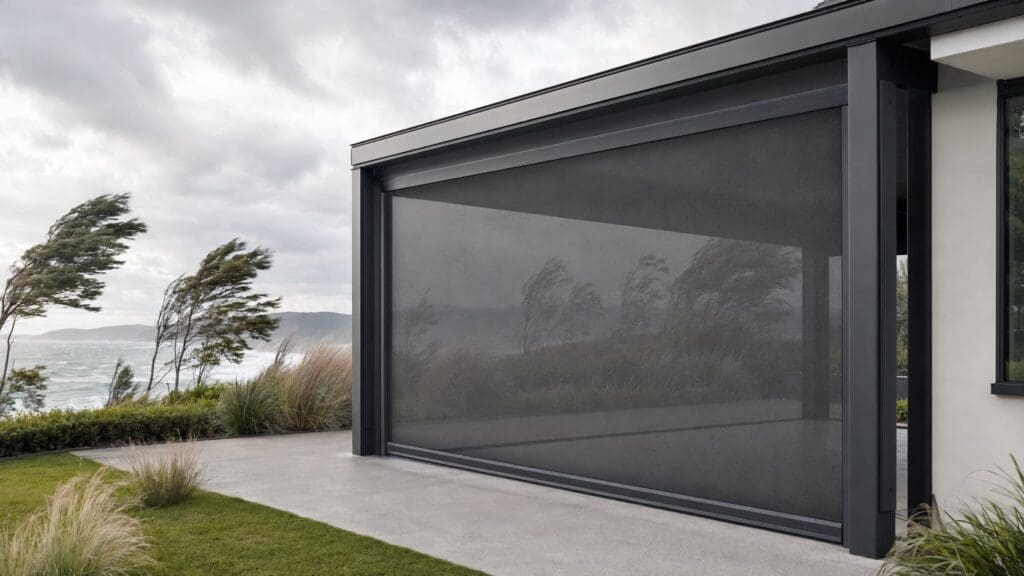
Outdoor blinds can provide shade, privacy and weather protection, but the type of fabric selected becomes especially important in exposed or high-wind locations.
Clear PVC blinds may appear to offer the greatest protection because they create a solid barrier. However, that solid surface can also become a disadvantage when wind pressure increases. For coastal properties, exposed decks, pergolas and commercial outdoor areas, a Titan mesh blind is generally the stronger and more practical option.
When wind reaches a blind, it needs somewhere to go.
Clear PVC creates a completely solid surface. Rather than allowing air to pass through, the PVC absorbs the pressure across the full width and height of the blind. This can create a “sail effect”, transferring substantial force into the fabric, bottom rail, roller, side channels, brackets and supporting structure.
The larger the blind, the greater the surface area exposed to this pressure.
Wind load also increases rapidly as wind speed rises. If the wind speed doubles, the resulting pressure can be approximately four times greater. This is why a blind that appears stable in a moderate breeze can experience significantly more force when exposed to strong gusts.
In general terms, wind conditions in New Zealand are described as:
| Wind description | Approximate speed |
|---|---|
| Fresh winds | 30–39 km/h |
| Strong winds | 40–62 km/h |
| Gale-force winds | 63–89 km/h |
| Severe gales | Mean speeds of at least 90 km/h or frequent gusts exceeding 110 km/h |
These classifications are based on MetService wind-speed terminology.
For an outdoor blind, wind pressure can become significant before gale-force conditions are reached. Localised gusts around building corners, coastal properties, elevated sites and gaps between structures may be much stronger than the general forecast suggests.
Clear PVC provides excellent visibility and creates a strong barrier against rain. However, its solid construction means there is no pathway for wind to filter through the blind.
In high-wind conditions, this can result in:
PVC can be suitable for sheltered patios and protected openings, but it is not normally the preferred fabric for a location that regularly receives strong or turbulent winds.
Titan mesh fabric is not a completely solid surface. Its woven construction allows a controlled amount of air to filter through the material.
This means the blind does not present the same uninterrupted impact surface as clear PVC. Some of the air can pass through the mesh rather than forcing the blind and its hardware to absorb the full wind load.
This provides several important benefits:
Mesh does not eliminate wind pressure completely, but it can reduce the force acting against the blind compared with a fully solid PVC surface.
Titan outdoor blinds are cyclone-rated and designed for demanding outdoor environments.
Unlike a traditional loose-sided blind, the Titan system uses heavy-duty side channels and a zip-retention system that keeps both sides of the fabric securely guided. This prevents the edges from moving freely and helps maintain fabric tension across the opening.
The system combines:
The Titan V7.3 and V8 ranges can be configured for residential, commercial and extra-wide outdoor openings. The appropriate model depends on the opening dimensions, installation location and expected wind exposure.
Not every mesh fabric performs in exactly the same way. Fabric openness describes the percentage of the surface that allows light and air to pass through.
A more open mesh generally provides:
A tighter or lower-openness mesh generally provides:
The correct choice involves balancing wind exposure against privacy, shade and weather-protection requirements.
For a highly exposed location, a more open mesh may be preferable because it allows more air to pass through. For a sheltered area where privacy, rain protection or noise reduction is the priority, a tighter mesh may be more appropriate.
| Consideration | Titan mesh blind | Clear PVC blind |
|---|---|---|
| Airflow | Allows controlled airflow | Blocks airflow |
| Wind pressure | Reduced by fabric permeability | Absorbed across the full surface |
| Sail effect | Lower | Higher |
| High-wind suitability | Better suited | Best in sheltered locations |
| Side retention | Secure zip-track system | Depends on the blind system |
| Visibility | Filtered outward visibility | Clear visibility |
| Privacy | Depends on openness and colour | Limited during daylight |
| Solar control | Very good | Limited unless tinted |
| Rain protection | Good, depending on openness | Very good |
| Large openings | Titan V8 options available | Wind loading becomes a major consideration |
| Creasing and distortion | Generally lower | PVC may crease or stretch |
| Ventilation | Maintained | Outdoor area can become enclosed |
A cyclone rating does not mean that every Titan blind can remain lowered during every cyclone or extreme-weather event.
The applicable rating depends on:
A cyclone-rated blind must be installed into a structure capable of supporting the expected loads. A strong blind attached to an unsuitable fascia, lightweight frame or inadequate fixing point will not achieve the intended performance.
All blinds should be operated in accordance with the wind-rating, installation and care instructions supplied for the particular configuration.
Titan mesh blinds are particularly suitable for:
They can provide protection from sun, glare, wind and light rain without completely sealing the area or creating the same solid impact surface as PVC.
The decision should not be based on fabric alone. The opening size, wind direction, surrounding buildings and strength of the supporting structure should all be considered.
Apollo NZ can supply Titan blinds in different sizes, fabric openness levels and operating configurations. For larger or highly exposed openings, the Titan V8 provides a heavy-duty option with configurations available for substantial widths and heights.
Clear PVC can be useful where maximum rain protection and unrestricted visibility are the main priorities, particularly in sheltered areas.
For exposed locations where wind performance is more important, Titan mesh blinds are generally the better choice. The mesh allows controlled airflow, reduces the sail effect and works with the Titan zip-track system to provide improved stability.
Combined with its cyclone-rated construction, the Titan system provides a practical outdoor blind solution for New Zealand’s frequently windy conditions.


