
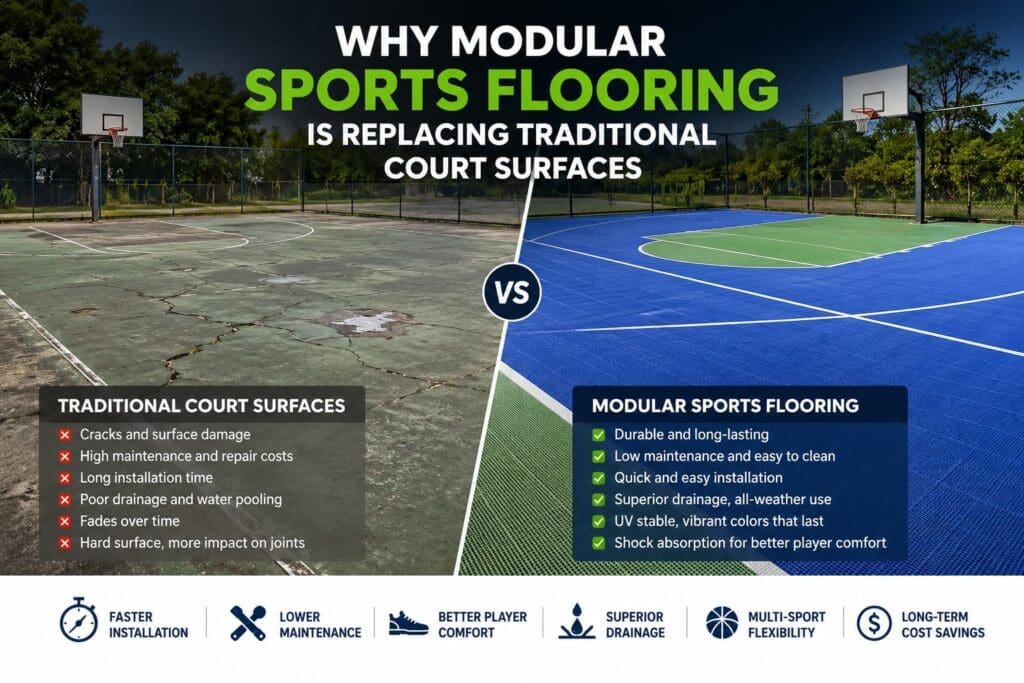
Sports facilities, schools, clubs, councils, and homeowners are increasingly turning to modular sports flooring as a smarter alternative to traditional court surfaces. While concrete and acrylic courts have been the standard for decades, modern modular sports flooring systems offer advantages in performance, installation speed, maintenance, and long-term flexibility.
As sports participation continues to grow, particularly in basketball, pickleball, tennis, futsal, and multi-sport environments, modular flooring is rapidly becoming the preferred choice for new court projects and court upgrades.
Modular sports flooring consists of interlocking polypropylene (PP) tiles designed specifically for sports performance. The tiles connect together to create a seamless playing surface that can be installed over existing hard surfaces such as concrete or asphalt.
Modern systems are engineered to provide:
Unlike traditional court construction, modular flooring creates a finished sports surface without requiring multiple layers of acrylic coatings or extensive site preparation.
One of the biggest reasons modular flooring is replacing traditional surfaces is installation speed.
Traditional court construction often requires:
This process can take several weeks depending on weather conditions.
Modular flooring can often be installed in a matter of days once the base surface is ready. Many facilities can continue operating with minimal disruption, making it particularly attractive for schools, clubs, and community centres.
Hard concrete and acrylic courts can place significant stress on joints and muscles during play.
Modular sports flooring is designed with integrated suspension structures underneath the tile surface. These systems help reduce impact forces while maintaining excellent responsiveness for sports performance.
Benefits include:
For facilities hosting frequent play, tournaments, or training sessions, player comfort is becoming an increasingly important consideration.
Traditional acrylic courts require ongoing maintenance including:
Over time, weather and UV exposure can cause coatings to fade and deteriorate.
Modular flooring requires relatively minimal maintenance:
If a section becomes damaged, individual tiles can be replaced without resurfacing the entire court.
Many facilities already have existing hard surfaces that are underutilised.
Modular flooring allows:
Rather than demolishing existing surfaces, modular flooring can often be installed directly over suitable concrete or asphalt bases.
This significantly reduces renovation costs.
Modern facilities are increasingly looking for spaces that can accommodate multiple sports.
Modular flooring systems can support:
Custom line markings and colour layouts allow facilities to maximise usage from a single court area.
This flexibility makes modular flooring particularly attractive for schools and community facilities where space is limited.
Outdoor courts are heavily impacted by weather conditions.
Most modular sports flooring systems feature open-grid drainage designs that allow water to pass through the surface rather than pooling.
Advantages include:
For outdoor sports facilities, this can significantly increase available playing time.
While initial project costs vary, modular flooring can provide significant long-term value.
Potential savings include:
When life-cycle costs are considered, modular flooring often delivers a more cost-effective solution than traditional court surfaces.
The rapid growth of pickleball and residential sports courts has accelerated demand for modular flooring.
Homeowners are increasingly building:
Modular flooring provides a professional playing surface without the complexity of traditional court construction.
For many residential projects, it offers the fastest and most practical path to a finished court.
As sports facilities seek better performance, lower maintenance costs, and greater flexibility, modular sports flooring is becoming the preferred solution across a wide range of applications.
From schools and community facilities to professional training environments and backyard courts, modular flooring delivers a combination of performance, durability, comfort, and versatility that traditional court surfaces struggle to match.
For organisations looking to maximise court usage while reducing long-term maintenance requirements, modular sports flooring represents the future of outdoor and indoor sports surfaces.


