
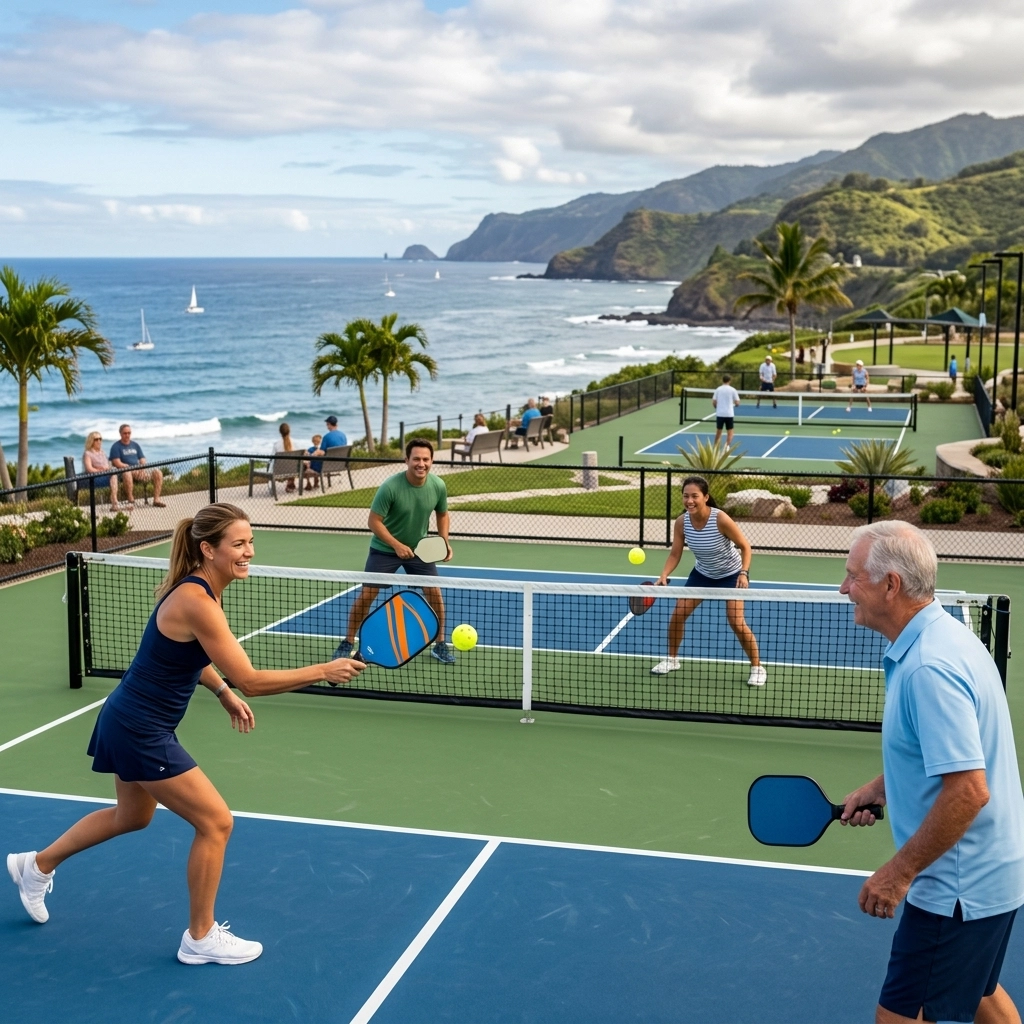
If you’ve spent any time near a local community center or a coastal resort recently, you’ve likely heard it: the distinct pop-pop-pop of a plastic ball hitting a paddle. That is the sound of pickleball, a sport that is currently steamrolling its way across the Pacific. From the shores of the Cook Islands to the suburban backyards of New Zealand and the luxury resorts of Fiji, pickleball has transitioned from a niche hobby to a full-blown regional phenomenon.
In some parts of the Pacific, participation rates are doubling annually. But why? And more importantly, if you are looking to bring this "addictive" sport to your own property or facility, how do you ensure the court you build can withstand the unique challenges of a Pacific climate?
This guide explores the rise of the sport and provides a technical blueprint for planning a professional-grade pickleball court.
The rapid growth of pickleball isn't an accident. While tennis requires a grueling learning curve and significant physical output, pickleball is often described as the "Goldilocks" of sports: it’s just right for almost everyone.
The Pacific region has a diverse demographic, including active retirees and fitness-conscious youth. Because the court is smaller than a tennis court and the ball is lighter, there is less ground to cover and less strain on the joints. This makes it a lifetime sport.
In Pacific cultures, community and social interaction are paramount. Pickleball is inherently social; the proximity of players on a small court allows for constant banter, making it as much a social club as it is a competitive arena.
You can walk onto a court having never held a paddle and be playing competitive rallies within 30 minutes. Research shows that while the 25-34 age group is currently the fastest-growing demographic, the sport bridges generational gaps like no other.

Building a pickleball court in the Pacific requires more than just a flat piece of ground and some net posts. Between high UV indices, salt spray, and tropical deluges, the technical specifications must be precise.
A standard pickleball playing area is 20' x 44' for both singles and doubles. However, the biggest mistake planners make is only clearing enough space for the lines. If a player lunges for a wide shot and hits a fence or a wall, your court becomes a liability rather than an asset.
The 34' x 64' dimension provides a 7-foot side buffer and a 10-foot rear buffer, which is essential for high-level play and safety. If you are integrating this into a multi-sport area: perhaps alongside an in-ground 3x3 basketball hoop: ensure the surfacing transitions are flush to avoid trip hazards.
In the Pacific, your court surface has two major enemies: High UV and Extreme Humidity.
While some DIYers look at modular PP tiles for their ease of installation, professional-grade pickleball courts typically require a permanent, multi-layered acrylic system over a concrete or asphalt base.

Heavy rainfall is a staple of Pacific geography. A court that holds water is a court that breeds algae and becomes a slip hazard.
To ensure rapid drying, the court must be engineered with a 1% to 2% slope (the "planar" slope).
✅ Pro Tip: Ensure the drainage runoff is directed away from buildings or landscaped areas that might erode.
In the Pacific, the sun is a formidable opponent. There is nothing worse than trying to return a 50mph serve while staring directly into a sunset.
Always orient your court North-South. This ensures that the sun stays to the sides of the players during the peak hours of morning and late afternoon. If you are forced into an East-West orientation due to land constraints, you may need to invest in specialized wind-blocking and sun-shading solutions like high-wind protection blinds to mitigate glare.

Once the base and surface are set, the "smart" features determine how often the court is actually used.
A 10-foot high chain-link fence is standard. In coastal areas (Fiji, Cook Islands, coastal NZ), ensure the fencing is vinyl-coated or made of high-grade galvanized steel to prevent rust from salt air.
Standard floodlights create "hot spots" and shadows that make tracking a fast-moving ball difficult. Look for LED sports lighting with asymmetrical optics. These lights are designed to push illumination onto the court surface evenly without blinding the players.
For a professional feel, use permanent net posts sleeve-mounted into the concrete. While portable nets are convenient, they lack the tension required for the "net cord" shots that are a staple of competitive pickleball.
To ensure your Pacific pickleball court is built to last, follow this essential technical checklist:
Pickleball is more than a trend; it is a structural shift in how we view outdoor recreation in the Pacific. By prioritizing proper drainage, orientation, and high-performance surfacing, you can create a facility that serves the community: or your family: for decades to come.
Key Takeaway: Success in pickleball court construction lies in the preparation of the sub-base and the precision of the slope. In a region defined by sun and rain, cutting corners on drainage or UV protection will lead to a failed surface within 24 months. Plan for the climate, and the players will follow.


