
The Pacific Islands present one of the most demanding environments on Earth for structural engineering. While the tropical climate is a primary draw for tourism and residential development, the combination of high salinity, extreme humidity, intense UV radiation, and seasonal cyclonic activity creates a "perfect storm" for material degradation. Traditional housing methods: often reliant on timber framing or standard light-gauge steel: frequently succumb to these elements within a few short years.
To address these challenges, Arborlon Expandable Container Houses have been engineered with a specific focus on coastal resilience. This guide examines the technical specifications and engineering choices that allow these structures to thrive where conventional buildings fail.
In coastal Pacific regions, the atmosphere is perpetually laden with chloride ions from sea spray. When combined with humidity levels that often exceed 80%, the result is an incredibly corrosive environment.
Understanding these factors is the first step in appreciating the specialized engineering found in expandable container houses.
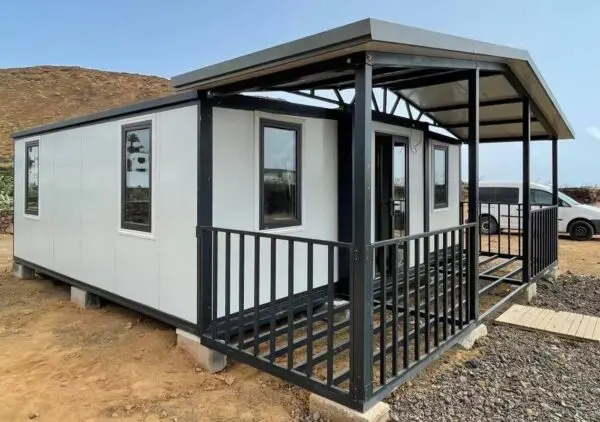
The foundation of coastal resilience lies in the choice of raw materials. Arborlon structures move away from standard construction steel in favor of high-performance alloys designed for marine exposure.
The primary structural frame of an Arborlon house is constructed from specialized alloy steel. Unlike mild steel, this alloy is formulated to provide higher tensile strength while maintaining a better base resistance to oxidation. This ensures that the skeleton of the home remains rigid even under the stress of high-velocity winds.
A common failure point in modular housing is the hardware. If a carbon steel bolt rusts, the entire joint is compromised. Arborlon utilizes 316L marine-grade stainless steel for critical fasteners and fittings.
For window frames, door trims, and external flashing, aluminum alloys are used. Aluminum naturally forms a protective oxide layer, ensuring that moving parts like sliding doors do not seize up or corrode due to salt-laden moisture.
Material selection is only half the battle; the exterior coating system provides the primary shield against the environment. Arborlon utilizes a rigorous three-stage marine coating process to ensure long-term durability.

One of the most significant advantages of the Arborlon design is its fully sealed and welded structural frame. Many modular homes rely on mechanical joints (bolts and brackets) that can loosen over time or provide entry points for moisture.
By utilizing seamless welded frames, the structure functions as a single, cohesive unit. This is critical for two reasons:
To complement the welded frame, marine-grade gaskets and high-performance weatherproofing seals are applied to all joints where the container expands. This ensures that the interior remains a dry, climate-controlled environment, regardless of the conditions outside.
Technical claims of "rust-proof" or "weather-resistant" are only as good as the testing behind them. Arborlon components undergo ASTM B117 Salt Spray Testing.
This is an accelerated aging test where materials are placed in a high-temperature chamber and subjected to a continuous fog of 5% salt solution. Surviving this test for extended periods (often 1,000+ hours) is the benchmark for products destined for offshore oil rigs and ocean-going vessels. By meeting these standards, these homes prove their ability to endure decades of exposure in locations like Fiji, Samoa, or the Cook Islands.

The "expandable" nature of these houses is not just a design feature; it is a logistical necessity for the Pacific region. Transporting building materials to remote islands or coastal areas is notoriously difficult and expensive.
For NGOs providing emergency housing or developers working on remote commercial hubs, this speed of installation is a game-changer. It bypasses the "building material lag" often experienced in island nations where timber and cement must be imported in multiple shipments.
While engineered for the harshest coastal conditions, the versatility of the Arborlon system makes it suitable for a wide range of uses across the Pacific:
Because these units are designed to integrate with other high-performance systems: such as marine-grade louvre systems: they can be customized to maximize natural ventilation while maintaining full protection from the elements.

When evaluating housing for the Pacific Islands, the following technical features of the Arborlon system provide the necessary confidence for long-term investment:
Building in the Pacific requires a departure from standard mainland construction philosophies. By prioritizing marine-grade materials and multi-stage protection systems, the Arborlon expandable house offers a technically superior solution for coastal resilience, ensuring safety and longevity in one of the world's most beautiful: yet punishing( climates.)


