
You're probably in one of two places right now. You've either had a wood-fired pizza at a mate's place and can't stop thinking about that blistered crust and smoky finish, or you're planning an outdoor area and trying to decide whether a wood burning oven for pizza is a worthwhile centrepiece or just an expensive weekend toy.
In New Zealand, that decision sits inside a bigger reality. Our outdoor spaces work hard. They host family dinners, slow Sunday lunches, birthday gatherings, and those shoulder-season evenings when the weather turns mid-meal and the setup still needs to function. A pizza oven that looks good in a showroom but struggles with wind, damp firewood, awkward placement, or council confusion won't stay enjoyable for long.
The good news is that a well-chosen wood oven can be one of the most rewarding pieces of outdoor equipment you'll own. It brings theatre, heat, and a cooking style that standard barbecues and indoor ovens don't replicate. The trick is buying with Kiwi conditions in mind, then learning to run the oven properly from day one.
A proper wood-fired pizza night has a rhythm to it. Someone is stretching dough on a board near the bench. Another person is choosing toppings. The fire is settled, the dome is glowing, and every guest drifts toward the oven because that's where the action is. People don't just eat around a wood oven. They gather around it.
That's a big part of why wood-fired ovens keep showing up in better outdoor spaces across New Zealand. They do more than cook dinner. They anchor the whole entertaining area. You get warmth, smell, movement, and a reason for everyone to stay outside longer.
The broader market reflects that appeal. Wood-fired pizza ovens hold a 38.2% share of the global outdoor pizza oven market, ahead of gas-fired units at 31.4%, and the overall category was valued at USD 180 million in 2023 with a projection to reach USD 460 million by 2032 at an 11.2% CAGR, according to DataIntelo's outdoor pizza oven market report. That global preference lines up neatly with what many Kiwi homeowners already value. Food that feels less manufactured, outdoor cooking that draws people in, and equipment that becomes part of the property rather than something dragged out a few times each summer.
New Zealand buyers usually aren't chasing convenience alone. If convenience were the only goal, a standard gas grill would do. What they want is a more memorable cooking experience and a stronger connection between the kitchen, the deck, and the people using both.
A wood burning oven for pizza suits that style of living because it rewards participation. You feed it, read it, manage it, and cook by feel as much as by timer. That sounds like work to some people. To the right buyer, it's the whole point.
A good wood oven changes the pace of entertaining. Guests stop being passive and start joining the process.
Many buyers go wrong. They shop on appearance first, then discover later that placement is awkward, heat-up takes patience, and wet timber ruins the session before the first pizza goes in.
The owners who enjoy their ovens most usually get three early decisions right:
A wood oven can absolutely deliver restaurant-style pizza at home. It can also become the best-used feature in your outdoor room. But only when the dream is matched by a realistic setup.
The simplest way to understand a wood oven is to stop thinking of it as a box with a fire in it. Think of it as a thermal battery. You burn wood to charge the oven's mass, then that stored energy cooks the pizza through several forms of heat at once.
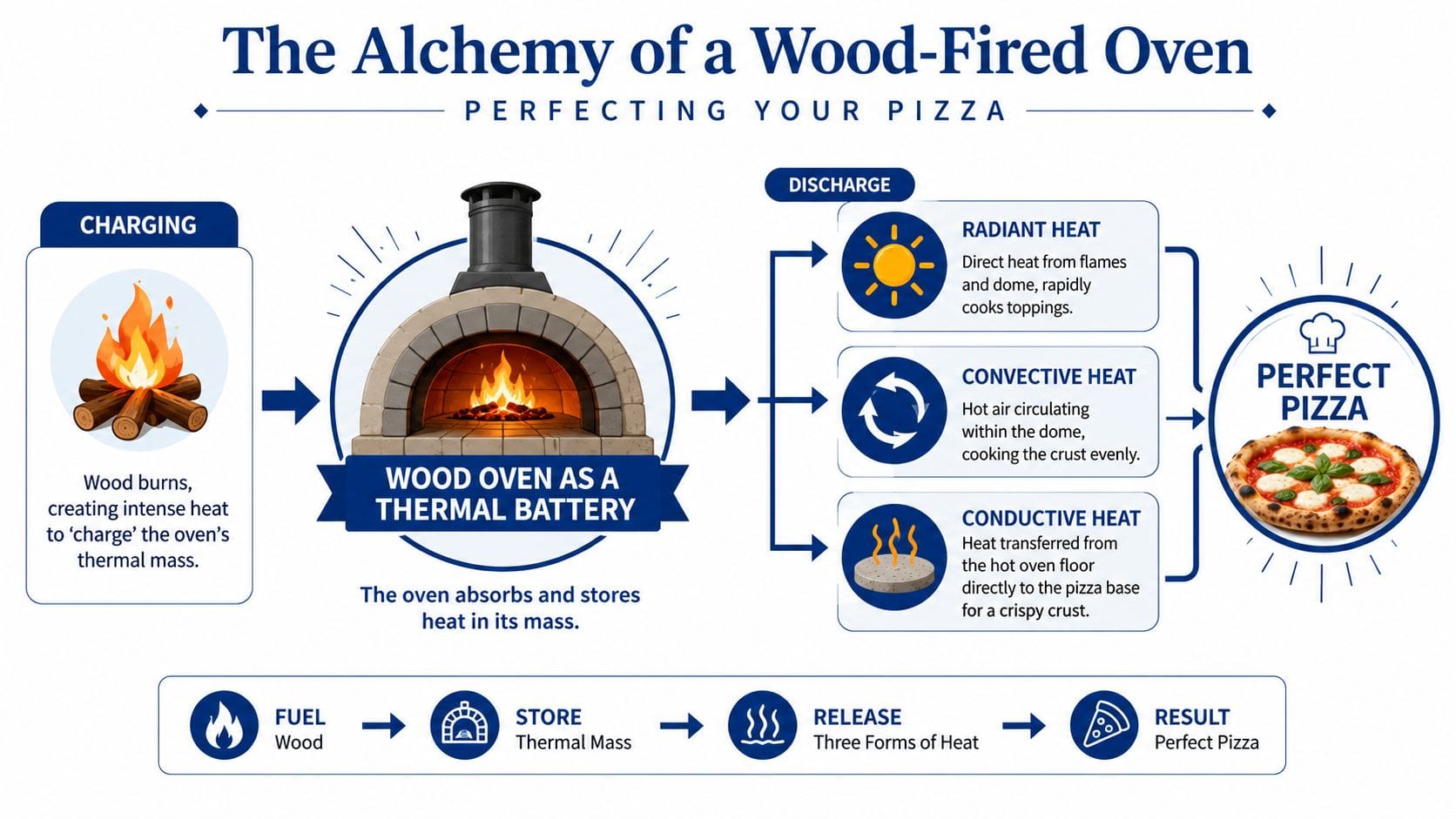
A household oven mostly relies on heated air. A wood oven does much more than that. The floor bakes the base directly. The dome throws heat back down onto the toppings. The live fire and hot chamber keep air moving through the cooking zone. That combined effect is why the pizza can finish so fast without tasting rushed.
A traditional wood-fired oven has a documented thermal efficiency of 13 ± 4% and reaches 400°C (750°F) for the rapid baking style associated with authentic pizza, as outlined in this published study on traditional wood-fired ovens. That same source also notes that enthusiasts value the process for its social and artistic character, even though gas is easier.
That detail matters because many first-time buyers assume hotter always means harsher. In a good oven, hotter means shorter exposure. A thin pizza gets set quickly before toppings dehydrate and before the crust dries out.
Three kinds of heat work together.
If one of those is missing, the result is usually disappointing. A hot floor with weak top heat burns the base before the toppings are ready. Too much live flame without a charged floor gives colour without structure.
Practical rule: Don't judge a wood oven by flame alone. Judge it by whether the floor, dome, and chamber are working together.
For NZ users, this balance becomes even more important outdoors. Wind enters the mouth of the oven. Damp air affects fuel quality. Rainy-day light can make visual cues harder to read. A good operator compensates by watching the oven surface, the coal bed, the pizza edge, and the pace of the bake.
A wood burning oven for pizza isn't magic. It's controlled stored heat. Once you understand that, buying and using one becomes far less mysterious.
The oven that suits a compact patio in Christchurch usually isn't the same oven that suits a built outdoor kitchen in Tauranga or a hospitality-style entertaining area in Queenstown. Buyers often jump straight to finish colour or dome shape, but the more useful starting point is how the oven will live on site.
Here's the simplest comparison framework.
| Oven Type | Portability | Heat-Up Time | Cost | Best For |
|---|---|---|---|---|
| Portable | High | Shorter than full masonry styles | Lower entry point | Casual users, smaller decks, flexible layouts |
| Modular kit | Limited once installed | Moderate to longer | Mid-range to higher | Homeowners who want permanent performance without full custom build |
| Fully assembled | Low | Moderate | Mid-range to higher | Buyers wanting a ready-made permanent feature |
| Custom built-in | None | Varies by build and mass | Higher overall project complexity | Architectural outdoor kitchens and integrated entertaining zones |
Portable ovens suit people who want a lighter commitment. They're easier to place and can work well for occasional entertaining. The trade-off is less visual permanence and, in many cases, a smaller cooking envelope.
Modular kits sit in the practical middle. They give you the feel and thermal behaviour of a more substantial oven while keeping the project more predictable than a fully bespoke masonry build.
Fully assembled ovens appeal to buyers who want certainty. The main body arrives engineered, the performance is more knowable, and the installation path is cleaner.
Custom built-in ovens look fantastic when they're done properly. They also create the most room for poor decisions if the builder doesn't understand oven behaviour, movement, support, and weather exposure.
This is the part generic overseas advice gets wrong. In New Zealand, the build versus buy decision isn't just about whether you enjoy DIY.
According to The Fire Brick Co NZ FAQ, many guides oversimplify the issue by ignoring thermal expansion risks in volcanic soil regions, the scarcity of certified refractory bricks, and the reality that pre-assembled units with engineered thermal buffers often outperform DIY builds that can crack under NZ's daily temperature swings.
That's a serious point. Masonry ovens don't fail only because someone used the wrong mortar or rushed the cure. They also fail because movement, substrate behaviour, and uneven expansion weren't respected from the start.
A few practical buying observations usually help:
For buyers comparing premium home use with light commercial-style entertaining, these NZ hospitality pizza oven insights are useful because they frame the decision around throughput, workflow, and installation reality rather than pure aesthetics.
A larger oven sounds appealing until it's underused and slow to bring to life for a quick weeknight cook. A smaller oven sounds efficient until you're trying to feed a crowd and constantly waiting for space.
Choose based on how you cook:
The right oven feels proportionate to the space and natural to use. The wrong one turns every cook into a compromise.
A well-bought oven can still be a poor project if it's sited badly. Most installation problems aren't dramatic. They show up later as drifting smoke, uncomfortable working space, damp fuel storage, awkward access, and an oven nobody wants to fire up in marginal weather.
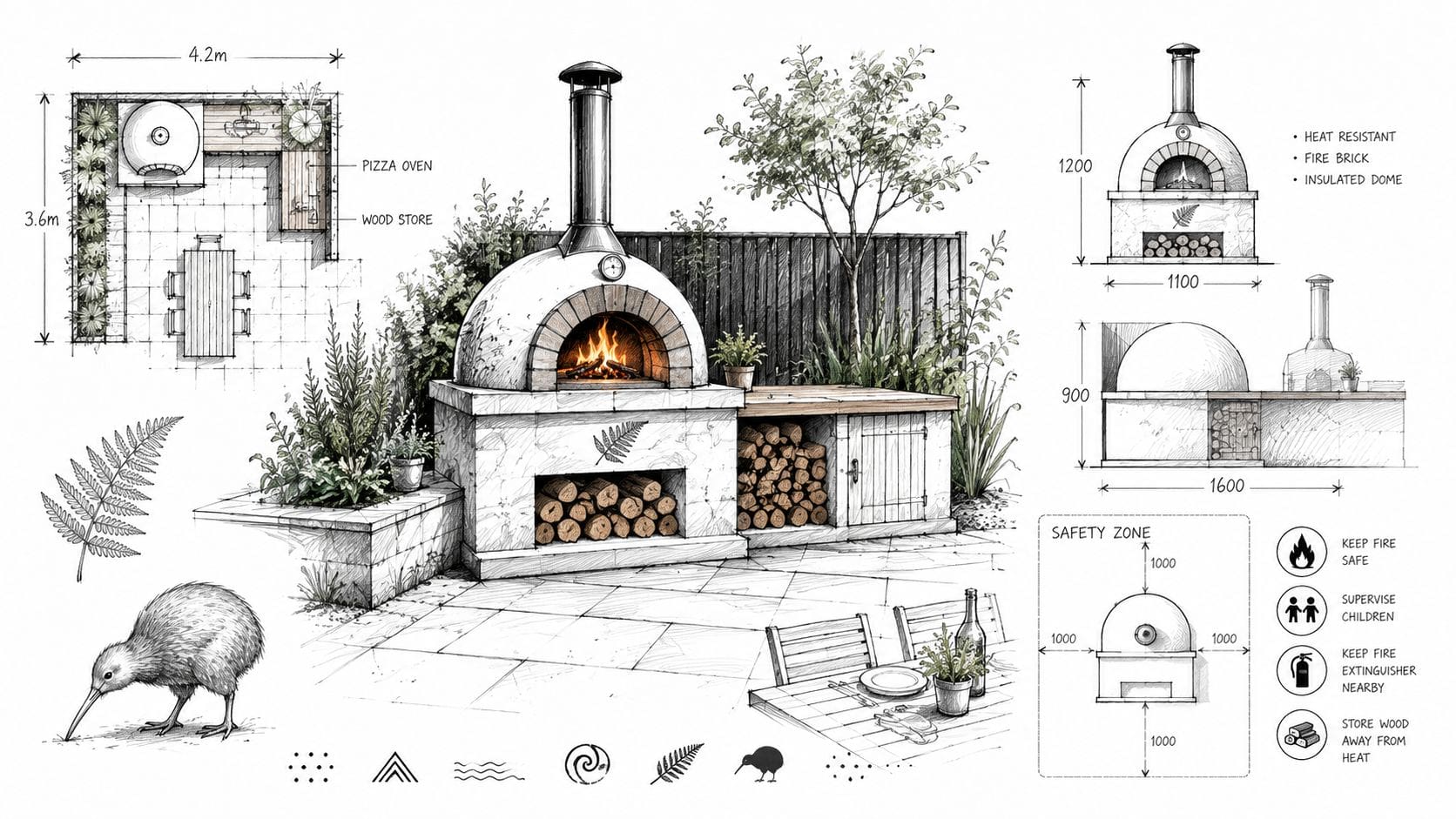
Start with the user, not the oven. The cook needs room to move, launch, turn, retrieve, plate, and talk without backing into furniture or carrying hot food through a traffic lane.
A strong installation usually includes:
If you're integrating the oven into a broader outdoor room, this outdoor kitchen planning guide from Task Masters Inc. is helpful for thinking through layout flow, surfaces, and appliance relationships. For a New Zealand-specific look at making the outdoor area itself more usable across the seasons, Apollo NZ's ideas on creating an outdoor room in NZ add useful context around shelter and liveability.
Many NZ homeowners hesitate because they've heard some version of this claim: wood-fired ovens are banned, or they require complicated abatement equipment to be legal. That rumour has travelled far further than the facts.
According to Alfa Forni's review of wood-fired oven regulations, no specific bans exist for domestic wood-burning ovens, and good management practices are key. That means using dry, untreated wood, ensuring proper chimney extraction, and preventing nuisance or indoor contamination.
The legal question is usually simpler than the technical one. Most problems come from poor siting and poor fuel, not from missing exotic control hardware.
That doesn't mean every installation is casual. Local requirements, neighbour impact, and sensible fire safety still matter. But most homeowners don't need to over-engineer their setup because of imported rumours from other jurisdictions.
The smarter approach is straightforward. Put the oven where smoke can rise and move away cleanly. Use clean fuel. Keep the flue path practical. Build for safe operation, not internet panic.
A wood oven rewards patience before it rewards speed. New owners often rush the firing stage because they're hungry, guests are arriving, and the flames look impressive. Then the first pizza sticks, burns underneath, or comes out pale on top.
The oven needs time to absorb heat into its mass before it's ready to cook properly.
A traditional brick oven needs 1 to 2 hours of thermal saturation to reach an operating range of 300°C to 400°C, and the dome interior turning white is one of the key readiness signs. Once ready, the fire is raked to the side to create a radiant cooking zone that can bake a pizza in 60 to 90 seconds, as described in The Fire Brick Co's D95 brick oven guidance.
That timeline tells you something important. The goal isn't just a live flame. The goal is a charged floor and dome.
A practical firing sequence looks like this:
During service, most of the skill lies in restraint. Too much fresh wood creates unstable flame and excess smoke. Too little fuel lets the top heat fade and slows the bake.
The best sessions usually follow a rhythm:
Apollo NZ's write-up on why cooking with fire is making a comeback speaks to the appeal of this style of cooking well. Fire asks for attention, but it gives more back in return.
Watch for this sign: If the top races ahead while the base lags, the floor isn't ready. If the base scorches while the cheese barely moves, your chamber balance is off.
NZ conditions add another layer. Dry fuel matters more than many first-time owners realise. Damp wood drags down the fire, increases smoke, and makes heat control sloppy. On breezy sites, keep your body position and launch angle consistent so wind doesn't disrupt the peel or throw ash into the cooking zone.
A wood burning oven for pizza isn't difficult once the sequence clicks. It's repetitive in the best sense. Fire, saturate, clear, cook, feed, rotate, repeat.
Once the pizza session ends, the oven still has work left in it. That stored heat is too useful to waste. The owners who get the most value from a wood oven treat it as an all-day cooker rather than a single-purpose pizza machine.
After peak pizza temperature, the oven settles into a friendlier range for other food. That's when roasting, baking, and slower dishes start to make sense. Vegetables pick up colour without drying out. Bread benefits from retained masonry heat. Covered dishes can sit and develop while the outdoor gathering continues around them.
This is one reason permanent ovens stay relevant beyond novelty. You're not only paying for a dramatic pizza moment. You're investing in a heat source with a long useful curve after the first rush of service.
For buyers wanting to compare different oven formats and finishes, Apollo NZ's range of XclusiveDecor wood-fired pizza ovens shows the kind of product category that fits both standalone and integrated outdoor setups.
A wood oven doesn't need fussy maintenance, but it does need disciplined habits.
A cared-for oven stays easier to light, easier to manage, and more predictable on the night you really want it to perform.
Choosing a wood burning oven for pizza is rarely just about pizza. It's usually part of a bigger plan to make the outdoor area more social, more useful, and more rewarding to spend time in.
The best outcomes come from matching the oven to the site, the weather exposure, and the way you entertain. Some buyers need a compact unit that fires reliably and fits an existing patio. Others are planning a full outdoor kitchen where the oven sits alongside shading, seating, and prep space. In both cases, the purchase works better when the supplier understands the wider project rather than just the appliance.
For New Zealand buyers, useful support usually means practical help with product fit, layout thinking, and installation pathways where needed. That matters because a premium oven is only one piece of the overall result. Base construction, shelter, flue path, fuel storage, and access all influence whether the oven becomes a favourite ritual or a frustrating feature.
It also helps to see the products in context. This video gives a sense of how wood-fired cooking fits into an outdoor living environment rather than standing alone as a gadget.
Apollo NZ operates as a New Zealand supplier across outdoor living categories, with wholesale-direct pricing, supply-only options, and access to approved agents and installers in selected areas. For a buyer planning a wider outdoor upgrade, that broader scope can simplify the process because the oven, shelter, and surrounding elements don't have to be treated as separate disconnected decisions.
If you've reached the point where the idea has become a real project, keep the checklist simple. Choose the right oven type. Site it properly. Use dry fuel. Learn heat management before inviting a crowd. Build the surrounding outdoor space so the oven gets used in more than perfect summer weather.
A well-set-up wood oven doesn't just make good pizza. It gives the whole property another place to gather.
If you're ready to turn the plan into a real outdoor cooking space, explore Apollo NZ for wood-fired oven options and broader outdoor living products that can support the full project.
Prepared with Outrank


