
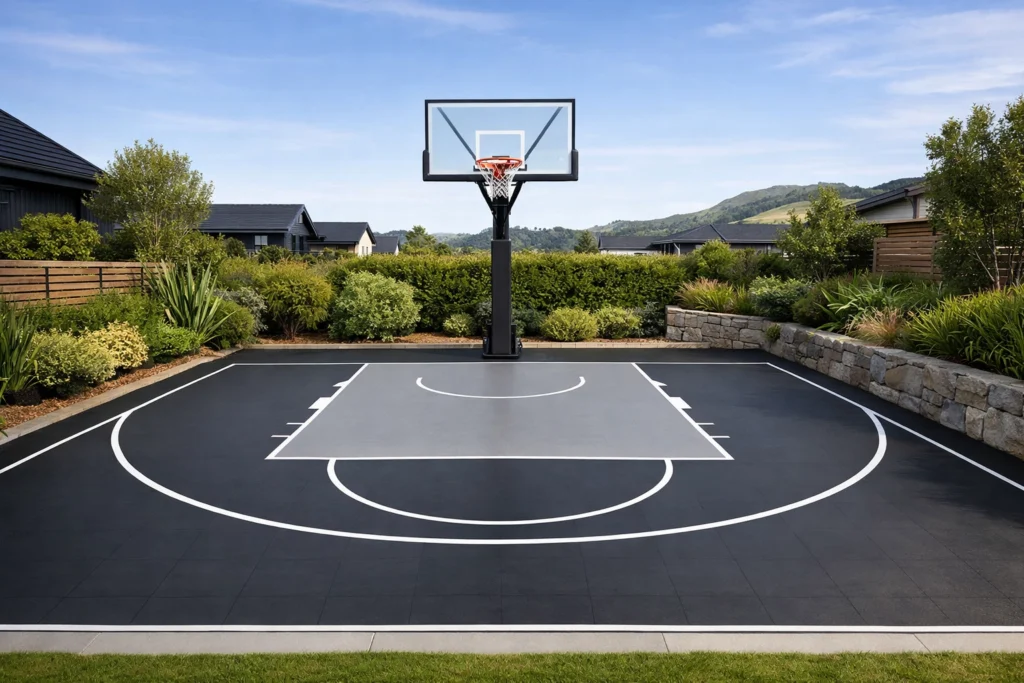
For decades, the backyard has been sacred ground for casual sport, family competition, and after-school energy. But walk through any modern New Zealand suburb today, and you’ll notice a shift in the landscape. Informal play areas are being replaced by purpose-built hoops, and rough open spaces are giving way to the sharp lines of a half-court.
The rise of 3 x 3 basketball isn't just a professional sporting trend; it’s a lifestyle movement that has found its place in residential outdoor spaces. It’s fast, it’s social, and quite frankly, it’s a lot easier to fit on a standard 600-square-meter section than a full-sized tennis court.
If you’ve been wondering why more households are practicing their jump shots until dusk, or if you’re considering turning part of your outdoor area into a dedicated sports zone, here is everything you need to know about the 3x3 revolution.
Before you start painting lines, it’s worth understanding exactly what the game entails. 3 x 3 basketball is the official FIBA-sanctioned version of the game played on a single basket on a half-court. While the "streetball" version of this has existed as long as the game itself, the formalization of 3x3 has turned it into one of the fastest-growing sports in the world.
The rules are designed for speed and intensity:
For the Kiwi homeowner, this format is a dream. It means you don't need a massive backyard or a professional gymnasium to get a high-quality workout or host a competitive game with friends.

New Zealand’s urban density is changing. As sections become more compact, homeowners are looking for ways to maximize the utility of every square inch. A full-sized tennis court is a luxury of the past for most urban dwellers, but a basketball half-court fits perfectly into the modern "outdoor living" philosophy.
A standard FIBA-standardized 3x3 court is 15 meters wide and 11 meters deep. However, for a residential setting, you can go even smaller and still have a highly functional space. Even a 6m x 9m area provides enough room for the key, the free-throw line, and a partial 2-point arc. This creates a flexible, compact play area that still delivers a strong game experience.
Unlike grass-based sports that turn into a mud-pit during a classic Kiwi winter, a paved half-court is a year-round asset. When paired with high-quality drainage and a durable surface, it becomes a space that the kids (and the adults) can use 365 days a year.
A well-designed sports court is no longer seen as a niche addition. It’s a sign of a lifestyle-focused home. It signals that the property is geared toward family wellness and social entertainment. It’s the outdoor equivalent of a home cinema: functional, impressive, and consistently fun.

If you’re moving from the "idea" phase to the "implementation" phase, there are several technical factors to consider. A 3x3 court is more than just a hoop on a wall; it’s a engineered play surface.
While you can play on plain concrete or asphalt, your joints might not thank you for it in ten years.
For a true 3x3 experience, you want a system that can handle the intensity of the game.
To officially call it a 3 x 3 basketball court, you need the right lines. This includes the free-throw line (5.80m from the baseline), the 2-point arc (6.75m from the center of the hoop), and the "no-charge semi-circle" under the basket.

In the modern world, getting kids off screens and into the fresh air is a constant battle. The "must-have" status of the half-court comes from its ability to act as a social magnet. It’s a place where the neighborhood kids congregate, where Friday night BBQs turn into friendly shooting competitions, and where parents can actually spend time with their teenagers in a way that doesn't feel forced.
Integrating the court into your wider outdoor design is key. Imagine a court that sits adjacent to a covered seating area. While the game is in full swing, others can watch from the comfort of a manual or motorised louvre system, staying dry or shaded while staying part of the action.
The best residential courts don’t look like they’ve just been "dropped" into the outdoor area; they feel like part of the home’s architecture. This is where the intersection of sports and design becomes interesting.

Before you break ground, it is vital to check your local council regulations. In many parts of New Zealand, adding a paved surface over a certain percentage of your section can affect your "permeable surface" ratios. This relates to how your property handles stormwater.
Additionally, if you are installing high-mast lighting or exceptionally tall hoop systems, you should be mindful of "recession planes" (the height-to-boundary rules) to keep your neighbors happy. A quick chat with a professional installer or a look at your local District Plan can save a lot of headaches later.
The beauty of a well-installed half-court is the low maintenance. Unlike a pool that requires chemical balancing or a lawn that needs constant mowing, a basketball court simply needs:
The move toward 3 x 3 basketball courts in New Zealand homes is a reflection of how we live now. We value efficiency, we love sport, and we want our homes to be multifunctional hubs of activity. By dedicating space to the game itself, homeowners are creating areas that promote health, community, and genuine fun.
Whether you're a serious player or just someone who wants a bit of "hoop therapy" after a long day at work, the half-court is a versatile, durable, and social addition to any Kiwi home. It’s not just about the game; it’s about making the most of the space you have.


