
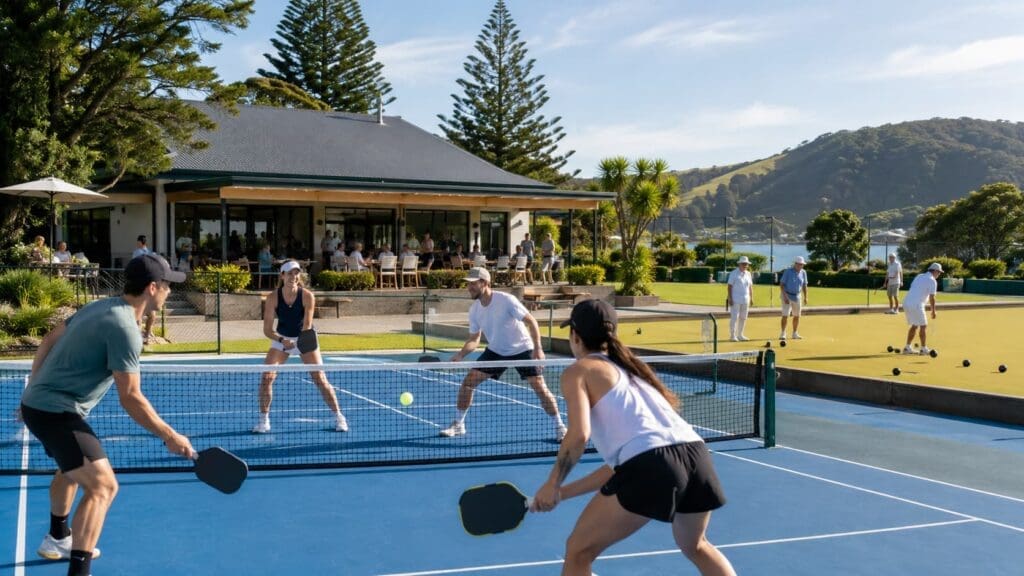
Yes—pickleball courts can often be installed over existing asphalt or tennis courts. Artificial turf is more complicated and is generally unsuitable unless it is removed or specifically designed as a firm court surface.
The condition, firmness, drainage and level of the existing surface will determine which pickleball flooring system is suitable.
Asphalt can provide an excellent base for a permanent or semi-permanent pickleball court. USA Pickleball identifies both asphalt and concrete as acceptable court bases, provided the surface meets the appropriate requirements for drainage, slope and finish. USA Pickleball court construction guidance
Before installing over asphalt, check for:
Minor cracks and shallow imperfections can often be repaired. Asphalt with major movement, subsidence or widespread cracking may require resurfacing before court flooring is installed.
Depending on the intended use, asphalt may support:
Acrylic coatings provide a traditional hard-court finish. Roll-out mats can create a consistent pickleball-specific surface with less construction work, while modular tiles are useful where drainage, easy replacement and multi-sport use are priorities.
Existing tennis courts are among the best locations for introducing pickleball. They usually already provide:
The existing tennis surface should still be inspected for cracks, ponding water and worn areas before adding pickleball flooring or line markings.
A tennis court can be converted in several ways:
Temporary nets and removable court markings allow the space to continue operating as a tennis court. This can be a practical starting point for schools, clubs and community centres testing local demand.
Permanent pickleball lines can be added in a contrasting colour while retaining the original tennis markings. Careful colour selection is important so players can easily distinguish between the different courts.
An older or underused tennis court can be resurfaced and permanently converted into one or more pickleball courts. This can include new flooring, permanent nets, fencing changes and dedicated court markings.
Modular sports tiles or roll-out pickleball mats can be installed over a suitable existing hard court. This provides an opportunity to upgrade the playing characteristics without completely rebuilding the base.
A standard pickleball court measures 6.10 × 13.41 metres inside the lines. However, additional run-off space is essential. USA Pickleball recommends a minimum overall playing area of approximately 9.14 × 18.29 metres, with 10.36 × 19.51 metres preferred where space permits.
The number of pickleball courts that can fit on a tennis court therefore depends on:
Some tennis areas can accommodate multiple pickleball courts, but the layout should never compromise safe space around the baselines and sidelines.
Pickleball can technically be played on some artificial surfaces, but normal landscaping turf, football turf and long-pile synthetic grass are generally not recommended.
Soft or high-pile turf can cause:
The pickleball ball requires a relatively firm, predictable surface. A soft grass-like surface will not normally produce the consistent bounce expected from a proper court.
Generally, they should not be installed directly over ordinary artificial turf.
The turf and its shock pad or infill may allow the flooring to flex, separate or move under players. Connections between modular tiles may also be placed under unnecessary stress.
The better approach is usually to:
If the existing surface is a specialist short-pile, sand-dressed sports turf, it should be individually assessed. It may be adequate for casual recreational play, but it will not necessarily provide the same speed, traction or ball response as a dedicated pickleball surface.
| Existing surface | General suitability | Preparation usually required |
|---|---|---|
| Sound asphalt | Very good | Cleaning and minor repairs |
| Existing acrylic tennis court | Excellent | Cleaning, crack repairs and layout planning |
| Concrete | Very good | Joint, crack and moisture assessment |
| Cracked or uneven asphalt | Conditional | Repairs or resurfacing |
| Short-pile sports turf | Limited | Specialist assessment |
| Landscaping artificial grass | Poor | Turf removal normally recommended |
| Long-pile football turf | Poor | Remove turf and assess the underlying base |
| Compacted gravel or soil | Unsuitable as a direct base | A proper hard base is normally required |
Roll-out mats are suited to facilities wanting a pickleball-focused playing surface with faster installation than a conventional court coating system.
They can work well for:
The base needs to be clean, firm, smooth and properly drained.
Interlocking polypropylene tiles can provide:
The condition of the base still matters. Modular flooring will not correct major dips, potholes or structural movement.
Before choosing court flooring, record:
This information helps determine whether the existing surface can be used as it is or requires preparation.
Pickleball courts can be successfully installed over sound asphalt, concrete and existing tennis courts. These surfaces can support acrylic coatings, modular sports tiles or roll-out pickleball mats when properly prepared.
Ordinary artificial turf is usually not a suitable direct base. In most cases, the turf should be removed so the flooring can be installed over a stable hard surface.


