
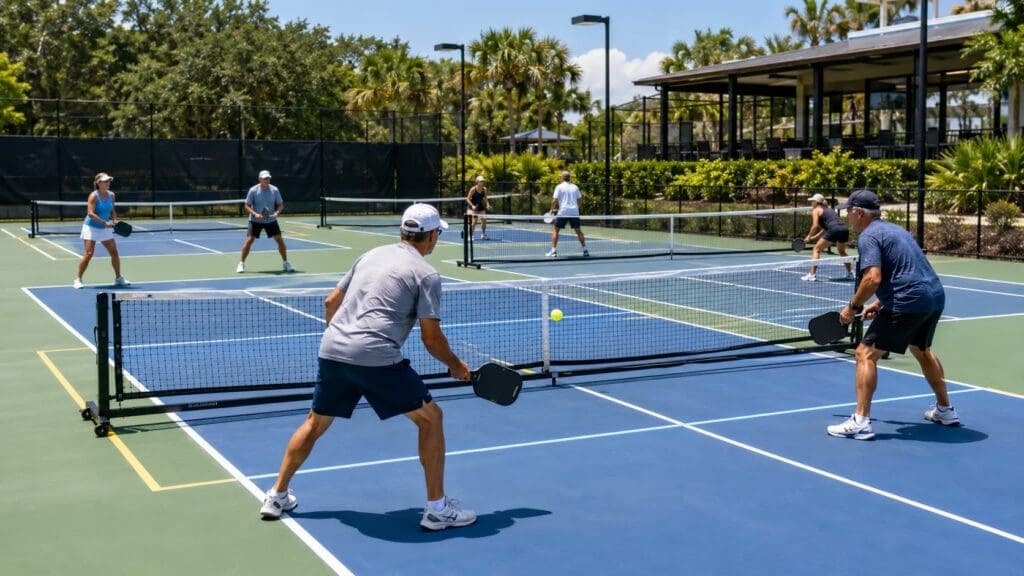
Pickleball is one of the fastest-growing sports worldwide, and tennis clubs, sports centres, schools, and community facilities are increasingly looking at ways to add pickleball courts without the expense of building entirely new facilities. Fortunately, existing tennis courts provide an excellent foundation for pickleball, making court conversion one of the most cost-effective ways to expand participation and generate additional revenue.
Many tennis clubs have seen an increase in demand for pickleball from both existing members and new players. The sport appeals to a broad demographic, from younger athletes to active retirees, creating opportunities to attract members who may not have considered joining a traditional tennis club.
Tennis courts can often sit unused during off-peak periods. By incorporating pickleball, clubs can significantly increase court utilisation throughout the day.
A standard tennis court can accommodate up to four pickleball courts, allowing far more players to use the same footprint at once.
Pickleball opens new opportunities through:
Many clubs find pickleball programs generate strong participation with relatively low setup costs.
A tennis court measures approximately 36.6m x 18.3m including run-off areas.
A pickleball court measures:
Depending on available space and safety clearances, clubs can fit:
The simplest and lowest-cost option is adding pickleball lines to an existing tennis court.
Benefits:
Different colours can be used to distinguish pickleball lines from tennis markings and reduce player confusion.
Best for:
Roll-out pickleball mats have become increasingly popular because they can transform a tennis court into a dedicated pickleball surface within hours.
Benefits:
These systems are particularly useful for clubs that want dedicated pickleball play while maintaining flexibility for tennis events and competitions.
Best for:
Modular sports flooring is one of the most popular long-term conversion solutions.
Benefits:
Many clubs choose modular tiles because they provide a dedicated pickleball playing experience without requiring the removal of the existing tennis surface.
Best for:
For clubs looking to completely reposition part of their facility around pickleball, resurfacing may be the preferred option.
This typically involves:
While the most expensive option, it creates a professional tournament-quality facility.
Best for:
Temporary or portable pickleball nets are ideal for shared courts, while permanent net systems work best for dedicated facilities.
As participation grows, many clubs are upgrading to anti-glare LED sports lighting designed specifically for pickleball.
Benefits include:
Modern pickleball facilities often use contrasting court colours to improve visibility and create a distinctive appearance.
Popular combinations include:
Keep in mind that additional colours can increase installation complexity, as more colour transitions often mean more seams and detailing during construction.
Rather than replacing tennis, pickleball is increasingly complementing it. Clubs that embrace both sports can attract a wider audience, improve facility utilisation, and create stronger revenue opportunities.
For many facilities, the most practical approach is starting with court markings or portable pickleball mats before progressing to modular flooring or dedicated pickleball courts as demand grows.
The result is a flexible, future-focused sports facility that serves more players, more often, while maximising the value of existing court infrastructure.


