

In the New Zealand outdoor living market, the line between a functional private sanctuary and a "fishbowl" environment is often determined by the quality of your shading solution. While off-the-shelf, standard-sized shades are readily available at big-box retailers, they frequently fail to meet the specific technical and privacy requirements of modern Kiwi homes.
Achieving true privacy requires more than just hanging a piece of fabric. It demands precise engineering, high-performance materials, and a fit that leaves no room for sightlines or environmental intrusion. To help you navigate the transition from a standard setup to a professional-grade installation, this guide explores the technical advantages of custom-engineered outdoor blinds.
The primary failure of standard outdoor shades is the "one-size-fits-all" approach. Residential architecture in New Zealand is rarely uniform; deck openings, patio spans, and pergola heights vary significantly from one property to the next.
When you install a standard shade that is "close enough" to the required dimensions, you are left with gaps. Even a 50mm gap on either side of a blind creates a significant sightline for neighbors or passersby. At night, when your outdoor area is illuminated from the inside, these gaps act like beacons, completely undermining the purpose of a privacy screen.
Custom outdoor blinds are manufactured to the millimeter. This ensures a "flush" fit against posts or walls. By eliminating the perimeter gaps, you create a total visual barrier that standard products simply cannot replicate.
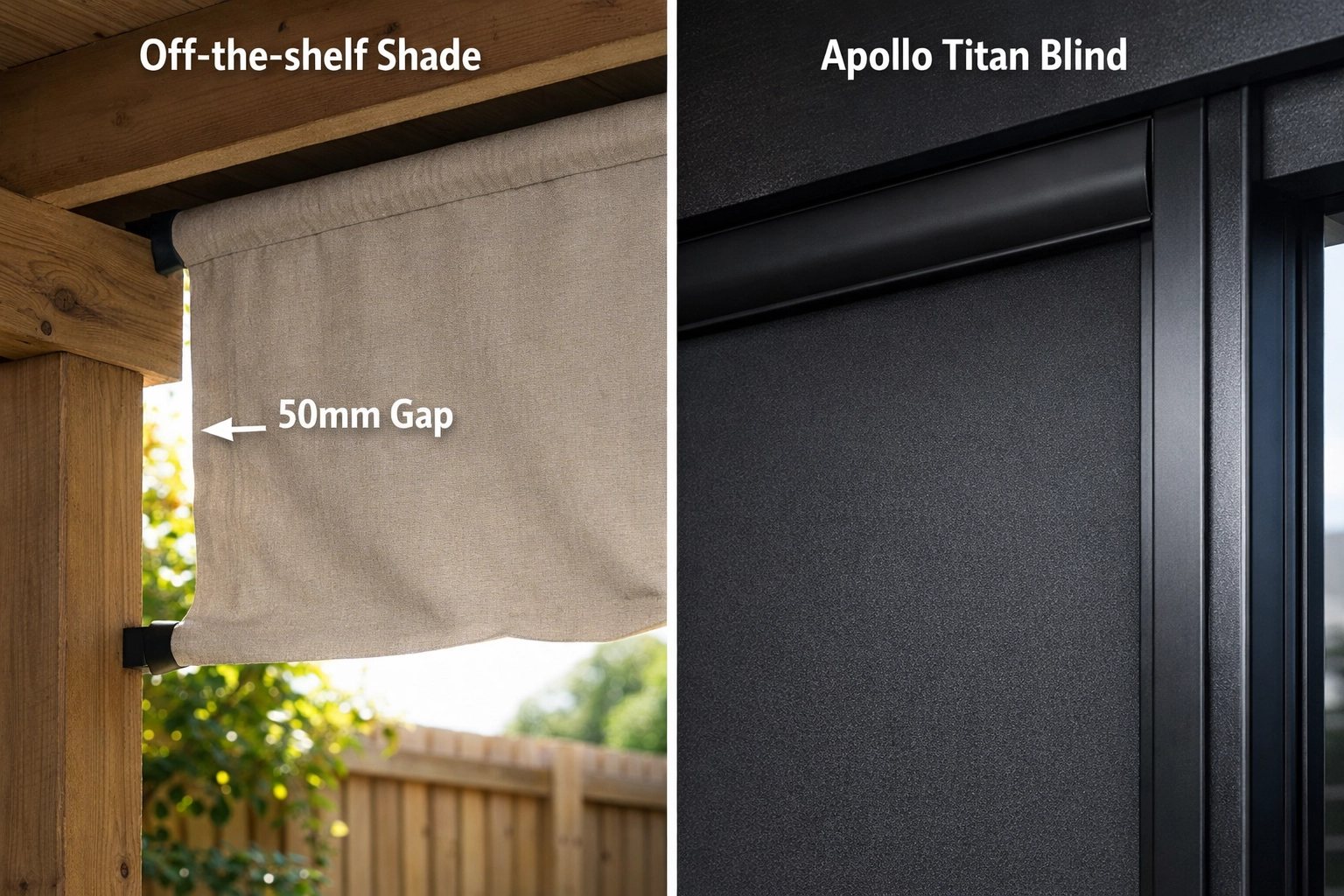
To achieve a professional level of privacy, specify a system that utilizes a track-guided mechanism. Traditional shades often hang freely, meaning they flap in the wind and pull away from the edges of your structure.
Privacy is a function of light transmission. Many homeowners choose standard shades only to realize that while they provide shade during the day, they become transparent at night. This is known as the "silhouette effect."
Fabric for outdoor blinds is rated by its openness factor: usually 1%, 3%, 5%, or 10%.
When ordering custom solutions, you have the authority to specify the exact density required for each side of your patio. You might choose a 1% density for the side facing a neighbor’s driveway and a 5% density for the side facing your own garden. Standard shades rarely offer this level of granular control.
The color of your blind affects both heat absorption and privacy.
New Zealand’s climate is notoriously harsh on outdoor fabrics and mechanical components. High UV indices and sudden coastal gusts can turn a standard, lightweight shade into a liability within a single season.
Standard shades are often made from low-grade polyethylene or thin polyester that becomes brittle after six months of exposure to NZ’s sun. Custom-grade systems utilize PVC-coated polyester or solution-dyed acrylics designed specifically for marine or high-exposure environments. These materials maintain their dimensional stability, meaning they won't stretch or sag over time: a common issue that leads to unsightly gaps in standard setups.
A privacy screen is useless if it has to be retracted every time the wind picks up.
Standard shades are almost exclusively manual. While functional, manual operation often leads to the blinds being left up (sacrificing privacy) or left down (risking damage in a storm) because the effort to adjust them is too high.
Custom outdoor blinds offer the option of motorization. This is a critical feature for privacy management.
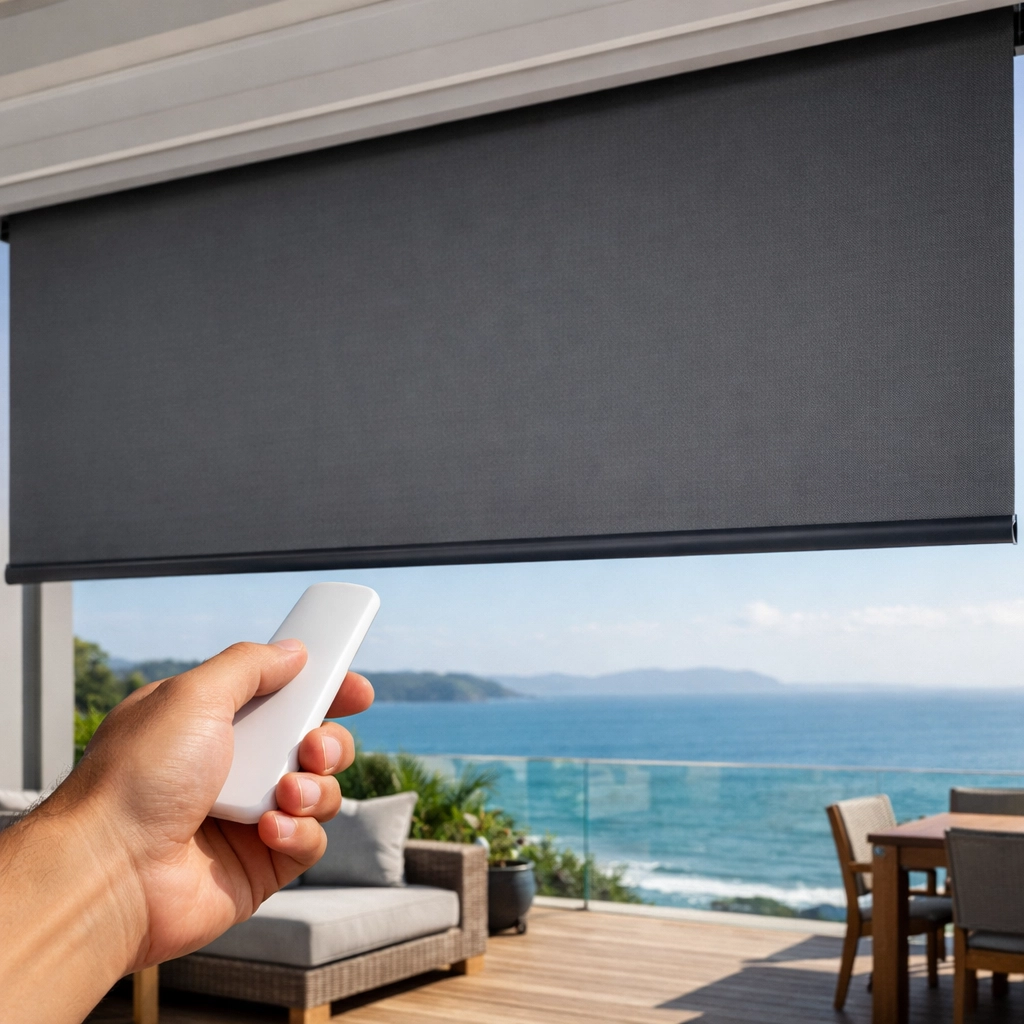
A major drawback of standard shades is that they look like an "afterthought." They come in limited colors (usually beige or charcoal) and the hardware often clashes with the architectural style of the home.
Custom solutions allow for a seamless architectural integration:
While the initial price point of a custom blind is higher than a standard shade, the Total Cost of Ownership (TCO) is often lower. Standard shades typically require replacement every 2–3 years due to mechanical failure or fabric degradation. A custom, professionally installed system can last 10–15 years with basic maintenance.
By sourcing through wholesale direct channels, homeowners and developers can access high-spec systems: the same quality used in commercial resorts: at a price point that bridges the gap between "cheap" retail options and high-end boutique installations. This provides a professional-grade result without the traditional retail markup.
While blinds provide the vertical perimeter of your privacy, they often work best as part of a larger shade strategy. For compact areas where a full blind system might not be feasible, a wall-mounted umbrella can provide targeted overhead shade and privacy from multi-story neighbors. For larger residential or commercial spaces, a multi-canopy system allows for massive coverage while maintaining a high-end aesthetic that complements custom blind installations.
True privacy in an outdoor space is achieved through the elimination of variables. By controlling the dimensions, the fabric density, and the structural integrity of the installation, custom outdoor blinds provide a level of security and comfort that standard shades simply cannot match. Focus on the technical specifications of your space, and invest in a system designed to withstand the environment while keeping your private life private.


