
Over the last few years, both padel and pickleball have exploded in popularity around the world. From community sports clubs and schools to private homeowners and commercial sports facilities, more people are discovering these fun, social, and highly accessible racket sports.
While they may look similar at first glance, padel and pickleball offer very different playing experiences. If you're considering building a court, joining a club, or simply trying a new sport, understanding the differences can help you decide which one is right for you.
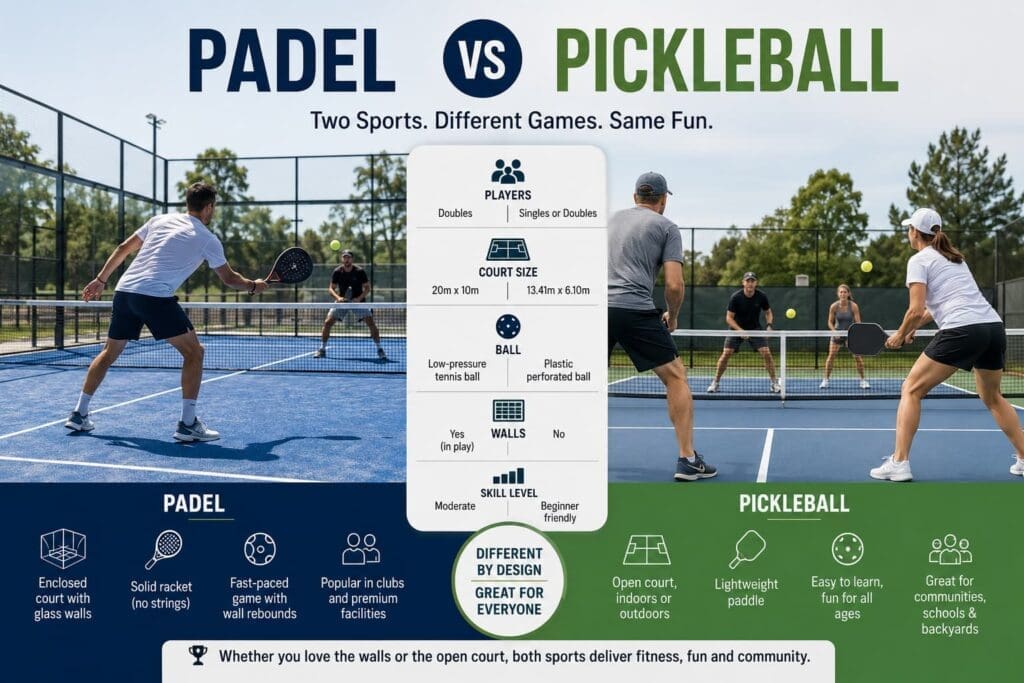
Padel is a fast-paced racket sport that combines elements of tennis and squash. It is played on an enclosed court surrounded by glass and mesh walls, which are used during play to create longer rallies and more strategic shot-making.
Padel is typically played as doubles and uses a low-pressure tennis-style ball along with a solid racket that has no strings.
The enclosed court and wall rebounds add a unique dimension that makes the game both exciting and highly social.
Pickleball is one of the fastest-growing sports in the world. It combines aspects of tennis, badminton, and table tennis into a game that is easy to learn but challenging to master.
Players use lightweight paddles and a perforated plastic ball on a smaller court. The game can be played as singles or doubles and is suitable for players of almost any age or fitness level.
Its simple rules and smaller playing area make it particularly popular among beginners, families, schools, and community groups.
Because pickleball equipment is generally less expensive and easier to source, it often has a lower barrier to entry for new players.
For most beginners, pickleball is the easier sport to learn.
The smaller court, slower ball speeds, and straightforward rules allow new players to become competitive very quickly. Many people can enjoy a full game after just a single session.
Padel also has a gentle learning curve, but understanding wall rebounds and positioning takes more time. Players with a tennis background often adapt quickly to padel.
Both sports provide excellent cardiovascular exercise while being easier on the body than traditional tennis.
The answer depends on your goals.
Many sports facilities are now investing in both sports to cater to different audiences and maximise court usage.
New Zealand has seen strong growth in both sports.
Pickleball has expanded rapidly through community groups, schools, retirement villages, and recreational centres. Its affordability and accessibility have helped drive widespread adoption.
Padel is newer to the market but is gaining momentum as purpose-built courts are developed throughout the country. The sport's premium feel and exciting gameplay are attracting both tennis players and newcomers alike.
Padel and pickleball are both fantastic sports that promote fitness, social interaction, and healthy competition.
If you're looking for an easy-to-learn sport with broad appeal and lower installation costs, pickleball is hard to beat.
If you're after a dynamic racket sport with a premium club atmosphere and exciting wall-play action, padel offers a unique experience unlike any other.
As participation continues to grow across New Zealand, both sports are set to play a major role in the future of recreational and competitive court sports.


