
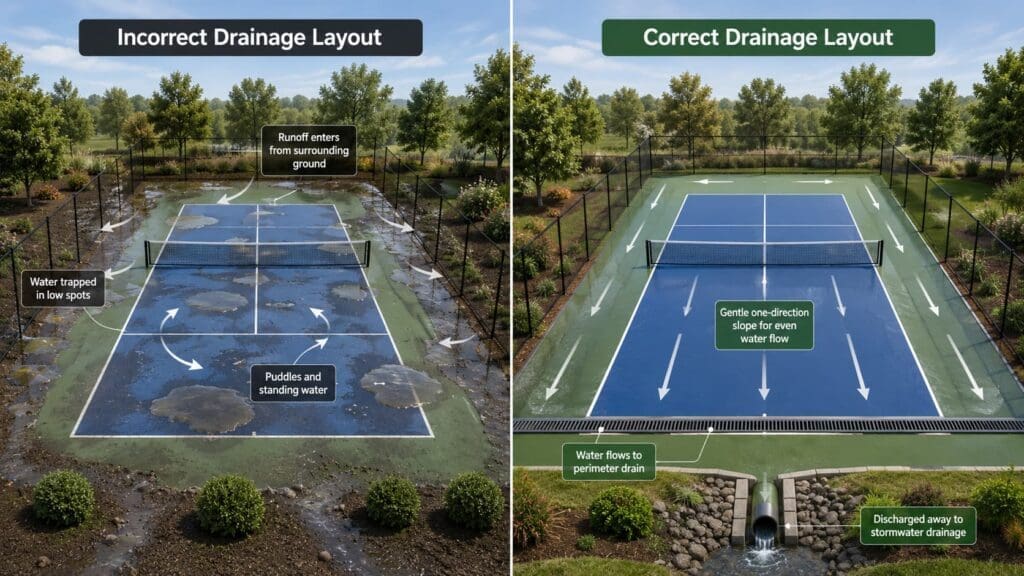
A pickleball court can have accurate line markings, a quality playing surface and professional equipment, but poor drainage can still make it frustrating—or unsafe—to use.
Standing water does more than delay play after rainfall. Repeated puddling can stain the surface, encourage organic growth, weaken the underlying base, contribute to cracking and reduce the life of acrylic coatings, modular tiles and roll-out court systems.
For outdoor pickleball courts in New Zealand and the Pacific Islands, drainage should be treated as part of the original court design rather than something added after puddles begin appearing.
Outdoor courts are constantly exposed to rain, groundwater, surface runoff and changing temperatures. Water needs a clear route off the playing area and away from the court foundation.
When that route is missing or restricted, several problems can develop:
USA Pickleball recognises both asphalt and concrete as suitable outdoor court bases but recommends reviewing the required slope, drainage, surface finish and construction specifications before the base is installed.
The important point is that the visible puddle may only be the symptom. The underlying problem could be an incorrectly formed slab, a blocked outlet, inadequate perimeter drainage or water entering from the surrounding property.
A pickleball court needs to appear level to players, but it should normally have a small, consistent fall that moves water towards a designated drainage point.
For many asphalt and concrete pickleball court systems, a finished slope of approximately 0.83% to 1% in one direction is commonly recommended. This is enough to move surface water without producing a slope that significantly affects normal play.
The slope should be formed within the base construction. It should not be created by applying thicker layers of acrylic coating in selected areas.
A properly formed court should generally fall in one continuous plane:
Creating multiple conflicting falls, a raised net line or a central crown can complicate play and produce low points where water collects.
The final direction of fall should be determined by the site layout, surrounding ground levels, stormwater system, fencing, neighbouring properties and available discharge point.
Good pickleball court construction may require two separate drainage strategies.
Surface drainage controls rainwater that lands directly on the court.
It relies on:
Subsurface drainage manages water beneath or around the court foundation.
Depending on the ground conditions, this may include:
Subsurface drainage is especially important where the court is built on clay, near a slope, below surrounding ground or in an area with a high water table.
Sport England’s outdoor-surface guidance notes that drainage systems should remove surface water quickly enough to avoid flooding, protect the load-bearing formation layers and prevent water from surrounding areas from affecting the facility.
Not every drainage problem begins on the court itself.
A court constructed below a lawn, car park, garden or neighbouring bank may receive additional runoff during heavy rain. Even a correctly sloped playing surface can become overwhelmed when water is allowed to flow onto it from the surrounding site.
Before construction, examine:
Possible solutions include catch drains, kerbs, swales, grated channels or retaining-wall drainage that intercepts runoff before it reaches the court.
Court drainage should always direct water towards an approved collection or discharge point. It should not simply transfer the problem to a neighbouring property, footpath or building.
When the court has insufficient fall, rainfall cannot move effectively towards the perimeter.
A court can have the correct overall fall but still contain depressions caused by poor finishing, settlement or surface deformation.
Leaves, sediment, grass clippings and rubbish can restrict channels and drain grates.
Concrete kerbs, fencing foundations or surrounding landscaping can form an unintended barrier that traps water on the playing surface.
Soft soils, insufficient compaction and poor base preparation can cause sections of the court to settle.
Nearby roots may lift asphalt, distort the base or damage underground drainage.
Water can enter cracks and joints, affecting the material below the playing surface.
A drain may work during light rain but overflow during heavier downpours because the pipe, channel or outlet is too small.
Acrylic sport coatings are applied over asphalt or concrete. They provide colour, texture and playing characteristics, but they are not intended to correct major drainage defects in the underlying base.
Low areas should be repaired before resurfacing. USA Pickleball describes resurfacing as including crack repairs, treatment of low areas, new base and colour coatings, and replacement line marking.
Acrylic courts also need adequate perimeter drainage to reduce the risk of moisture moving beneath the coating system.
Modular tiles normally allow water to pass through the open tile structure. However, the water still needs somewhere to go once it reaches the base.
Installing drainage tiles over a slab with existing puddles does not necessarily solve the underlying drainage problem. Moisture, dirt and organic material may remain beneath the tiles, creating odours, algae or maintenance issues.
The supporting base should still have a planned fall and clear drainage route.
Outdoor roll-out surfaces depend heavily on the condition of the supporting base.
The surface beneath the rolls should be:
Water entering beneath a roll-out surface can affect adhesion, seams and surface stability. Drainage and moisture conditions should therefore be checked before permanent installation.
The best time to inspect a court is during rainfall or shortly after it stops.
Walk around the outside of the court and record:
A straightedge or survey equipment can then be used to identify localised depressions. For larger or more valuable facilities, a level survey can provide a clear map of the court elevations.
Repeated puddles in the same locations usually indicate a grading or settlement problem rather than unusually heavy rainfall.
The correct repair depends on the cause and severity of the problem.
Remove leaves, sediment and vegetation from channels, grates and outlets. Confirm that underground pipes are clear.
Small depressions may sometimes be treated with a compatible acrylic patching or levelling system before recoating.
Cracks should be assessed before they are filled. Some are limited to the surface, while others indicate movement within the slab, asphalt or sub-base.
Applying colour coating alone will not permanently repair structural cracks.
Additional channels, catch drains or subsoil drainage may be needed where external water is entering the court area.
More extensive asphalt deformation may require grinding, levelling or installation of a new asphalt layer.
Where puddling results from widespread settlement or failed base construction, rebuilding part or all of the court may be more effective than repeatedly patching the surface.
A qualified sports-court contractor should assess major movement, extensive cracking or recurring coating failure.
A simple maintenance programme can prevent small drainage problems from becoming expensive repairs.
Check for debris, blocked outlets, ponding and damage caused by runoff.
Clear leaves and sediment from court edges, channels and grates.
Inspect cracks, joints, fencing foundations, nearby vegetation and surrounding ground levels.
Confirm that the court drains correctly. Resurfacing should not proceed until significant drainage defects and low areas have been addressed.
Check drainage whenever gardens, paths, retaining walls, buildings or car parks are added near the court. A change outside the fence can alter the amount and direction of water reaching the playing area.
Avoid aggressive pressure washing close to the surface. USA Pickleball advises using only the pressure required for cleaning because excessive water pressure can damage acrylic court coatings.
Before approving a pickleball court design, ask:
These decisions should be documented before excavation and base construction begin.
Drilling holes is rarely a complete drainage solution. It may allow water to enter the sub-base without providing a controlled discharge route. It can also create future moisture or structural problems. The cause of the puddling should be assessed first.
Acrylic coatings can assist with minor surface corrections when used with an appropriate patching system. They should not be relied upon to correct major depressions, structural movement or an incorrectly sloped slab.
No. Water may pass through the tiles, but the underlying slab still needs to drain. Existing low spots may continue to hold water beneath the tile system.
Water can be directed towards a fence line, but concrete mowing strips, fence footings and landscaping must not block the drainage path. A channel or planned outlet may be required.
That depends on the court size, slope, local rainfall, surrounding catchment and outlet capacity. Several collection points or a continuous channel may perform better than one small drain.
This may indicate water pressure beneath the surface, a saturated sub-base or groundwater movement. Further investigation is recommended before the court is recoated.
The quality of a pickleball court begins below the visible playing surface.
Correct site levels, a stable base, an appropriate court fall and an effective stormwater route help keep the court playable after rain while protecting the surface from premature damage.
Whether the final system uses acrylic coating, modular polypropylene tiles or an outdoor roll-out surface, the same principle applies:
Water must be directed off the playing area, away from the court foundation and into a suitable drainage system.
Planning this correctly during the original construction is usually easier and more cost-effective than repairing puddles, cracks and coating failures later.


