
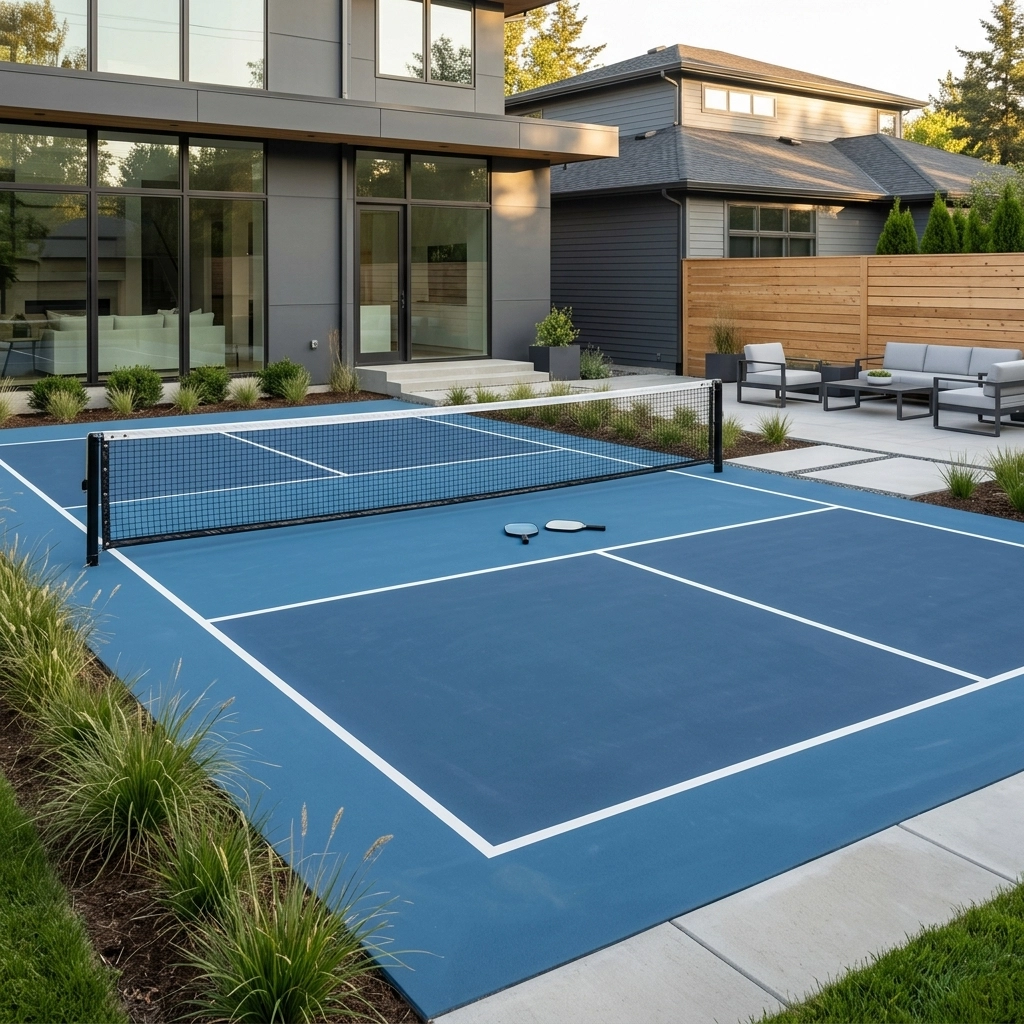
If you’ve spent any time looking at backyard trends lately, you’ve likely seen the term Pickleball popping up more often than a caffeine-fueled squirrel. It’s the sport that has taken the world: and New Zealand: by storm, transforming quiet suburban cul-de-sacs into hubs of competitive energy.
But what exactly is it? Think of Pickleball as the more approachable, slightly more social cousin of tennis. It’s played on a smaller court, with what looks like oversized table tennis paddles and a perforated plastic ball. It’s fast, it’s fun, and: most importantly for homeowners: it is arguably the easiest sports installation you can add to a modern backyard.
In this guide, we’re breaking down the educational basics of why this sport is winning the "backyard battle" and how you can integrate it into your outdoor design without needing a stadium-sized budget or a massive plot of land.
The single biggest hurdle for most homeowners wanting a backyard sports facility is space. A standard tennis court requires a massive amount of real estate: roughly 24 meters by 11 meters just for the lines, and even more for the "out" zones.
Pickleball, however, is a game of efficiency. A standard Pickleball court measures 6.1 meters by 13.4 meters (20 feet by 44 feet). To put that in perspective, you can fit nearly four Pickleball courts into the space required for one tennis court.

Caption: A technical diagram showing the standard dimensions of a Pickleball court compared to a traditional tennis court.
One of the reasons "Pickleball Fever" is so contagious is that the barrier to entry is incredibly low. You don't need to spend thousands on high-tech rackets or specialized footwear to get a decent game going.
The rules are equally accessible. If you’ve ever played a racket sport, you’ll pick it up in five minutes. The most famous feature is "The Kitchen": a 2.1-meter (7-foot) non-volley zone near the net that prevents players from standing right at the mesh and smashing every ball. This "Kitchen" rule turns the game into a strategic match of dinks and lobs rather than just pure power, making it accessible to everyone from kids to grandparents.
When it comes to adding a court to your backyard, the surface is where the magic happens. You have three main educational pathways here:
This is the traditional route. You pour a slab, finish it, and paint it with an acrylic coating. It provides the most consistent bounce but is a permanent structural commitment. It’s a "measure twice, pour once" situation.
This is the modern favorite for outdoor sports enthusiasts. These are high-impact polymer tiles that "snap" together over any flat surface.
If you have a flat driveway, you’re already 90% of the way there. With some temporary tape or high-visibility chalk, you can turn your parking space into a championship court in minutes.

Caption: A neutral cross-section diagram showing how modular sports tiles sit atop a sub-base for drainage and impact absorption.
Unlike high-intensity sports that can be exclusionary based on fitness levels, Pickleball is a social equalizer. It’s often played as doubles, which reduces the amount of running required and keeps everyone within talking distance.
In a modern backyard design, the court becomes the "Social Engine." It’s a reason to get off the couch and outside. Because a typical game only lasts about 15 to 20 minutes (playing to 11 points), it’s easy to rotate players in and out during a BBQ or a family gathering.
A backyard shouldn't just be a court; it should be an environment. The beauty of Pickleball’s small size is how well it integrates with other design elements.
One of the reasons homeowners shy away from backyard additions is the fear of ongoing maintenance. Grass requires mowing; pools require chemicals.
A Pickleball court: especially one using modular tiles or coated concrete: is remarkably low-maintenance.
When you weigh up the options for backyard recreation, Pickleball stands out for its sheer practicality. It offers the competitive thrill of a "real" sport without the massive land requirement of tennis or the high maintenance of a swimming pool.
Key Takeaways for Your Backyard Project:
Whether you're looking to keep the kids active, improve your own fitness, or simply become the favorite house on the block for Friday night drinks, adding a Pickleball court is a strategic, high-value move for any modern outdoor space. Grab a paddle: the fever is real, and it's here to stay.


