
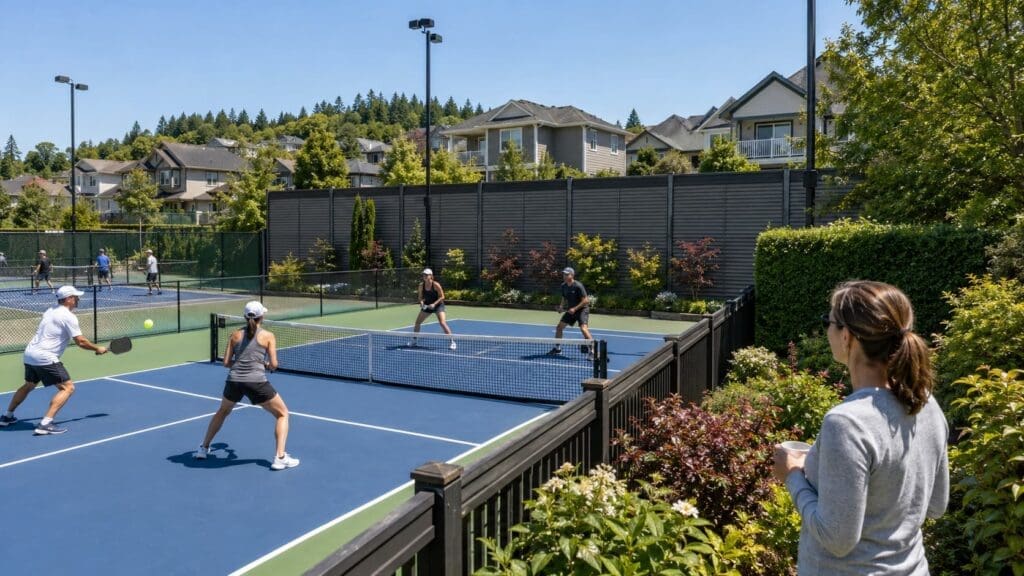
Pickleball is one of the fastest-growing sports in the world, and it is easy to see why. It is social, simple to learn, suitable for a wide age range, and works well for clubs, schools, retirement villages, resorts, and community facilities.
But as more clubs add pickleball courts, one issue keeps coming up: noise.
The sound of pickleball is different from tennis. The ball is hard plastic, the paddle is solid, and every rally creates a sharp “pop” when the ball is struck. For players, that sound is part of the game. For nearby neighbours, especially if courts are close to homes, it can become repetitive and frustrating.
This does not mean clubs should avoid pickleball. It means clubs need to plan courts properly, communicate early, and take noise seriously from the start.
Pickleball noise is not just about how loud it is. It is also about the type of sound.
A pickleball hit creates a short, sharp, high-pitched impact noise. Research and acoustic guidance describe pickleball as having a distinct repetitive “pop” that can stand out more than steady background noise, especially in quiet residential areas.
That is why two courts with the same average decibel reading can feel very different to neighbours depending on distance, background noise, fencing, buildings, wind direction, and how many courts are being played at once.
The more courts in use, the more constant the sound becomes.
For clubs, pickleball can be a major opportunity. It can bring in new members, increase court bookings, attract older players, create social events, and turn underused tennis or bowls areas into stronger revenue-generating spaces.
However, noise complaints can slow down or restrict a project if they are not handled properly.
Clubs should think about noise before installing courts, not after complaints start. A well-planned court layout is much easier to manage than a court placed too close to homes without screening, restricted hours, or community consultation.
USA Pickleball has recognised this issue by creating a Quiet Category for pickleball products, including paddles, balls, paddle covers, and court noise-mitigation screens. The goal is to reduce sound output during play without taking away the nature of the sport.
There are several reasons pickleball noise can become more noticeable:
The paddle and ball combination
Unlike tennis, where the ball compresses into a stringed racquet, pickleball uses a hard plastic ball and a solid paddle. The contact creates a sharper pop.
Shorter rallies and faster repetition
Pickleball points can include many quick exchanges at the kitchen line. This creates repeated impact noise in short bursts.
Multiple courts close together
A tennis court conversion can fit several pickleball courts into the same footprint. That is great for participation, but it can increase the total amount of sound from one area.
Nearby homes
The closer homes are to the court, the more likely noise will become an issue, especially during evenings, weekends, and quiet periods.
Hard surrounding surfaces
Concrete, walls, fences, clubrooms, and nearby buildings can reflect sound if the space is not planned correctly.
Noise levels vary depending on the paddle, ball, number of players, distance, barriers, wind, and surrounding surfaces.
USA Pickleball has stated that common industry-standard paddles can register around 85+ decibels when striking a ball, with a frequency range around 1,100–1,200 Hz. Its first certified Quiet Category paddle was reported as below 80 decibels and below 600 Hz, with a claimed 50% noise reduction.
The key point for clubs is this: even a small reduction at the source can make a big difference when combined with smart court placement, suitable fencing, sensible playing hours, and good neighbour communication.
In New Zealand, noise rules are generally managed through local council plans, zoning, resource consent conditions, and noise-control processes. Clubs should not assume one national rule applies everywhere.
For example, Auckland’s Unitary Plan recognises that sport and active recreation areas can generate high levels of noise and requires adverse effects to be avoided, remedied, or mitigated, especially where residential neighbours are nearby. It also sets specific noise limits at residential boundaries for Open Space – Sport and Active Recreation Zone interfaces.
This is important for clubs because pickleball courts near homes may need more careful planning than courts in commercial, rural, school, or large reserve settings.
The best noise control starts with court placement.
Where possible, place pickleball courts away from neighbouring homes, bedrooms, outdoor living areas, and quiet boundaries. Use existing clubrooms, storage sheds, banks, landscaping, or carparks as natural buffers.
Avoid placing courts in hard, enclosed corners where sound can bounce off walls and fences.
Converting one tennis court into multiple pickleball courts is popular because it makes good use of existing space. But it can also increase the number of players and the frequency of ball strikes in one area.
Before converting, clubs should ask:
Can the courts be positioned further from homes?
Will there be acoustic fencing or screening?
How many courts will be active at once?
Will evening play be restricted?
Are neighbours already sensitive to noise from the club?
A conversion is often the easiest pickleball option, but it still needs a proper noise plan.
Quiet equipment is becoming more important. Clubs can set rules around approved paddles and balls, especially for courts close to homes.
This is one of the simplest ways to reduce noise because it targets the sound at the source. USA Pickleball now lists Quiet Category equipment and lower acoustic profile products, showing that equipment choice is becoming part of proper court management.
For social clubs, retirement villages, schools, and residential settings, quieter paddles should be strongly considered.
Standard chain-link fencing does very little to stop pickleball noise. If noise is a concern, clubs should consider proper acoustic fencing, sound-absorbing panels, or specialist court screening.
USA Pickleball identifies acoustic fabrics, sound-absorbing panels, and court noise-reduction systems as part of the wider solution for sound-sensitive venues.
The barrier needs to be high enough, close enough, and dense enough to be effective. A low fence or decorative screen may look good but may not meaningfully reduce sound.
Operating hours are one of the most practical tools for reducing complaints.
Clubs may consider:
Morning start times that respect nearby residents
Earlier finish times for outdoor courts
No late-night casual play near homes
Dedicated quiet sessions
Reduced court numbers during sensitive times
Clear booking rules for members
Noise that is acceptable at 2pm may feel very different at 8pm.
If a club has several courts close to homes, it may not need to use all courts at once every day.
A practical approach could be:
Full use during tournaments or peak club sessions
Reduced use during early morning or evening
Buffer courts left empty near residential boundaries
Rotating court use to spread activity
This gives clubs flexibility without removing pickleball altogether.
Court surfacing can improve play quality, comfort, slip resistance, and installation speed. Modular tiles and roll-out pickleball mats can be excellent options for clubs wanting fast court setup.
However, clubs should be realistic: the main pickleball noise usually comes from paddle-ball impact, not just the floor. Good surfacing should be part of a complete court plan, not the only noise-control measure.
For best results, combine quality court surfacing with quiet paddles, controlled hours, smart court placement, and acoustic fencing where needed.
Neighbours are not wrong to raise concerns. Repetitive noise close to a home can affect outdoor living, relaxation, working from home, and sleep patterns.
The best first step is usually communication. Talk to the club early and explain the issue clearly. A useful complaint is specific: when the noise happens, how often it happens, where it is heard, and how it affects the household.
Neighbours can ask clubs about:
Playing hours
Quiet paddle policies
Number of courts in use
Acoustic fencing plans
Tournament schedules
Contact person for concerns
Whether a noise assessment has been completed
Most clubs do not want conflict with neighbours. They often need clear feedback before they understand the scale of the issue.
Before opening pickleball courts, clubs should create a simple noise-management plan.
This should include:
Court location and layout
Distance to neighbouring homes
Expected playing hours
Number of courts in use
Fencing or barrier plans
Approved balls and paddles
Member behaviour rules
Complaint-response process
Review period after opening
This helps show neighbours and councils that the club is being proactive.
Not all noise comes from paddles and balls.
Players can also create noise through shouting, music, celebrations, coaching, portable speakers, and social gatherings. Clubs should make expectations clear.
Simple rules can help:
No speakers near residential boundaries
Respectful language during games
Quiet arrival and departure during early or late sessions
No unnecessary shouting
Clear finish times
Good signage around neighbour respect
The best clubs build a culture where players understand they are sharing the space with the wider community.
Noise should not stop clubs from adding pickleball. The sport has too many benefits to ignore.
It attracts new people.
It gives older members a lower-impact option.
It can generate strong court hire revenue.
It works well for social nights, coaching, tournaments, schools, and retirement villages.
It helps clubs make better use of existing outdoor space.
But the clubs that succeed long term will be the ones that plan properly.
Pickleball courts should be treated like any other facility upgrade: location, neighbours, parking, lighting, access, noise, and future growth all need to be considered.
Pickleball noise is manageable, but it should not be ignored.
For clubs, the goal is to create courts that are popular, profitable, and community-friendly. For neighbours, the goal is to enjoy peace at home without stopping healthy community sport.
The best result comes when clubs plan early, use quieter equipment, manage hours, communicate clearly, and install proper noise-control solutions where needed.
Pickleball can be a win for clubs and communities — but only when the sound of the game is planned as carefully as the court itself.


