
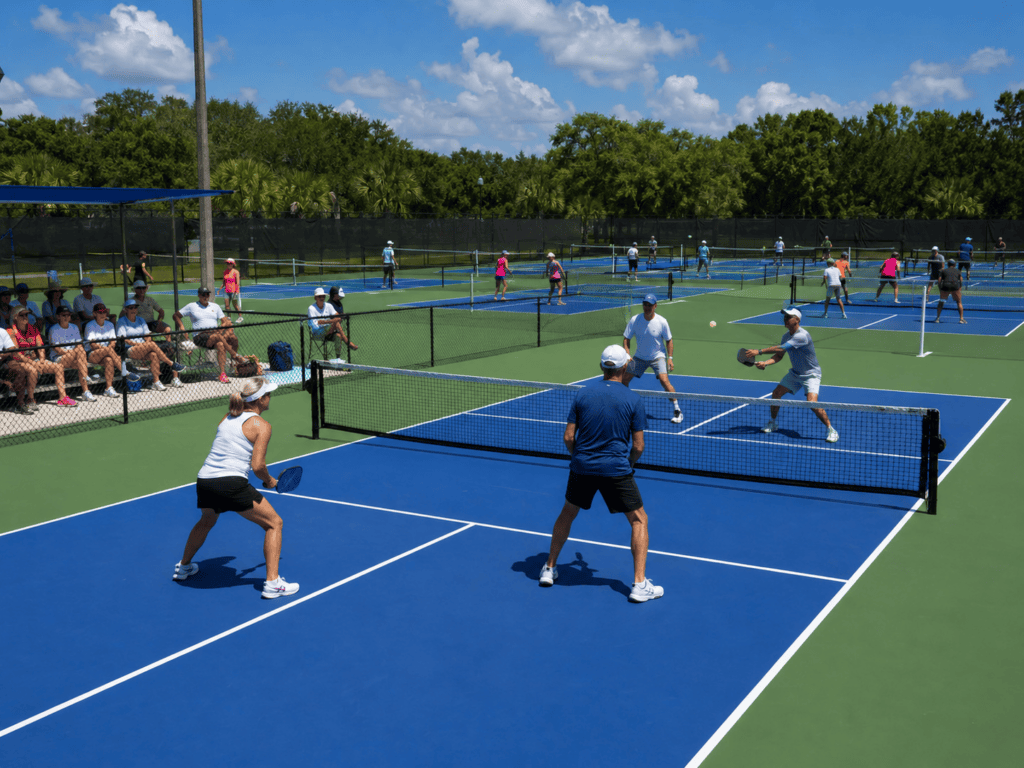
A successful pickleball tournament requires more than finding a venue and accepting registrations. The number of courts, the chosen competition format, match length and player numbers must all work together.
Too many players can create long delays and rushed matches. Too few players may leave courts unused and reduce the atmosphere of the event. Good planning creates a tournament that runs on time, gives participants enough games and remains enjoyable for players, volunteers and spectators.
Before calculating court time, decide what type of tournament you are organising.
A tournament may be designed as:
A social event should usually prioritise guaranteed games and participation. A competitive tournament may place greater importance on accurate seeding, referees, medal matches and formal elimination brackets.
The tournament format should match the experience you want participants to have.
The marked pickleball court is 6.10 metres wide and 13.41 metres long for both singles and doubles.
However, organisers must also allow space around the playing lines. The 2026 USA Pickleball Official Rulebook specifies a minimum playing surface of 9.14 metres by 18.29 metres and recommends approximately 10.36 metres by 19.5 metres for tournament play. This additional space allows players to move safely behind the baselines and outside the sidelines.
Do not calculate venue capacity from court markings alone. Allow room for:
Where temporary courts are installed inside a sports hall, check the position of walls, basketball hoops, storage areas, doors and other potential obstructions.
There is no single player-to-court ratio that works for every tournament. Capacity depends on match length, competition format and the number of hours available.
The following are practical planning ranges for a one-day doubles tournament:
| Available courts | Comfortable player range | Typical event size |
|---|---|---|
| 2 courts | 16–24 players | Small club event |
| 4 courts | 24–48 players | Club or community tournament |
| 6 courts | 40–64 players | Larger club tournament |
| 8 courts | 64–96 players | Regional event |
| 12 courts | 96–144 players | Large multi-division event |
These are starting points rather than fixed limits. A knockout tournament can accommodate more entrants because eliminated teams stop playing. A full round robin requires considerably more court time because every team plays every other team.
Organisers should also count teams, not only individual players. For doubles:
The competition format has the greatest effect on scheduling.
Official tournament formats can include round robin, pool play, single elimination, single elimination with consolation and double elimination. Pool play commonly uses round-robin groups to seed teams into a later elimination bracket.
In a round robin, every team plays every other team in its group.
This format works well for smaller divisions because it guarantees multiple matches and reduces the impact of one poor performance. However, the number of matches increases rapidly as more teams are added.
The number of round-robin matches is:
Number of teams × number of teams minus one ÷ two
| Teams in a group | Total matches | Matches per team |
|---|---|---|
| 4 | 6 | 3 |
| 5 | 10 | 4 |
| 6 | 15 | 5 |
| 7 | 21 | 6 |
| 8 | 28 | 7 |
A single eight-team round robin requires 28 matches. Dividing the same teams into two pools of four requires only 12 pool matches, followed by playoff matches.
Pool play followed by a knockout bracket is one of the most practical formats for club and regional tournaments.
Players receive several guaranteed matches during pool play, while the knockout rounds create a clear path to the final.
For example:
This creates:
Single elimination is fast and easy to administer. Once a team loses, it leaves the competition.
A 16-team bracket requires 15 matches to determine a winner. Adding a bronze-medal playoff increases the total to 16 matches.
The disadvantage is that half the entrants may play only one match. This is generally better suited to championship playoffs than a social club tournament.
Double elimination gives teams a second opportunity after their first loss. It produces more matches and can create a fairer competitive result, but it is more difficult to schedule and explain.
It is best used when:
A consolation bracket allows teams eliminated from the main draw to continue playing.
This is a useful compromise when organisers want the excitement of elimination play while still giving entrants reasonable value from their registration.
Tournament scoring must be confirmed before the draw is created.
Under the 2026 USA Pickleball rules, approved standard tournament options include:
The permitted formats are generally played with a two-point winning margin. Rally scoring is also available as a provisional option in some tournament situations, subject to the relevant competition rules.
For a community or club tournament, a practical approach is often:
Longer medal matches should only be used when sufficient court time remains.
Do not base the schedule on the fastest possible match. Close games, time-outs, disputed calls and slow player changeovers can all affect the programme.
Useful planning allowances are:
| Match format | Suggested schedule slot |
|---|---|
| One game to 11 | 20–25 minutes |
| One game to 15 | 25–35 minutes |
| One game to 21 | 35–45 minutes |
| Best two of three to 11 | 45–60 minutes |
| Medal match with introductions | 50–70 minutes |
These are scheduling estimates rather than official match limits.
For early planning, a 30- or 35-minute court slot works well for many one-game pool matches. Longer slots can be allocated for finals.
Use the following calculation:
Available match slots = courts × playable minutes ÷ match-slot length
Then reduce the result by approximately 15–20% to allow for delays, court changes, injuries and administration.
A venue has:
The theoretical capacity is:
6 courts × 480 minutes ÷ 30 minutes = 96 match slots
At 80% operational capacity:
96 × 0.80 = approximately 76 usable match slots
A 68-match tournament should therefore be achievable, while still leaving some room for delays and longer playoff matches.
Running every court at 100% capacity for the entire day is rarely realistic.
The following example uses 48 doubles players, creating 24 teams.
| Time | Activity |
|---|---|
| 8:00 am | Registration and court warm-ups |
| 8:30 am | Player briefing |
| 8:45 am–11:40 am | Pool play sessions 1–5 |
| 11:40 am–12:10 pm | Lunch and schedule buffer |
| 12:10 pm–3:05 pm | Pool play sessions 6–10 |
| 3:05 pm–3:20 pm | Results confirmed and playoff draw published |
| 3:20 pm | Quarterfinals |
| 4:05 pm | Semifinals |
| 4:50 pm | Final and bronze-medal match |
| 5:40 pm | Presentations |
Each pool-play wave uses a 35-minute court slot. Pools can be rotated so that players generally receive a break between matches.
The lunch period also acts as a recovery buffer when the morning programme runs late.
Players need time to recover, refill water, check results and move between courts.
Try to provide:
When competitors enter several events, schedule complete divisions in separate blocks or on different days wherever possible.
For example:
Attempting to run every division simultaneously can create court vacancies while organisers wait for players who are still competing elsewhere.
Wave scheduling is often easier to manage than giving every match a unique start time.
A wave may begin every 30 or 35 minutes. All available courts start together, results are entered, and the next group is called.
Benefits include:
Players should still be told that scheduled times are estimates and that they must remain available when their division is active.
Every tournament should have one central operations area.
The check-in desk should manage:
Display court numbers clearly and use a noticeboard, screen, printed draw or online tournament platform so players can check their next match.
Players should report early rather than arriving at the stated match time. Late arrivals can delay several later rounds, not just their own match.
A match does not end when the final point is scored.
The schedule must account for:
Limit warm-ups to a stated period, such as two or three minutes, and publish that rule before play begins.
Each court should have:
The venue should also provide:
For larger tournaments, consider assigning a court marshal or court runner to each group of courts.
The surface affects player safety, ball response and the overall quality of the tournament.
Tournament options can include:
Permanent acrylic or similar sports-court systems provide a familiar playing environment and clearly marked lines.
Interlocking sports tiles can create permanent or semi-permanent pickleball courts over a properly prepared base. They can also allow courts to be repaired in sections rather than resurfacing the entire area.
Roll-out court mats can be useful for indoor halls, exhibitions, temporary tournaments and venues that cannot permanently mark the floor.
They allow organisers to:
All temporary surfaces must be installed flat, secured correctly and inspected for movement, raised edges or trip hazards before competition begins.
Outdoor tournaments need a backup plan.
Possible arrangements include:
Do not wait until rain begins to decide how the programme will change.
The Tournament Director should have a pre-approved order for reducing the schedule, such as shortening early-round matches before changing medal rounds.
More registration income may appear attractive, but excessive entries can create late finishes, poor player experiences and volunteer fatigue.
Scheduling every game into a 15-minute slot leaves no protection against close matches or delays.
An eight-team round robin requires 28 matches. Smaller pools followed by playoffs are often more manageable.
A mathematically possible schedule may still be physically unreasonable.
Players entered in multiple divisions can hold up several courts.
At least 15% of available court time should remain available for normal disruptions.
Players should know the scoring system, guaranteed number of matches, tie-break procedure and qualification process before the tournament begins.
Before opening registrations, confirm:
Tournament planning becomes much simpler when courts are clearly laid out, surfaces are consistent and players can move safely around each playing area.
Apollo NZ can supply modular sports flooring and roll-out pickleball court options for clubs, schools, community organisations and temporary tournament venues. These systems can help convert suitable existing spaces into dedicated or multi-use pickleball facilities without relying solely on permanently constructed courts.
The best tournament is not necessarily the one with the most entrants. It is the one that provides good matches, clear communication, realistic scheduling and a positive experience from registration through to the final presentation.


