
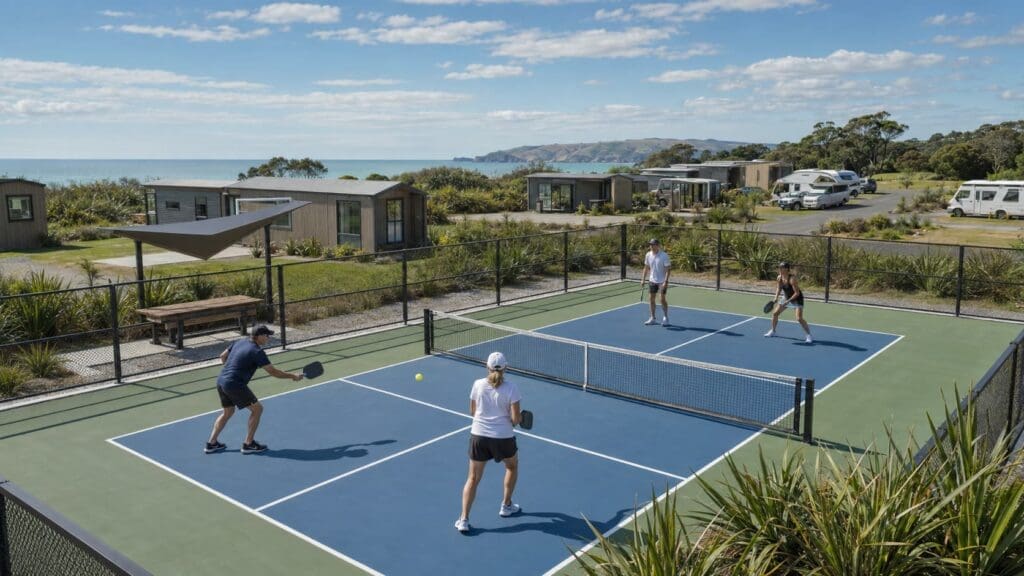
Pickleball is an excellent addition to holiday parks, campgrounds and resort-style accommodation. It appeals to a wide range of ages, requires less space than many traditional court sports and can provide guests with another activity without requiring a large recreation facility.
A well-planned pickleball area can become a social hub within a holiday park, encouraging guests to meet, stay active and spend more time onsite. However, court location, surface selection, noise, safety and future demand should all be considered before installation.
Pickleball is relatively easy for beginners to learn, while still providing enough speed and competition for experienced players. This makes it particularly suitable for holiday parks accommodating families, couples, retirees, school groups and organised clubs.
Potential benefits include:
Portable paddles, balls and nets can also be made available through reception, removing the need for guests to bring their own equipment.
The marked playing court measures approximately 6.10 metres wide by 13.41 metres long. However, the playing lines are only part of the total area required.
Additional space is needed around the court so players can safely move beyond the sidelines and baselines. A practical minimum total court area is approximately 9.14 metres by 18.29 metres, although more generous run-off space provides a better playing experience.
Holiday park operators should avoid squeezing a court into an area that only accommodates the painted lines. Insufficient run-off space can make the court uncomfortable and increase the chance of players colliding with fences, seating, landscaping or other structures.
Court location can have a major effect on both player enjoyment and surrounding guests.
Where possible, position the court:
Grouping pickleball with swimming pools, playgrounds, games rooms and other activity zones can help separate recreation noise from quieter accommodation areas.
Pickleball produces a distinctive impact sound when the ball meets the paddle. Repeated games close to cabins, tent sites or campervan spaces may disturb guests who are resting.
Noise can be managed by considering:
A clearly displayed schedule can prevent early-morning or late-evening games from affecting surrounding guests.
Holiday parks do not all need the same type of court. The best surface depends on the existing base, available budget, expected use and whether the area must remain available for other activities.
Interlocking polypropylene sports tiles can be installed over a suitable concrete or asphalt base.
They provide:
Modular tiles are particularly suitable for permanent recreation areas and courts expected to receive regular use.
Roll-out pickleball surfaces are useful where faster installation or greater flexibility is required. They can be used for portable or semi-permanent court installations over a suitably prepared hard surface.
Benefits include:
Roll-out surfaces may be particularly useful for seasonal parks, events and facilities that want to test demand before investing in a permanent court.
Existing concrete or asphalt areas can also be repaired, coated and line-marked. The underlying surface must be level, stable and free from significant cracking or drainage problems.
Painting lines onto a poor-quality base will not correct dips, movement or surface damage. The condition of the existing area should be assessed before choosing this option.
An underused tennis court can often be adapted for pickleball. Depending on its dimensions and surrounding space, it may accommodate one or more pickleball courts.
Possible approaches include:
When multiple sports share the same surface, line colours should be selected carefully so players can easily distinguish the pickleball boundaries.
Some campgrounds may only need additional recreation facilities during summer, school holidays or organised group bookings.
A temporary court can be created using:
This allows operators to measure guest demand before committing to a permanent development. The area can then return to general recreation, event or overflow use outside peak periods.
Pickleballs can travel beyond the playing area, particularly when the court is used by beginners. Fencing or ball-containment netting helps prevent balls from entering roads, campsites, swimming areas or neighbouring properties.
Fencing should be planned so that:
Mesh screens can also provide wind reduction, visual separation and an improved backdrop for following the ball.
Court orientation affects glare and player visibility. A generally north–south layout is often preferred where the available site allows it, as it can reduce the amount of time players face directly into low morning or evening sun.
Natural or constructed shade can be provided beside the court for players waiting between games. Shade structures should remain outside the required safety area and must not introduce posts or obstacles close to the court.
Outdoor courts must be able to drain efficiently after rain. Standing water can interrupt play, create slippery conditions and shorten the life of some surface systems.
Before installing a court, consider:
These points are especially important for holiday parks in coastal areas and throughout the Pacific Islands.
Court lighting can extend playing hours and provide another evening activity for guests. However, lights must be positioned carefully to avoid glare for players and light spill into cabins or camping areas.
A suitable lighting plan should consider:
Operating hours should be clearly displayed, even when the court has lighting.
A well-designed recreation facility should be easy to reach and comfortable to use.
Consider providing:
Equipment hire or complimentary equipment packs can make the facility usable by guests who have never played before.
A single court may be sufficient for a small campground, but larger holiday parks should consider how demand could grow.
If space allows, plan the initial area so that another court could be added later. Two or more courts make it easier to run social sessions, family competitions and organised tournaments without long waiting periods.
A simple booking system can also prevent one group from occupying the court for extended periods during busy holidays.
A pickleball court can be included as a complimentary guest facility or used to generate additional income.
Possible options include:
Even when access is free, the court can add perceived value to a holiday park and strengthen its appeal to active families and group travellers.
Pickleball courts are generally straightforward to maintain, but regular inspection is still important.
Operators should:
A simple maintenance schedule can help keep the facility safe and presentable throughout the busy season.


