
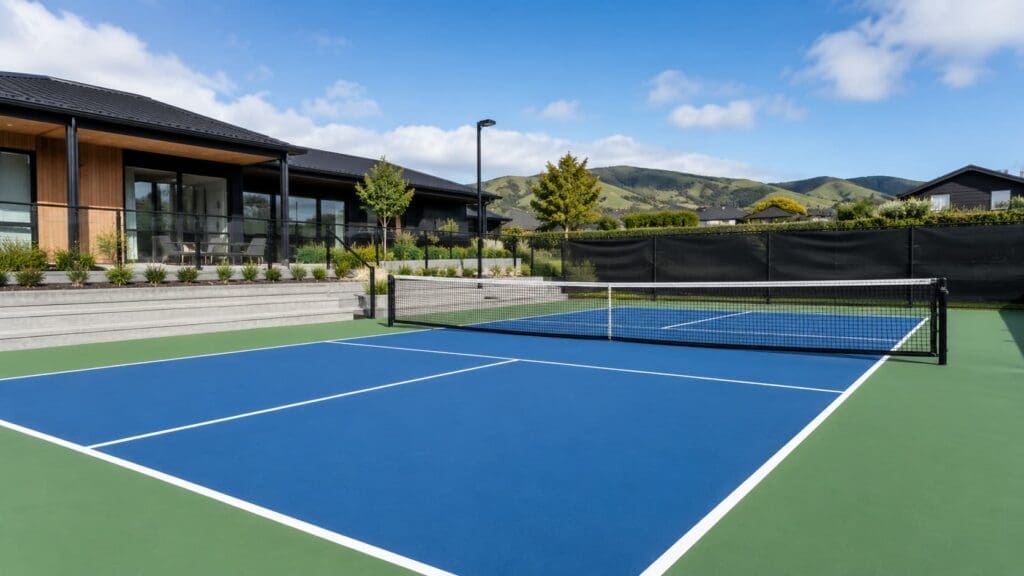
Pickleball is growing rapidly across New Zealand, creating demand for affordable courts that can be installed without the cost and disruption of traditional sports court construction.
For schools, sports clubs, retirement villages, community centres, commercial venues and homeowners, roll-out pickleball mats offer a practical way to convert suitable existing surfaces into dedicated or multi-use pickleball courts.
A pickleball court mat provides a consistent playing surface, clear court markings and faster installation than many traditional painted acrylic court systems. Depending on the project, the mat can be installed temporarily, semi-permanently or permanently.
This guide explains how pickleball mats work, where they can be installed, which surface is best and what New Zealand customers should consider before ordering.
A pickleball court mat is a specialised sports flooring system supplied in large rolls or sections.
Once positioned and joined together, the sections form a complete pickleball playing surface. Court lines may be incorporated into the material during production, reducing the need for on-site measuring and painting.
A quality pickleball mat is designed to provide:
Unlike loose household flooring or general-purpose rubber mats, pickleball court mats are manufactured specifically for sports use.
Many New Zealand organisations want to add pickleball without constructing a completely new court.
Traditional court construction may involve excavation, drainage work, concrete pouring, curing, surface coating, line marking and significant disruption to the site.
Roll-out pickleball flooring can simplify the process where a suitable foundation already exists.
Pickleball mats are particularly useful for converting:
The ability to install a court over an existing base makes roll-out flooring attractive to venues looking for a faster and more flexible solution.
The official pickleball playing area measures:
6.10 metres wide × 13.41 metres long
This is the marked court area only.
Additional space should be allowed around the outside of the court so players can safely move behind the baselines and beyond the sidelines.
For a comfortable recreational layout, an overall area of approximately:
9 metres wide × 18 metres long
is often recommended.
Where space is restricted, a smaller surrounding area may be possible. However, reducing the run-off area can affect player safety and the overall playing experience.
Before ordering a pickleball mat, the available space should be measured carefully.
Apollo NZ offers specialised pickleball mat systems suitable for different venues, player groups and installation requirements.
The PM-T Acrylic Sand system is approximately 3.0 mm thick.
It provides a firm and responsive playing surface for customers wanting consistent ball performance and reliable traction.
The PM-T option is suited to:
Its acrylic sand-style surface provides a familiar sports court feel while allowing the convenience of a roll-out flooring system.
The PM-S Pickle Sand system is approximately 3.5 mm thick.
Its additional thickness can provide slightly greater cushioning underfoot, making it suitable for venues where player comfort and frequent use are important.
The PM-S option is well suited to:
The thicker construction may help reduce the harsh feel associated with playing directly on concrete while maintaining the firmness required for consistent ball bounce.
Both systems can create a suitable pickleball playing surface, but they involve different installation processes.
A traditional acrylic court typically requires several coating layers to be applied directly to a prepared concrete or asphalt base.
This can provide an excellent permanent surface, but installation may depend on:
A roll-out court arrives as a manufactured sports surface.
Depending on the selected system, it can provide:
A pickleball mat is not automatically better for every project. The correct choice depends on the existing base, venue use, budget, installation requirements and whether the court may need to be moved later.
Selected pickleball mats can be installed outdoors, provided both the flooring and installation system are suitable for exterior conditions.
An outdoor mat should be designed to handle:
The condition of the base remains extremely important.
A waterproof or UV-resistant mat will not correct poor drainage, major cracking or an uneven foundation underneath it.
Indoor pickleball mats are an excellent option for facilities that need to create courts inside existing buildings.
Suitable locations can include:
Portable indoor courts can be rolled out when required and stored when the space is needed for another activity.
The existing floor should be checked to ensure the mat and fixing method will not damage timber, vinyl, rubber or other finished surfaces.
The quality of the foundation has a major influence on the performance of the finished court.
Concrete is generally the preferred base for a pickleball mat.
A suitable concrete surface provides:
A smooth broom-finished surface is usually preferable to highly polished concrete because it can provide better compatibility with tapes or adhesives.
The concrete should be fully cured, dry and free from major cracking.
Pickleball mats can also be installed over suitable asphalt.
The asphalt should be:
Old or deteriorating asphalt may require repairs before the mat is installed.
Some pickleball mats can be positioned over existing indoor sports surfaces.
Compatibility should be confirmed before installation, particularly where tape or adhesive will be used.
Pickleball mats should not normally be placed directly over:
Installing over an unstable base may cause wrinkles, movement, poor ball bounce and trip hazards.
A roll-out court follows the shape and condition of the surface beneath it.
Cracks, holes, raised joints and surface debris may become visible or noticeable through the mat.
Before installation, the base should be:
Any necessary repairs should be completed before the flooring is installed.
A pickleball mat should not be used to conceal serious damage or structural movement in the existing court.
Portable pickleball mats are useful when a venue needs to remove the court after games, events or tournaments.
The court sections are rolled into position, aligned and secured using an appropriate temporary joining or tape system.
Portable courts are suitable for:
The flooring must be rolled and stored correctly after use to prevent creases or damage.
A semi-permanent installation provides greater stability than a completely portable court while still allowing the surface to be removed in the future.
The sections may be secured using:
This installation method is often suitable for:
The correct tape or fixing system should be selected for both the mat and the base underneath it.
For frequent or long-term use, the pickleball mat may be permanently bonded to a properly prepared base.
A permanent installation can provide:
Professional installation is recommended for permanently bonded courts.
The selected adhesive must be suitable for the flooring, the foundation and the environmental conditions.
A complete pickleball court is normally supplied in several large rolls or sections.
Depending on the mat width and court design, approximately four to five rolls may be required for one court.
The exact quantity will depend on:
A final production layout should be approved before ordering.
Each section may be numbered to make installation and future reassembly easier.
Court lines can be incorporated into the roll-out flooring during production.
Pre-marked lines offer several advantages:
For multi-sport venues, additional line colours may be included. However, pickleball markings should remain clearly distinguishable from other court lines.
The area immediately beside the net is known as the non-volley zone, or more commonly, the kitchen.
The kitchen extends 2.13 metres from the net on each side.
Players cannot volley the ball while standing inside this zone. They also cannot allow their momentum to carry them into the kitchen after completing a volley.
Clear kitchen markings are essential for both casual and competitive play.
Some venues choose a contrasting colour for the non-volley zone to make it easier for players to identify.
Colour selection can influence both the appearance and usability of a pickleball court.
Popular combinations include:
Good contrast helps players track the ball and identify court boundaries.
Outdoor projects should also consider heat. Very dark surfaces may absorb more heat when exposed to direct sunlight.
The colour combination should suit the venue, surrounding environment and intended ball colour.
A properly installed pickleball mat should provide consistent ball response across the playing area.
Performance can be affected by:
A thicker mat does not automatically produce better performance. The flooring must still remain firm enough to support predictable pickleball bounce.
This is why sports-specific pickleball flooring should be used rather than general rubber or foam flooring.
Pickleball involves frequent short movements, stops and changes of direction.
Playing directly on hard concrete can be uncomfortable, particularly during longer sessions.
A purpose-made pickleball mat may offer more comfort underfoot than an uncoated concrete surface.
This can be particularly valuable for:
Players should still use appropriate footwear with good support and non-marking soles where required.
Outdoor drainage must be considered before installing the court.
The existing base should have a suitable fall that allows rainwater to move away from the playing surface.
Potential drainage problems include:
A pickleball mat does not create drainage beneath the court.
Any existing drainage problems should be corrected before installation.
Regular maintenance helps protect the appearance, grip and playing performance of the mat.
Recommended maintenance includes:
Pressure washing should only be used where it is approved for the specific mat and installation method.
Aggressive water pressure may affect seams, adhesive or perimeter fixings.
Portable pickleball flooring should be rolled rather than folded.
Before storage, each section should be clean and completely dry.
Good storage practices include:
Incorrect storage can permanently damage the playing surface.
Uneven concrete or asphalt can affect ball bounce and create noticeable high or low areas.
Water trapped underneath the court may affect seams, adhesives and long-term stability.
General-purpose tape may not provide the required grip or may damage the existing floor.
Pulling the flooring too tightly can create movement as the material settles or changes temperature.
Some flooring systems should be placed in the installation environment before final fitting.
Folding can create creases that may be difficult or impossible to remove.
Dust, oil and loose material can interfere with tape and adhesive performance.
The court dimensions, seam direction, colours and markings should be approved before production.
Pickleball mats can be an effective option for schools because they can make use of existing halls, gyms and concrete sports areas.
Benefits for schools include:
Portable courts may allow a school gymnasium to remain available for other sports and events.
Pickleball has become popular with older players because it is social, accessible and played on a smaller court than tennis.
A slightly cushioned roll-out surface may provide a more comfortable playing experience than bare concrete.
For retirement villages, important considerations include:
The PM-S Pickle Sand mat may be particularly suitable where additional thickness and comfort are priorities.
Tennis clubs can use pickleball mats to introduce pickleball without permanently converting every tennis court.
Depending on the available area, mats may be used for:
Portable flooring can allow a club to test demand before committing to a larger court development.
Bowls clubs often have clubrooms, halls, car parks or underused hard-surface areas that may be suitable for pickleball development.
Adding pickleball can help clubs:
The proposed area must still have a suitable foundation and enough space for safe play.
Commercial pickleball centres need surfaces that can handle regular use and provide consistent performance.
A roll-out sports flooring system may be suitable for:
Commercial projects should consider:
Professional installation may be preferable for high-use commercial courts.
Pickleball court mats can provide:
A pickleball mat is only as good as the base beneath it.
Roll-out flooring will not permanently correct:
Portable courts may also require regular checking and adjustment to keep seams and edges secure.
The area should be inspected before the final court system is selected.
The PM-T Acrylic Sand and PM-S Pickle Sand systems are designed for different venue requirements.
Choose the PM-T Acrylic Sand Mat where priorities include:
Choose the PM-S Pickle Sand Mat where priorities include:
The best surface will depend on the foundation, player group, installation method and intended court use.
A roll-out pickleball mat can turn an existing concrete court, hall, gymnasium or recreation space into a dedicated pickleball facility without the need for a complete court rebuild.
Whether you are planning a single residential court, a school facility, a club conversion or a multi-court commercial venue, Apollo NZ can help you review the available area and select a suitable pickleball mat system.


