
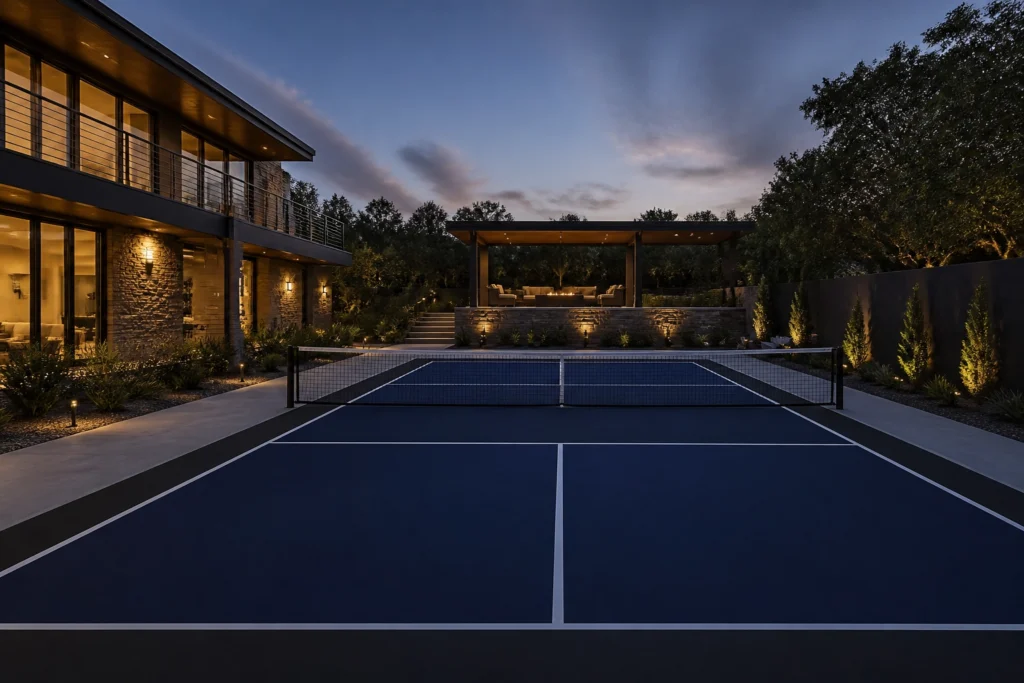
The landscape of the modern luxury estate is undergoing a fundamental shift. For decades, the quintessential high-end backyard was defined by three primary elements: a sprawling swimming pool, a manicured lawn, and perhaps a full-sized tennis court. However, as lifestyle priorities evolve toward high-engagement social activities and functional fitness, the traditional tennis court is increasingly being replaced by a more compact, social, and dynamic alternative: the pickleball court.
Pickleball has transitioned from a niche recreation to a dominant cultural phenomenon. In the luxury real estate sector, it has become a "must-have" amenity, often prioritized over more traditional installations. This trend is driven not just by the sport's popularity, but by its unique ability to foster community, enhance wellness, and integrate seamlessly into sophisticated architectural designs.
The rise of the private pickleball court represents a broader trend in residential design: the decentralization of the country club. Modern homeowners are seeking to bring high-performance recreational facilities directly to their primary residences. Unlike tennis, which often requires a high level of technical skill and a massive physical footprint, pickleball is accessible to a wider demographic: from young children to retirees: making it the ultimate multi-generational asset.
The sport’s smaller court size: roughly one-third the size of a standard tennis court: allows for more creative land use. This efficiency enables developers and homeowners to include professional-grade play surfaces without sacrificing significant garden space or outdoor living zones.

The decision to install a residential court is rarely about the sport alone. It is a strategic investment in lifestyle and property marketability.
Pickleball is inherently social. The compact court dimensions mean players are closer together, facilitating conversation and a more relaxed, communal atmosphere. For families, it serves as a central hub where multiple generations can engage in competitive play on a level playing field. This makes it a superior amenity for hosting and entertaining compared to more solitary or technically demanding sports.
The sport provides a significant cardiovascular workout with lower impact on the joints than tennis or basketball. As wellness becomes a central pillar of luxury living, having immediate access to a high-intensity, low-impact exercise facility is a major draw.
In the current real estate market, a professionally designed pickleball court is a major differentiator. Buyers in the luxury segment are looking for turnkey lifestyle solutions. A well-integrated court, complete with high-end lighting and noise-mitigation features, can significantly boost a property's appeal and resale value. More information on why these facilities are becoming essential can be found in this overview of pickleball in hospitality and residential design.
Building a professional-grade court requires more than just pouring a slab of concrete. To maintain the aesthetic and functional integrity of a high-end estate, several technical factors must be addressed during the planning phase.
A standard pickleball court measures 20’ x 44’, but the total required footprint for a professional experience includes the "out-of-bounds" areas. A total area of 30’ x 60’ is generally recommended to allow for safe movement and professional-level play.
The quality of the play surface defines the experience. Luxury estates typically opt for a multi-layered acrylic coating system. This provides:
For those considering the technical aspects of surfacing and construction, a deeper dive into building a professional court can provide valuable guidance on balancing cost and performance.
The "thwack" of a pickleball paddle is distinct and can be a point of contention in high-density luxury neighborhoods. Sophisticated estates incorporate several noise-reduction techniques:

The most prestigious modern courts are now being equipped with AI-driven recording and tracking technology. This takes the backyard experience from a casual hobby to a professional-grade training facility.
High-end estates are increasingly installing 180-degree 4K panoramic camera systems that use artificial intelligence to automatically track play. These systems offer:
Implementing AI-based sports motion cameras ensures that every match is recorded without the need for a dedicated camera operator, maintaining the "stealth" luxury aesthetic while providing pro-level data.

A sports court should not look like an afterthought. In high-end landscape design, the court is often treated as an architectural feature.
One of the primary reasons pickleball is favored over other amenities like pools or natural grass courts is its low maintenance requirement. A professionally installed acrylic court generally only requires:

The inclusion of a pickleball court is a clear signal of a home designed for the modern era. It balances the need for high-performance fitness with the desire for social engagement and architectural beauty. By focusing on professional surfacing, noise mitigation, and integrated AI technology, homeowners can create a recreation hub that rivals any professional club.


