
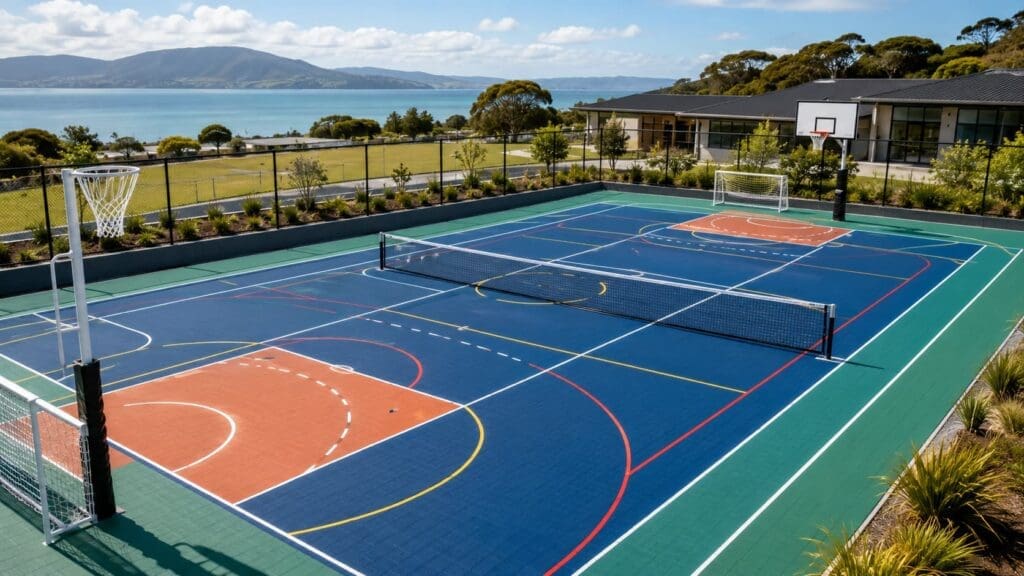
Across New Zealand, outdoor space is becoming more valuable than ever.
Schools need courts that can handle PE, lunch-time sport, after-school programmes and weekend community use. Clubs need new ways to attract younger members, families and casual players. Homeowners want backyards that do more than sit unused. Councils and community groups are looking for sport facilities that are flexible, affordable and easy to activate.
At the centre of this shift is one simple idea:
Why build a court for one sport when the same footprint can support pickleball, tennis, basketball, netball, futsal and general fitness use?
That is why multi-sport courts are becoming one of the smartest investments in sport infrastructure. They are practical, space-efficient, visually impressive and suitable for a wide range of users. Most importantly, they answer one of the biggest challenges in modern sport: how to get more people active, more often, without needing major construction.
Sport New Zealand’s 2024/25 Active NZ results show that young people’s activity is bouncing back, but barriers such as time, cost and confidence still prevent many from being active. The same report notes that fun is the top reason young people are active, with 78% identifying it as their leading motivator. That matters because multi-sport courts are built around exactly that: accessible, social, flexible activity.
For years, most outdoor courts were thought of as tennis courts, basketball courts or netball courts. Pickleball has changed that.
Pickleball is compact, social, easy to learn and suitable for a wide age range. It can be played by children, adults, older players, beginners and competitive athletes. It does not require the same court size as tennis, and games can be run in a shorter time window, which makes it ideal for clubs, schools, resorts, retirement villages and community facilities.
In the United States, the Sports & Fitness Industry Association reported 24.3 million pickleball participants in 2025, with participation growing 479% from 2020 to 2025.
New Zealand is now part of that wider movement. Pickleball New Zealand Association announced that, as of 27 November 2025, pickleball had been officially accredited by Sport NZ, with PNZA recognised as the national governing body for the sport. That recognition is a major signal that pickleball is no longer just a novelty activity. It is becoming part of the organised sport landscape in Aotearoa.
For clubs and schools, this creates an opportunity. Existing outdoor areas can often be adapted to include pickleball lines, modular flooring or dedicated pickleball zones. For venues with underused tennis courts, hardstand areas or large asphalt spaces, pickleball can turn quiet hours into active sessions.
A court that only works for one sport can quickly become underused.
A court that works for several sports becomes a daily asset.
A well-planned multi-sport court can support:
This is why multi-sport courts are so attractive for schools and clubs. They create more activity from the same land area. They also help spread the investment across more users, more programmes and more booking types.
For example, a school court might be used for netball and basketball during PE, futsal at lunch, pickleball after school and community hire in the evening. A club might run pickleball mornings, junior tennis coaching, social basketball and weekend events from the same area.
That flexibility is what makes the investment easier to justify.
People share content when it gives them something useful, surprising or easy to explain.
Multi-sport courts do all three.
They solve a real problem: limited space.
They create a strong visual story: colourful courts with multiple line markings.
They give decision-makers a clear reason to act: more users from the same footprint.
The idea is simple enough for a school board, club committee, council, builder, homeowner or sports coordinator to understand quickly.
A single-purpose court is a facility. A multi-sport court is a programme platform.
That is the key difference.
One reason multi-sport courts are growing is that different sports use very different court sizes. Understanding those sizes helps venues plan smarter.
A standard pickleball court uses playing lines of 20 feet by 44 feet. USA Pickleball notes that a total playing surface of 30 feet by 60 feet is the minimum recommended area, with 34 feet by 64 feet preferred where possible. It also notes that asphalt or concrete are both acceptable bases for pickleball courts when properly prepared.
A tennis court is larger. The court itself is 23.77m long, 8.23m wide for singles and 10.97m wide for doubles.
Basketball requires a different layout again. FIBA’s venue guidance states that the inner playing area for basketball is 28.0m long and 15.0m wide, with additional boundary space around the court.
That difference in sizing is what makes planning so important. A full-size court is not always necessary for every user group. Many schools, clubs and homes benefit from recreational-size courts that combine multiple markings and functions.
| Space Available | Best Uses | Good Fit For |
|---|---|---|
| Small backyard or compact hardstand | Pickleball, shooting hoop, fitness, kids’ games | Homes, holiday parks, lifestyle properties |
| Medium outdoor court area | Pickleball, basketball key, netball shooting, futsal training | Schools, clubs, churches, community spaces |
| Existing tennis court | Tennis, multiple pickleball courts, coaching zones | Tennis clubs, bowls clubs, resorts |
| Large asphalt or concrete area | Basketball, netball, futsal, pickleball, PE layout | Schools, councils, recreation centres |
| Covered or indoor space | Pickleball, futsal, basketball, training circuits | Clubs, sports hubs, commercial venues |
Schools are under pressure to provide more activity options without taking on large construction projects.
A traditional single-sport court can be useful, but it may not serve the full school population. A multi-sport court gives teachers more flexibility and gives students more choice.
That matters because not every student wants to play the same sport. Some enjoy basketball. Some prefer netball. Some want futsal. Some may feel more comfortable trying pickleball because it is easier to pick up and less physically intimidating than some traditional sports.
Sport NZ identifies confidence as a critical factor for rangatahi because it turns interest into action. It also notes that connection, wellbeing and learning new skills are important motivators for young people.
This is where multi-sport courts can make a real difference. They create low-pressure ways for students to try different activities. They can also help schools run more inclusive PE sessions because the same space can be adapted for different age groups, skill levels and lesson goals.
For clubs, the challenge is not just having facilities. It is keeping them active.
Many clubs have outdoor areas that are busy at certain times but quiet for large parts of the week. Tennis clubs, bowls clubs, community clubs and sports clubs can all benefit from adding activities that bring in new people.
Pickleball is especially useful because it works well in social formats. It can be run as casual sessions, beginner nights, coaching blocks, mixed-age competitions or corporate events. It is also easier for new players to start compared with many traditional racquet sports.
For clubs with an ageing membership, this can be a major opportunity. Pickleball can attract older members while also bringing in families, younger adults and social players. It creates a bridge between competitive sport and community recreation.
The best clubs are no longer thinking only about membership. They are thinking about usage.
A multi-sport court can support:
That is why the return on investment is not just about the court surface. It is about what the court allows the venue to do.
A court is only as good as the surface underfoot.
The wrong surface can affect traction, ball bounce, comfort, drainage and long-term maintenance. The right surface can make the court safer, better looking and more enjoyable to use.
For outdoor multi-sport courts, there are three common surface directions:
Modular polypropylene sports tiles are popular because they can be installed over a suitable hard base, provide drainage, and create a clean, colourful sports finish. They are especially useful for basketball, netball, futsal-style use, pickleball and general play areas.
FIBA’s venue guidance recognises polypropylene flooring tiles as one of the common synthetic court flooring types, describing them as portable tiles that sit on an underlay layer. It also highlights key sports flooring performance needs such as a firm and level surface, consistent performance, resilience and shock absorbency.
For schools and outdoor courts, modular tiles are attractive because damaged sections can often be replaced without resurfacing the entire court. They also allow strong colour separation between playing zones.
Roll-out sports mats are a practical option where venues want a faster install or a semi-portable surface. They can work well for pickleball and tennis-style play, especially where the goal is to activate an existing hardstand or create a clean playing surface without a full traditional acrylic court build.
They are especially useful for clubs wanting to test demand before committing to a larger permanent facility.
Acrylic coatings are widely used on tennis and pickleball courts. They provide a traditional hard-court finish and can be applied over suitable asphalt or concrete bases. USA Pickleball notes that 100% acrylic coatings are recommended for surfacing pickleball and athletic courts, when properly applied.
Acrylic courts look professional and play well, but surface preparation and base quality are critical. Cracks, drainage issues and poor fall can affect long-term performance.
There is no single best surface for every project. The best option depends on the site, budget, usage, sport mix and whether the court needs to be permanent, semi-permanent or flexible.
| Surface Option | Best For | Key Strength | Things To Consider |
| Modular PP tiles | Schools, homes, clubs, multi-sport courts | Great for colour, drainage and multi-use layouts | Requires a suitable hard base |
| Roll-out mats | Pickleball, tennis practice, temporary or semi-permanent activation | Fast way to create a playable surface | Storage, joins and fixing method matter |
| Acrylic coating | Dedicated pickleball or tennis courts | Traditional hard-court feel | Base preparation and resurfacing cycle matter |
For many schools and clubs, modular tiles are the most flexible option. For dedicated pickleball areas, mats or acrylic coatings may also be suitable. The smartest projects start by asking what the court needs to achieve, not just what surface looks best on day one.
A strong court design does more than look good. Colour can make the court easier to understand and more enjoyable to use.
Different colours can separate sports zones, highlight key areas and improve ball visibility. USA Pickleball notes that surface colours can affect ball visibility during play and that contrast between ball colour and court colour can help players track the ball more easily.
For multi-sport courts, this matters because line markings can become confusing if the design is not planned properly.
Good colour planning can help:
One important point: the more colours and layout changes added, the more seams or joins may be involved in the installation process, especially with modular tile systems. That does not mean colour should be avoided. It means the design should be planned carefully so the finished court looks clean and performs well.
One reason multi-sport courts are ideal for schools, clubs and commercial venues is that they are highly visual.
A fresh court gives an organisation something powerful to share:
This is one of the hidden benefits of a well-designed court. It is not just a playing area. It becomes a marketing asset.
For clubs looking for sponsors, a colourful court can make proposals more compelling. For schools applying for funding, a multi-use court shows broad community value. For homeowners, it turns the backyard into a genuine lifestyle feature.
A court can create more than game time.
It can create revenue.
For clubs and community venues, a multi-sport court can support paid bookings, coaching, social competitions, school partnerships, birthday parties, holiday programmes and corporate events.
Pickleball is especially strong here because it is social and beginner-friendly. People can learn the game quickly, play in groups and rotate through matches without needing advanced skills. That makes it ideal for casual participation and event formats.
A bowls club, for example, may have a strong base of long-term members but need new reasons for younger people and families to visit. Adding pickleball or a multi-sport court can bring new users onto the site. Once they are there, food, drinks, memberships, event hire and social competitions become part of the wider opportunity.
The court is the hook.
The experience is where the value grows.
Before choosing a surface or layout, every project should start with a site check.
Key questions include:
The future of community sport is not only about bigger facilities. It is about smarter use of space.
A well-designed multi-sport court can help more people play, more often, in more ways. It can help schools run better PE programmes. It can help clubs attract new members. It can help homeowners create active outdoor spaces. It can help councils and community groups get more value from limited land.
Most importantly, it can make sport easier to start.
That is the real power of multi-sport courts.
They remove friction.
They create choice.
They turn unused space into movement, connection and community.
A beautiful court is great. A court that gets used every day is better.
That is why multi-sport courts are becoming so important across New Zealand. They are not just a surface upgrade. They are a participation strategy.
For schools, clubs, councils and homeowners, the question is no longer:
“What single sport should this court be for?”
The better question is:
“How many people, sports and programmes can this one space support?”
When that question leads the project, the result is a court that works harder, lasts longer and brings more people together.
And in a country where space, cost and participation all matter, that is exactly the kind of sport infrastructure New Zealand needs more of.


