
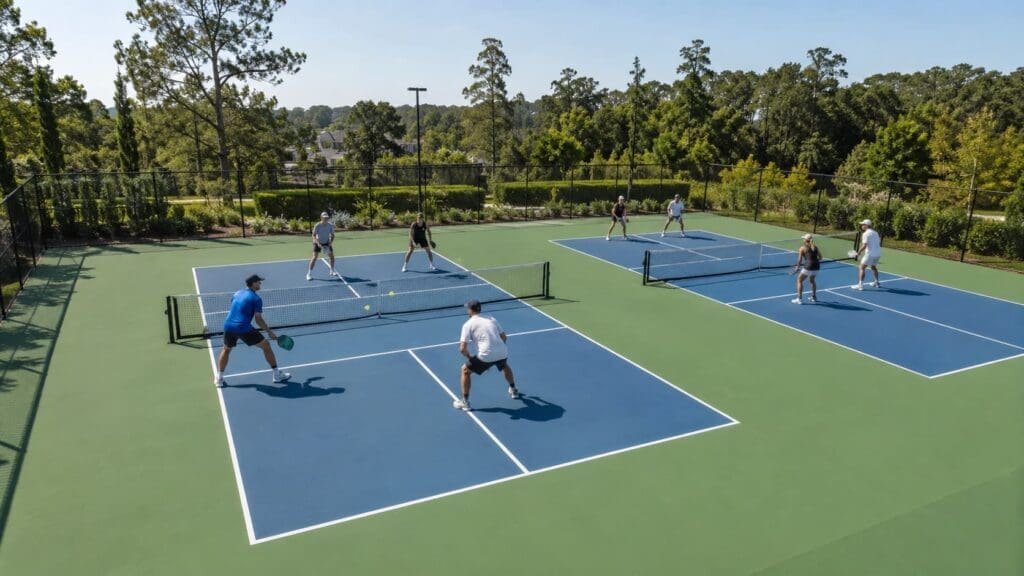
When planning a new sports court, most people begin with one question:
How large does the playing area need to be?
Court dimensions are important, but they are only part of the overall space required. The clear area surrounding the marked court—known as the run-off space—can have just as much impact on safety, comfort and the quality of play.
A court may technically fit within a site, but that does not necessarily mean there is enough room for players to use it safely.
Whether you are planning a pickleball court, basketball court, tennis conversion or multi-sport area, the complete court footprint should include both the playing lines and sufficient space around them.
Run-off space is the unobstructed area outside the official playing lines.
It gives players room to:
Run-off space is not simply unused ground. It is a functional part of the sports area.
A common planning mistake is to measure only the marked playing court.
For example, a site may have enough room for the official pickleball playing dimensions, but once space is allowed behind each baseline and beside each sideline, the actual area required becomes considerably larger.
The same applies to basketball courts. Players regularly carry momentum beyond the baseline when attempting layups, collecting rebounds or defending an opponent. A hoop positioned too close to a wall, fence or raised edge can create an unnecessary collision risk.
When assessing a potential site, consider three separate measurements:
Together, these measurements determine the true court footprint.
Sport involves rapid movement, sudden changes of direction and unpredictable ball placement.
Players are often watching the ball or another player rather than the court boundary. When they cross a sideline or baseline, they need enough room to regain balance and stop safely.
Insufficient run-off space can increase the risk of collisions with:
This becomes especially important at schools, retirement villages, community centres and public facilities where players may have very different ages, fitness levels and mobility.
A larger safety area can make the court more comfortable and accessible for everyone.
Run-off space does more than reduce collision risks. It also allows players to use the court properly.
On a pickleball court, players may move behind the baseline when returning deeper shots. If the rear clearance is too small, players can feel restricted and may be unable to complete a natural swing or defensive movement.
Side clearance is also important when retrieving wide shots. A narrow space beside the court can cause players to stop chasing balls they would otherwise be able to return.
Adequate run-off space supports:
A court with generous clearances will generally feel better to play on than one fitted tightly between surrounding obstacles.
The area behind each baseline often requires more consideration than the area beside the sidelines.
Players may need additional room behind the court for serving, returning deep shots and slowing down after moving backwards.
Baseline clearance can be restricted by:
Where possible, design the surrounding site before finalising the line-marking layout. Moving the playing area slightly may create much better clearance at one or both ends.
Fencing is useful for containing balls, separating courts and protecting surrounding property. However, the fence should sit outside the required run-off area rather than directly beside the marked court.
When planning a fenced court, allow for:
For multi-court facilities, the space between courts is especially important. Players from adjoining games should not be forced into the same narrow passage when retrieving balls.
Portable pickleball mats and temporary court surfaces can make it easier to establish courts for events, schools, clubs and community programmes.
However, temporary does not mean run-off space can be ignored.
Before installing a portable court, check that the surrounding area is:
Temporary nets, tape, barriers and court edges should also be positioned so they do not create hazards within the run-off area.
Tennis courts are frequently converted or adapted for pickleball because they already provide a large, level playing surface.
However, placing multiple pickleball courts onto one tennis court requires careful layout planning.
The aim should not simply be to fit the maximum number of marked courts into the available area. The design must also consider:
Adding too many courts can create congestion and reduce the quality of play. In some cases, fewer courts with better spacing may provide a safer and more enjoyable facility.
Ideally, the playing surface should continue through the run-off area.
A player should not cross the boundary line and suddenly encounter:
Consistent surfacing helps reduce changes in traction and allows players to move confidently outside the marked court.
When modular sports tiles or roll-out court mats are being installed, the full safety footprint should be considered during product selection and layout planning.
Covering only the marked playing dimensions may leave players stepping off the sports surface during normal play.
Outdoor courts need effective drainage, but drains must be positioned carefully.
Channels, grates and surface transitions should not create trip hazards near active playing areas. Water should also be directed away from the court so it does not collect around baselines, entrances or fence lines.
The court base should be assessed for:
Good drainage protects the court surface while helping keep the run-off area safe and usable.
Lighting can extend playing hours and improve court usability, but poles should be positioned outside the player safety area.
The same principle applies to:
Where equipment must be positioned near the court, suitable padding or protective barriers may be needed. The safest approach is usually to maintain clear, open space around the active playing area.
Not every court requires the same surrounding space.
A private residential court used casually by a small group may have different requirements from:
Competitive play, coaching sessions and organised events generally benefit from larger clearances because players move faster and more people use the facility at the same time.
The available space should also reflect the likely users. A court designed for children, older adults or new players should provide comfortable movement and simple access.
Before purchasing sports tiles, pickleball mats or court equipment, confirm:
Accurate site measurements can prevent costly changes after the surface has been ordered.
When working with a restricted site, it can be tempting to reduce every clearance so the playing lines will fit.
Although a smaller run-off area may appear workable on a plan, it can feel very different once players, nets, fences and equipment are in position.
Where space is limited, consider:
The goal should be a court that is practical to use, not simply one that fits on paper.
A successful court layout considers the complete user experience.
That includes:
Planning these elements together helps create a safer, more functional and longer-lasting sports facility.
Court size tells you where the game is played. Run-off space determines how safely and comfortably players can move around it.
A court with correct line dimensions but inadequate surrounding clearance may feel cramped, restrict play and place players unnecessarily close to fences, walls or equipment.
Before confirming a court layout or ordering a sports surface, measure the complete available area—not just the space inside the lines.


