
Pickleball is growing quickly across New Zealand, and many clubs, schools, retirement villages and community facilities are looking for faster ways to add courts without a full construction project.
One option becoming more popular is the roll-out pickleball mat system.
Unlike a traditional painted acrylic court, a roll-out mat court is supplied in large rolls, laid over a suitable hard base, joined together, secured, and then marked for pickleball play. This makes it a practical solution for facilities that want a dedicated pickleball surface without major building work.
At Apollo NZ, roll-out pickleball mat options include the PM-T Acrylic Sand 3.0 mm Mat and the PM-S Pickle Sand 3.5 mm Cushioned Mat.
Roll-out pickleball mats are sports surface rolls designed to create a playable pickleball court over an existing hard surface.
They can be used for:
The mats are usually supplied in multiple roll sections. A full pickleball court commonly uses around 4 to 5 rolls, depending on the selected court size, mat width and run-off area.
The rolls are positioned, aligned, joined and fixed so the finished surface is flat, safe and ready for play.
The word portable can sometimes be misunderstood.
A roll-out pickleball mat is portable because it can be removed, relocated or installed without permanently building a full court surface. However, it is not something that is rolled out in a few minutes like a picnic mat.
A proper roll-out pickleball court still requires:
For this reason, roll-out mats are often best described as portable or semi-permanent court systems.
They are more flexible than a traditional fixed court, but they still need to be installed properly.
The official pickleball playing court measures 20 ft x 44 ft, or approximately 6.10 m x 13.41 m, for both singles and doubles. The recommended total playing surface is larger than the actual court lines, with USA Pickleball noting 30 ft x 60 ft as a minimum recommended area and 34 ft x 64 ft preferred where space allows.
This extra space around the court is important because players need run-off room for movement, safety and better gameplay.
For compact facilities, smaller total areas can still work, but the more space available around the court, the better the playing experience.
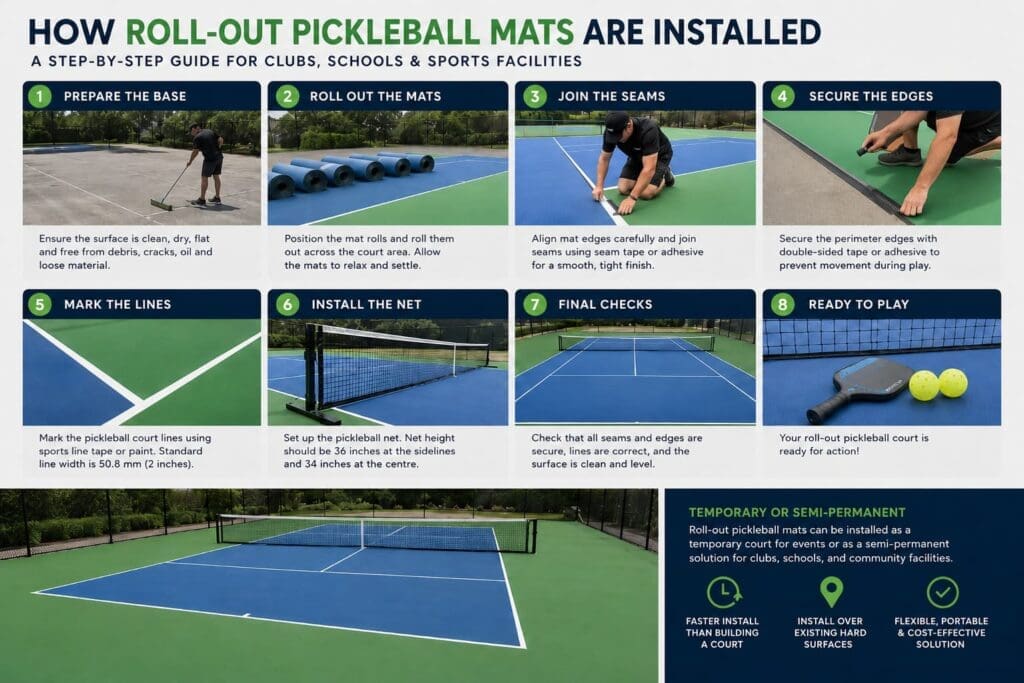
The base is the most important part of any roll-out pickleball mat installation.
The mat must be installed over a hard, flat and stable surface.
Good base options include:
Poor base options include:
The surface needs to be clean, dry, flat and free from stones, moss, oil, dust and debris.
If the base is uneven, soft or unstable, the mat may move, lift, ripple or affect the ball bounce.
Before the mats are rolled out, the installation area needs to be prepared.
This usually includes:
For outdoor installations, weather matters. Mats should not be installed during rain, heavy dew or damp conditions.
For indoor installations, the installer should check that tape or adhesive will not damage the existing floor.
Once the base is ready, the mat rolls are positioned and rolled out across the court area.
The installer will usually dry-lay the rolls first. This means the rolls are placed into position before being fixed down permanently.
This allows the installer to check:
The mats may need time to relax after being unrolled, especially if they have been tightly packed for transport.
This helps reduce curling and makes it easier to get a smooth, flat finish.
A full pickleball court is made from several mat rolls, so the joins need to be done carefully.
Good joins should be:
For temporary or semi-permanent installations, the mat sections are commonly joined using suitable sports flooring tape, seam tape or double-sided tape.
For longer-term installations, adhesive or heat welding may be used, depending on the mat type, base surface and project requirements.
The key is to avoid overlapping the mat edges. The edges should sit neatly together so the surface feels consistent during play.
Once the mat sections are joined, the outside edges of the court need to be secured.
This is important because pickleball involves quick sideways movement, fast stops and repeated footwork.
Loose edges can create trip hazards or cause the surface to move during play.
Depending on the installation type, the perimeter can be fixed using:
For a temporary court, the edges may be taped and checked regularly.
For a semi-permanent court, the perimeter should be more firmly secured.
Once the mats are flat and secure, the court lines can be marked.
Pickleball line marking includes:
Standard pickleball lines are typically 2 inches / 50.8 mm wide, and they should contrast clearly with the court surface.
Line marking can be completed using suitable sports court paint or line marking tape, depending on whether the court is temporary, semi-permanent or longer-term.
For temporary courts, tape may be used.
For more permanent installations, painted lines are usually preferred.
Accurate measuring is important because incorrect lines affect gameplay.
After the surface and court lines are complete, the net system can be installed.
Net options include:
The standard pickleball net height is 36 inches at the sidelines and 34 inches at the centre.
For clubs and schools, portable nets are a flexible option because they can be packed away when the area is used for other activities.
For higher-use facilities, a stronger semi-permanent or fixed post system may be a better option.
Roll-out pickleball mats can be installed in different ways depending on how the court will be used.
A temporary installation is best for events, trial courts, demonstrations or facilities that only need the court for short periods.
This may include:
Temporary installs are flexible, but they require regular checks. Edges, seams and line tape should be inspected before play.
A semi-permanent installation is better when the court will stay down for weeks, months or a full season.
This may include:
This is a common option for bowling clubs, schools, retirement villages and community facilities that want a reliable court without a full permanent construction project.
For longer-term projects, the mat may be bonded more securely to the base, seams may be welded or bonded, and lines may be painted.
This type of installation should be treated more like a sports flooring project and should be completed by installers with suitable experience.
Apollo NZ offers two key roll-out pickleball mat options.
The PM-T mat is a firmer roll-out sports surface with an acrylic sand-style finish.
It is a good option for projects where a practical, direct playing surface is required.
Best suited for:
The PM-S mat is slightly thicker and provides more cushioning underfoot.
It is a good option where player comfort and shock absorption are important.
Best suited for:
Both options are designed to create a dedicated pickleball surface without the same level of construction required for a full acrylic court system.
Roll-out mats are especially useful where the facility already has a hard surface available.
Good examples include:
Many bowling clubs have underused outdoor space and an ageing membership base. Pickleball can help attract new users, increase participation and create extra activity around the club.
Tennis clubs can use roll-out mats to create dedicated pickleball courts without fully resurfacing or rebuilding existing areas.
Schools can use pickleball mats to create flexible sports areas for PE, lunchtime play and community use.
Pickleball is social, accessible and easier to learn than many traditional racquet sports. Cushioned mats can make the playing surface more comfortable for regular use.
Indoor halls can use mats to create a temporary or semi-permanent pickleball court without permanently changing the floor.
Roll-out mats are useful for demonstrations, open days, sports activations and temporary pickleball events.
Roll-out pickleball mats offer several practical advantages.
Key benefits include:
For many facilities, the biggest advantage is flexibility. A club or school can add pickleball without committing to major construction from day one.
The quality of the installation has a big impact on the final court.
Common issues from poor installation include:
Most of these issues come back to three things:
That is why roll-out pickleball mats should still be treated as a proper sports surface, not just a loose floor covering.
Before the court is opened for use, the installer should check:
A short test play is recommended before handover.
This helps confirm that the surface feels safe, stable and ready for regular pickleball use.
Roll-out pickleball mats are low-maintenance, but they still need regular care.
Basic maintenance includes:
For outdoor courts, it is important to keep the surface clear of organic matter such as leaves and moss.
For temporary courts, checking seams and edges before play should become part of the normal routine.
A roll-out pickleball mat is a strong option if you want to add pickleball without major construction.
It is especially useful if you:
For the best result, the base must be suitable, the mat must be installed correctly, and the court should be checked before regular play.
Roll-out pickleball mats are changing how clubs, schools and community facilities add pickleball courts.
They offer a practical middle ground between a simple temporary setup and a full permanent court build. When installed properly, they can provide a clean, dedicated and enjoyable pickleball surface without major construction.
Whether used as a temporary event court, a semi-permanent club court or a longer-term sports surface, the key to success is simple: prepare the base properly, install the mats carefully, secure the joins and edges, and check the court before play.
For facilities looking to bring pickleball to their members, students or community, roll-out mats are one of the most flexible ways to get started.


